

The Heritage Crafts Red List of Endangered Crafts was first published by the Heritage Crafts Association in 2017 and ranked traditional crafts by the likelihood they would survive to the next generation. Each craft is classified into one of four categories (extinct in the UK, critically endangered, endangered and viable) using a combination of both objective criteria (such as numbers of crafts people and trainees) and subjective criteria (issues affecting the future viability of the craft including training opportunities and market trends).
Inspired by this list, I wanted to look at our archive collections and at the history of a few of these crafts in Wiltshire. In the first of a series of blogs (to be published at intervals throughout the year) I plan to explore a few of the critically endangered and endangered heritage crafts in this way: bell founding, clay pipe making, gloving, paper making as well as some archive related crafts such as parchment and vellum making and marbling.
A small shout out should also go to coracle making. Not a craft that you might associate with Wiltshire but we hold an oral history interview with Anthony Forsyth, a well-known local coracle maker in Bradford-on-Avon (ref 4196/BHMB12).
Bell founding
The Red List describes bell founding as “the casting of bells for use in churches, clocks and public buildings. Also includes the casting of musical handbells, cup bells, ships bells, handled bells and clock bells.”
It has early Medieval origins and is classed as critically endangered skill, now mostly practised in London and Loughborough.
The earliest bells were made of pottery, later becoming cast metal (the earliest of which from China). Portable bells came to the UK with the spread of Christianity and was predominantly carried out by monks in the early Medieval period. Eventually most towns or cities would have a foundry, and itinerant founders would also cast bells on site.
The casting of bells as a technique has remained quite unchanged since the twelfth century: bells are cast in a two-part mould mouth down in an allow of bronze. The mould is created made to measure to a specific design and then the bell cast, being tuned and having the clapper fitted once cooled.
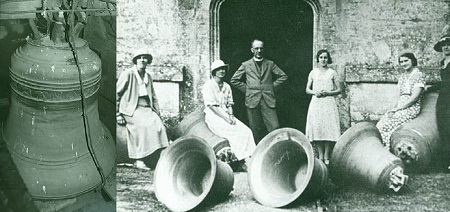
Left-hand: P56246 photograph, close up of a broken bell in situ at St Mary’s Church, Wingfield, Wiltshire, 1999
Right-hand: P11843 photograph, group standing by church bells, outside St James Church, Bratton, Wiltshire, c1928
In Wiltshire the founding of church bells was predominantly undertaken 1380-1826. The principal centre of the industry in Wiltshire was Salisbury but a foundry flourished in Aldbourne for over a century and individual founders also worked at Devizes and Warminster.
Pre-16th century it can be hard to identify much detail about bell makers – the only Wiltshire name to be directly ascribed to a bell is John Barber who inscribed a bell at Chitterne St Mary with ‘John Barbour made mee’. Until about 1700 Salisbury founders supplied most demand in south Wiltshire and into Hampshire and Dorset. Indeed, a deed of 1624 records Culver Street being known as bell-founders’ street.
Following the Reformation, bells almost always bore the date and name, initials or trademark of its maker and so the job of the historian is made easier!
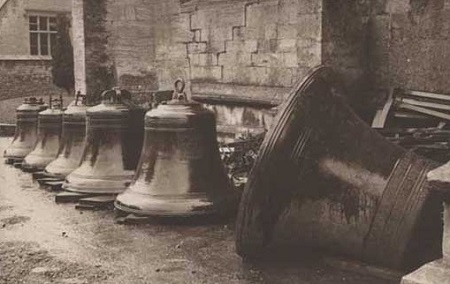
P14918 postcard, bells of All Saints Church after re-casting, Westbury, Wiltshire, 1920-1921
Brothers William and Robert Cor worked a foundry at the Court House, Aldbourne from 1694-1724 and produced some 88 bells. They introduced the practice of putting the lettering on the rim rather than the shoulder of the bell which was followed by all Aldbourne founders. Others continued the trade until 1757, after which Robert Wells started a new foundry at Bell Court in Aldbourne making at least 86 known bells. His sons, Robert and James, carried on this work and have left some 200 bells between them. Trade declined from 1812 and in 1826 James Wells went bankrupt. Most of the Wells bells, like the Cors, are found within 30 miles of Aldbourne but around 50 are known to be further afield.
These later bell makers such as those working in Aldbourne were higher status than the seemingly more humble artisans of earlier bell making. The Cors were able to afford a private Act of Parliament to resolve their inheritance (12 Geo. II, c. 26), while James Wells mortgaged his property for £5000 in 1810. Bellfounding had becomes increasingly specialised with the introduction of change ringing requiring tuned rings of six or eight bells, rather than single bells.

212A/36/36 1743 deed of court house with inventory of bell foundry equipment (Corr)
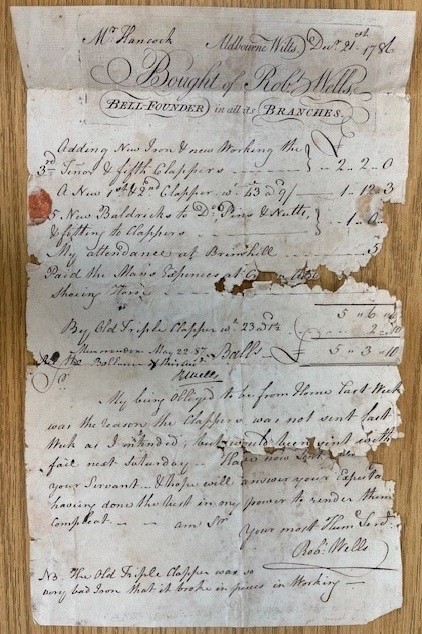
1195/30 Bill from Robert Wells, bell founder, of Aldbourne for repairs to the bells at Bremhill church. 1786-1787
As well as making repairs to bells such as those recorded in the above bill by Robert Wells for repairs to bells at Bremhill church 1786-87, bell founders would generally have supplementary trade. The Cors were wooden button makers, Robert Wells was a fustian maker (fustian was a heavy cloth woven from cotton) and James Wells was a corn dealer (a factor in his bankruptcy). As Robert Wells’ advertisment (taken from the Salisbury Journal 9 June 1766) states, he made hand bells, musical clock bells, horse bells, room and gate bells as well as mill brasses of the best metal ‘cast and sold at the lowest prices’. Sheep bells and handbells with his initials are also commonly found. Examples of his (and others) work can be found at the Wiltshire Museum.
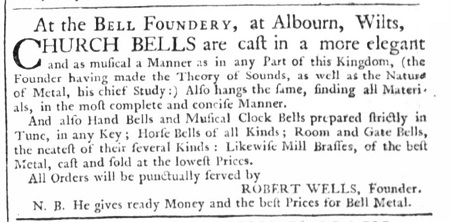
Salisbury Journal 9 June 1766
If you wish to research bell founding and founders in Wiltshire a little more, these below sources may be of interest. See our Planning a Visit pages to find out more about coming to see us.
Naomi Oakley, Archivist
Selected Archive Sources
1195/30 Bill from Robert Wells, bell founder, of Aldbourne for repairs to the bells at Bremhill church. 1786-1787
700/70 Abstract of title of Robert Corr the elder, bell founder of Aldbourne, to property in Aldbourne. 1674-1715
212A/36/36 41 deeds to the Aldbourne estate in 212A/36/35 with the Court house and bell foundry. Parties: Bazing, Lawrence, Strong, King, Smith, Ackerman, Bond, Corr, Mott, Goddard, Sheppard, Adams, Varney, Long, Brown, Stares, Neate, Wells; including wills of Strong family. 1743 deed of court house with inventory of bell foundry equipment (Corr). 1697-1773
1764/30 Accounts for recasting and rehanging the five church bells by Wells of Aldbourne. 1767
Local newspapers including the Salisbury Journal from 1736
Selected Local Studies Books:
Victoria County History of Wiltshire Volume 4 pp252-253
Pollard, David., Warminster bell founders John Lott and Lewis Cockey : with an addendum to Edward Cockey clockmaker. This article is to clarify the history of bell founding in Warminster, and to publish further research notes of Cockey clockmakers. Warminster : David Pollard, 2020.
Walters, Henry Beauchamp., The church bells of Wiltshire : their inscriptions & history: arranged alphabetically by parishes, with a general account of Wiltshire bells and bell-founders. Bath:Kingsmead Reprints, 1969. AAA.787
Gilligan, Terry., Aldbourne: the home of the hand bell and crotal bell. Aldbourne: Terry Gilligan, 2013.
Share this post
About Us
Research Tools
What We Do
Contact us
Wiltshire and Swindon History Centre
Cocklebury Road
Chippenham
SN15 3QN
E: heritageadmin@wiltshire.gov.uk
T: 01249 705500


