

This summer and autumn there is a packed programme of events happening in Calne to celebrate the 250th anniversary of the isolation of oxygen by Joseph Priestley at Bowood House. In this blog Nick Baxter (Wiltshire History Man), whom you can join for a guided walk ‘In the Footsteps of Joseph Priestley’ on Saturday 20 July or again on Saturday 10 August, gives a summary of Priestley’s work and his connection with Calne:

Joseph Priestley was a scientist fascinated by gases and electricity. He is most famous for discovering oxygen, which he achieved by isolating the gas in his laboratory at Bowood House, near Calne in Wiltshire, on 1st August 1774. He was a man of the late 18th century “Enlightenment” pushing forward the boundaries of knowledge.
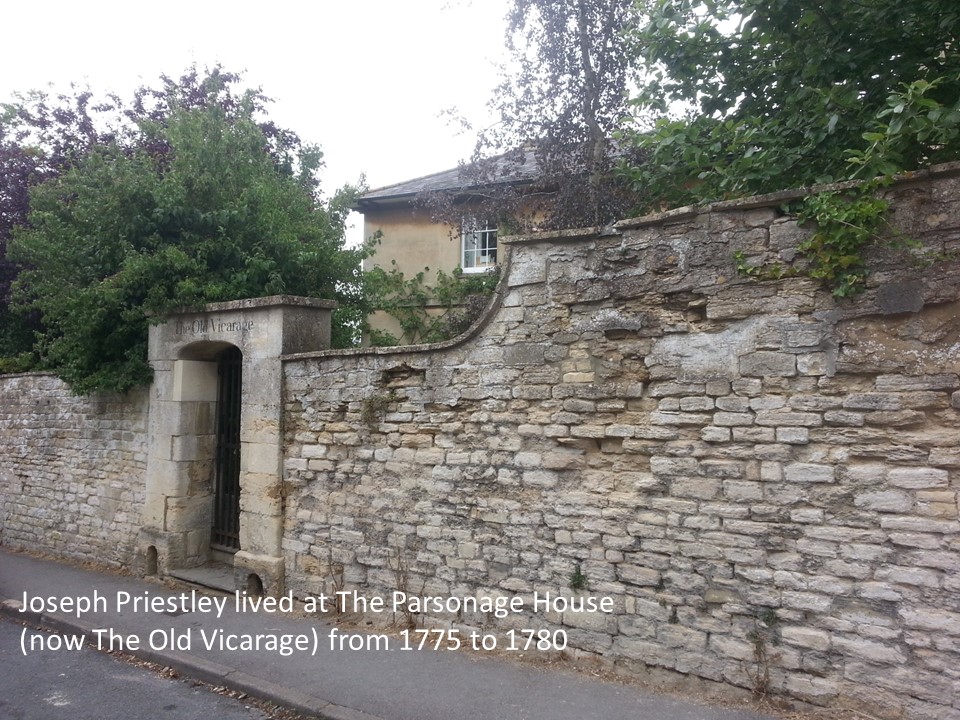
Joseph moved to a house on The Green in Calne with his wife, Mary, and their three children; Sally, Jos, and William, in June 1773. Two years later they moved to the Parsonage House (now the Old Vicarage in Anchor Road). Their fourth child, Henry was born on 24th May 1777.

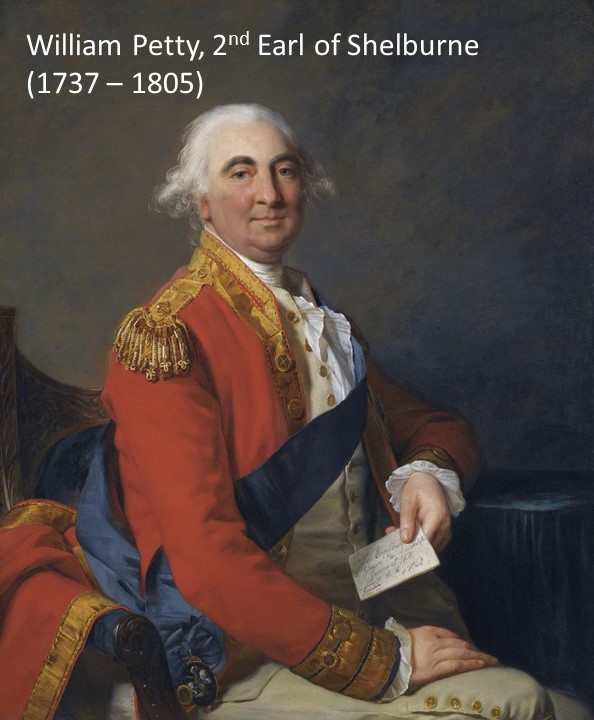
Priestley was a “Radical”, always striving to get to the root of everything scientific, religious, and political. His constant aim was to help to improve human progress and happiness. Lord Shelburne, a Whig politician and future Prime Minister, came to hear of Priestley through mutual friends and liked what he heard. So, in 1773, Priestley was invited to and accepted the post of librarian at Bowood House and tutor to Shelburne’s two sons. The job came with a house on The Green in Calne.
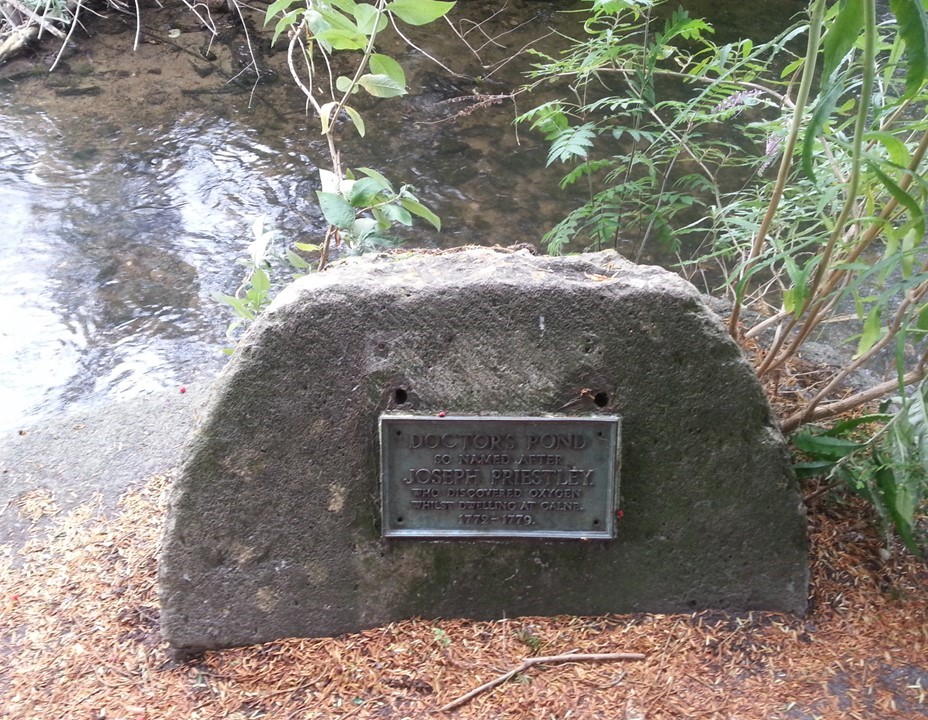
Priestley’s discovery of oxygen was inspired by bubbles of air he saw in Calne streams. The “Doctor’s Pond” in Calne commemorates this.
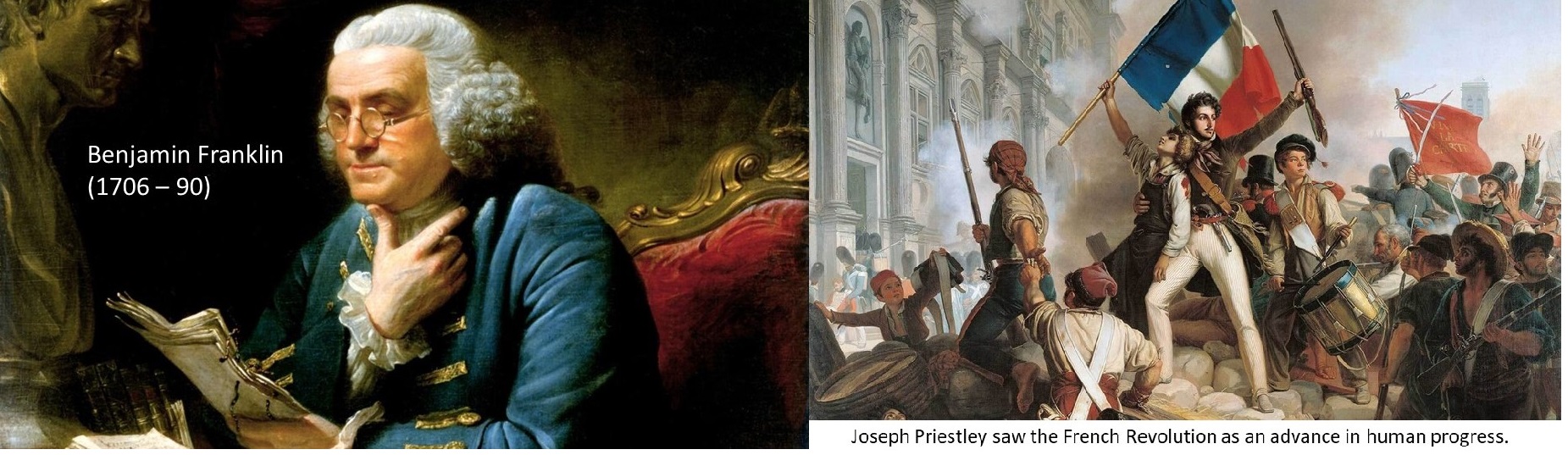
Priestley was a close friend of the American politician and scientist, Benjamin Franklin, who shared his passion for gases and electricity as well as the ideals of the American Revolution.
Later in life, Priestley saw the French Revolution as an advance in human progress.
Priestley knew air was made up of a mixture of gases or “airs”. He wrongly thought all substances contained “phlogiston”, which was believed retarded burning.
Using a “burning-glass”, a convex lens, to magnify the sun’s rays to heat mercuric oxide contained within a bell jar, an “air” was released which Priestley found made a candle burn brightly. After the candle dimmed and the air became “spent”, it could be revived by placing plants in the jar. Priestley had isolated oxygen and come tantalisingly close to discovering photosynthesis.
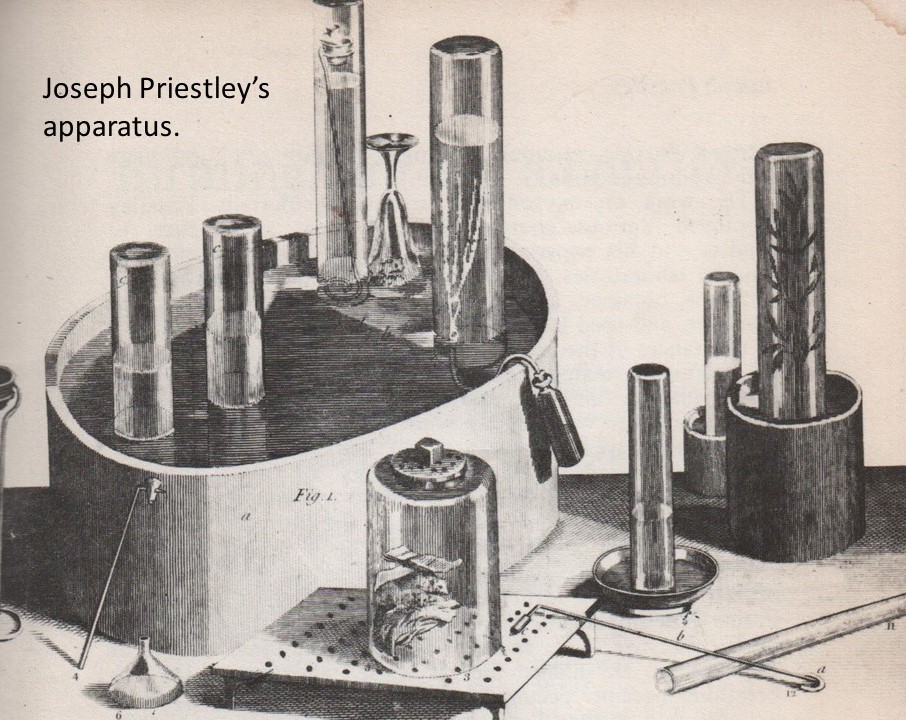
Priestley called oxygen, “dephlogisticated air”, as he believed the brightly burning candle showed phlogiston had been removed.
It was the French scientist, Lavoisier, who later gave the name “oxygen” to Priestley’s new “air”.

In 1780 Priestley parted company with Lord Shelburne, moving to Birmingham to become minister at the New Meeting House chapel.
Priestley’s support for the French Revolution led to a mob destroying the chapel and setting fire to his house. Further persecution led to him emigrating to the USA in 1794, where he died in 1804.
John Adams (US President 1797 – 1801) described Priestley as a, “great . . learned, indefatigable, most excellent and extraordinary man”. To Benjamin Franklin he was, “the honest heretic”. To his enemies he was quite simply, “Gunpowder Joe”.
Perhaps the most revealing testimony is from Marcus Key, Joseph Priestley Professor of Natural Philosophy Dickinson College Pennsylvania USA, “Our highest award in the sciences is named the Joseph Priestley Award. I could not do my work if it wasn’t for Joseph Priestley’s fundamental discovery 250 years ago!”
Nick Baxter, May 2024
Share this post
About Us
Research Tools
What We Do
Contact us
Wiltshire and Swindon History Centre
Cocklebury Road
Chippenham
SN15 3QN
E: heritageadmin@wiltshire.gov.uk
T: 01249 705500


