

The National Record for the Historic Environment (NRHE) project, a process which either combines or adds new records from Historic England to our Historic Environment Record (HER) has been taking up a lot of time in our day-to-day work (see previous blog from 12th September 2023).
Occasionally we can add new sites and monuments to our dataset from the project and I was delighted to come across some fascinating examples, such as the Holy Well (MWI79625) west of Chippenham, a spring described by 17th century antiquarian John Aubrey as having “water… good for the eyes” as well as containing tiny star-shaped fossils. However, the spring is still visible within the landscape.
I want to share some quick descriptions of sites we have added to our record, although they can no longer be seen, part of our invisible monuments. Each of these records, apart from the Roman relief, can be viewed on our website Historic Environment Records | Wiltshire Council by searching on their individual MWI numbers. Apologies for the lack of photos – they are invisible after all!
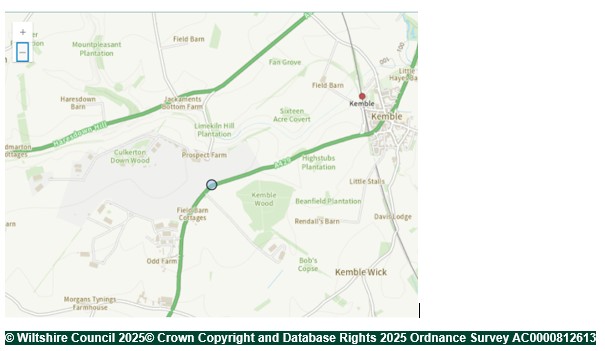
Zunt Stone, Kemble Head, Kemble – MWI78499
This was a large, pyramidal boundary stone between Wiltshire and Gloucestershire, believed to be Saxon, and mentioned in a 13th century copy of an Anglo-Saxon charter of King Athelstan, dated 931. The stone formerly stood at Kemble Head at the side of the old road from Jackaments to Malmesbury (now occupied by Kemble Airfield), from where it was removed during the erection of a tollgate. Mr J.Y. Akerman, who visited the site around 1856, found it lying under a wall near the tollgate. He was informed it would shortly be restored to its original position – however by 1924 the Zunt Stone had disappeared and no trace of it could be found….
WWII Bombing Decoy, Allington – MWI31661
During the Second World War, a bombing decoy was established near Allington, Chippenham, to divert enemy bombing away from RAF Hullavington. This decoy, likely a ‘Q-type’ night decoy, simulated an active airfield using lights to deceive German bombers. Q-type decoys employed various light patterns, including flarepath lights, obstruction lights, and other lighting effects, to mimic an active airfield environment at night. These decoys were part of a larger network of dummy airfields and other targets designed to confuse and divert the enemy. By the 1970s the site had been given over to agricultural use and no features of the decoy survive.

Roman Relief, Corsham (Unlocated) – MWI79598
A Roman, sculptured bas-relief of six figures is said to have been found in Corsham before 1862. John Aubrey writes “At the back of the late George Inn is an old Roman bas-relief of six figures, dug upon the spot” and this was apparently removed to a summerhouse at Corsham Court. This is a mystery – there is no inn named the George in Corsham, and we have found no records of earlier town hostelries with this title – the George Inn may well have been outside Corsham. There are a couple of George Inns nearby, such as The George, Lacock, dating from 1361 and the George Inn, Sandy Lane, an early 18th-century building. There is no knowledge of a Roman bas-relief still at Corsham Court by the late 1960s, and so this is another invisible monument which we will add to the database and hope that in time, we may be able to solve the mystery.

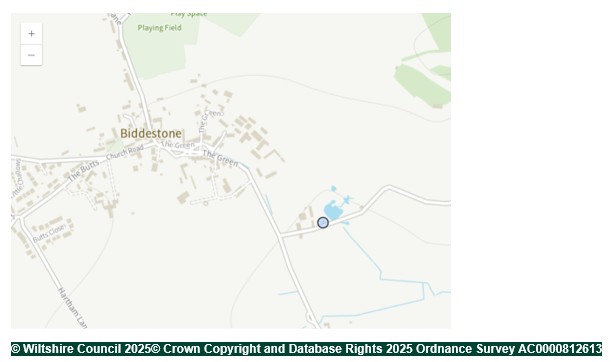
St Peters Church, Biddestone – MWI2242
A possible Saxon church, rebuilt in the 15th century and demolished in 1846. Immediately after its demolition, the 15th century bell- cote or turret was presented to Mr. Poulett-Scrope who lived at Castle Combe Manor. He placed it in the manor grounds, and it is now fashioned as a garden seat. Masonry from St. Peter’s was also used for repairs to St. Nicholas’ Church, Biddestone, including the sanctuary. A small enclosure marks the site of St. Peter’s Church but excavation by a 19th century rector failed to find any foundations. The area is now covered by glasshouses and within Biddestone Manor grounds. Unlike our other invisible monuments, you can still visit parts of St. Peter’s Church, either by strolling in Castle Combe Manor gardens or visiting St. Nicholas’ Church in Biddestone, which also has its origins in the 12th century.
There are many more invisible monuments within our HER and a huge number of very visible ones, so do have a look at the website Historic Environment Records | Wiltshire Council and explore your neighbourhood.
Jacqueline Ramsay, Historic Environment Record Data Manager
Share this post
About Us
Research Tools
What We Do
Contact us
Wiltshire and Swindon History Centre
Cocklebury Road
Chippenham
SN15 3QN
E: heritageadmin@wiltshire.gov.uk
T: 01249 705500


