

A continuing theme in the Treasures from History sessions is the creative use of archival documents. In the first session we explored the world of knitting and textile production in the home, exploring the knitting patterns that had been discovered in a nineteenth century household book from the Ashe family archives.
Connecting this to second session, I began with looking at the household books from the early 16th century onwards, exploring a number of different recipes which were documented by Wiltshire women.
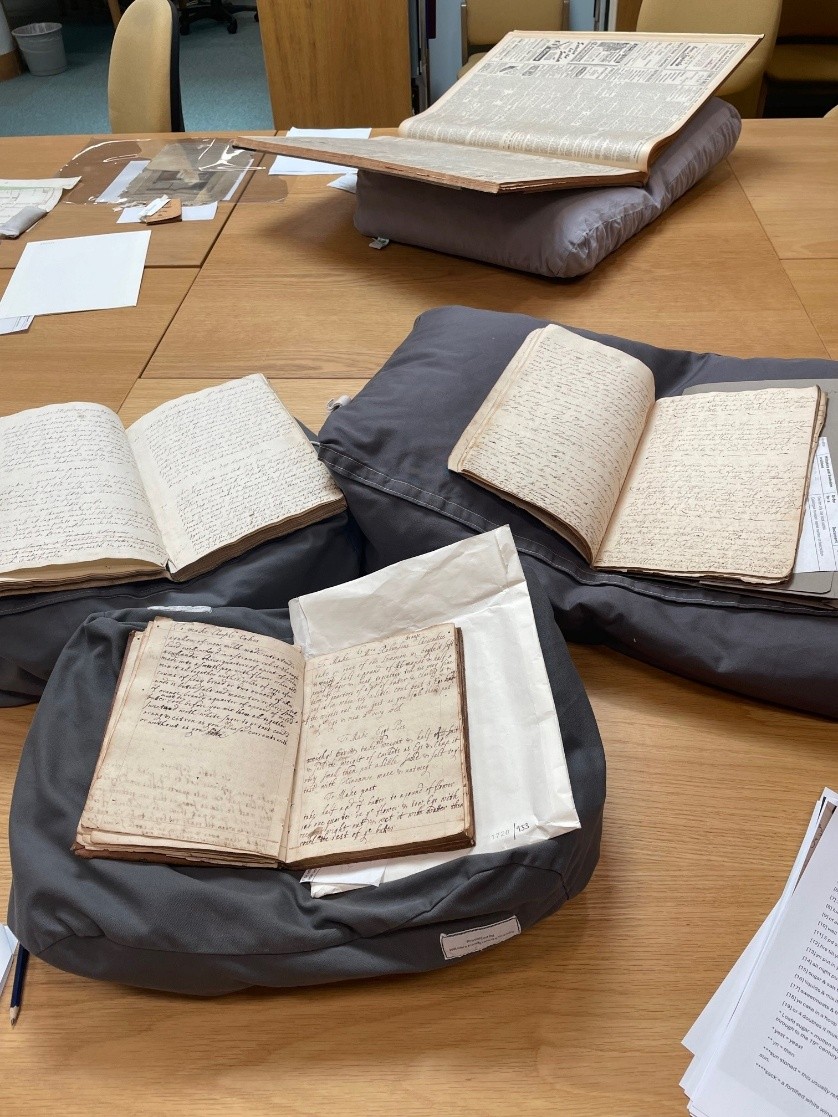
As with many historical records, we see women of a traditionally ‘higher social stature’ being represented in these recipes, which can often narrow our understanding of social history. However, the Wiltshire and Swindon History Centre is home to 12-miles worth of documents and for our second of ‘Treasures’ session, I was able to locate several documents from women not of the gentry, and often, what we might now call, ‘working class’. For example, one wonderful item housed at the WSHC archives is a food list written by Anna/Anne Smith c.1660, the housekeeper to Lady Johanna St John of Lydiard House. These two lists are varied, covering linens, household furnishings and, excitingly, food. (Ref 3430/25)
The writings of Anna/Anne indicate to us a great deal about her position at Lydiard and her importance to Lady Johanna. Identified as her writing through the numerous lists and letters to Lady Johanna in the Lydiard collection, clearly educated, in a time where literacy rates were low (David Cressy’s research suggests that by the time of the Civil War 30 per cent of adult males were literate whilst the figure dropped sharply to only 10 per cent of adult females), Anna must have had some form of education or tutelage to be able to communicate the complex needs of such a large household so thoroughly.
Most certainly an exciting topic to explore, organising my research chronologically allowed for a broader view of how this form of ‘women’s history’ evolved over the decades and centuries. We begin to see how some writers intended for those outside of the family to read their culinary creations, medicinal methods, and other household tips, whilst other writers (such as the Lady Anne Ivory) appeared to be making notes so that they, or those who were cooking for them, would not forget the household favourites.
Similar to the pilot ‘Treasures’ session, I began by first transcribing a number of recipes and identifying certain ingredients that we may not be able to find in the 21st century. However, surprisingly (or unsurprisingly, depending on how much food history you have explored) the major differences were vernacular ones. Of course, the ingredients we have today will vary in purity and accessibility, but much of the ingredients used are interchangeable with today’s modern counterparts. For example, sack is an ingredient we see often in the Lacock (2664) recipes; after researching this ingredient I discovered that ‘Sack’ is an antiquated term for wine, specifically white wine fortified and imported from mainland Spain or the Canary Islands. Once I understood this term, I was able to find a modern alternative.
The ‘translation’ of the recipes for the modern audience continued much of the same way. However, once the transcribing had finished, I encountered some difficulties in practicality- when all was transcribed and researched, I was left with the question of HOW do I create these recipes? At what temperature should I bake these items? For how long? To me, these questions and worries characterised the modern (and my) need to overcomplicate something that, at one point, was quite simple. In a time where the historical cook would have repeated a recipe so often that instruction did not need to be detailed or even present, I had to explore other ways to understand the dish in question. By researching the most popular recipes first, I was able to understand what the baked item was, and how it may need to taste/look/feel.
Therefore, I wanted to make sure that I comfortably understood the measurement systems used. The system of measurement used in early modern (and later) households would often have been the avoirdupois system. Evolving from Roman, Saxon, Celtic and many other localised measurement units, the avoirdupois system gained popularity in the twelfth century. Under the Avoirdupois system 1lb = 16oz = 7000 grains and 14lb is equal to 1 stone. If you are interested in learning more about the weight systems used in England, I would recommend the book ‘Weights and Measures of England’ by R.D.Connor, a thoroughly researched history which informed my own research into recreating historical recipes.
Of course, we can see other, malleable and informal measurements used in household recipe books (for example: ‘spoonfulls’ which may have equated to around ½ ounce) but overall, the measurements needed would be familiar to the modern baker. Another useful tool that I had used in my research was the University of Nottingham’s Manuscripts and Special Collections research guidance, which has a handy conversion chart for weights, measurements, money, and more.
The first recreative sample I produced was an eighteenth-century Cracknel recipe. An exceedingly popular biscuit, its prolific appearance in many documented banquets and feasts allows us, the researcher, to understand the biscuit, how it was to be made, and how those who were ‘contemporaries’ of the cracknel may have perceived it. A flat, thin biscuit, our recipe requires the baker to roll out the dough (infused with carraway seeds), as thin as possible, using a ‘cutter’ to create circular shapes, painting them with an egg wash. Our recipe, from the early 18th century recipe and remedy book of Hesther Washbourne, is, after transcription, relatively straightforward:
[1] To make cracknells
[2] Take half a pd of flour half a pd of sugar & 2 ounce of
[3] butter rub ye butter into ye flour yn take ye
[4] yolks of eggs & 2 or 3 spoonfulls* of cream and
[5] make it into a stiff past yn roul it as thin as
[6] possible & cut into cakes doe ye tops mighty thin over
[7] with a feather dipt in ye yolk of eggs & cream, put in
[8] seeds if you like them.
The process of recreating this recipe, as my first introduction into recreative food history, was somewhat tentative. I had a vague idea of how the finished biscuit should look like, yet handling a dough that resembled marzipan was somewhat confusing, and I found myself unable to establish whether my process was the correct one. Despite my trepidation, I followed Hester’s instructions, and they baked well. It is important to note that I consistently cross referenced my research findings with those of food historians, contemporaries of Hester’s, and other research avenues, such as measurement conversions and charts.

The second recipe I recreated, which is probably the most widely recognised, is the jumball. The cooking methods and ingredients for this beloved biscuit vary staggeringly; from boiling and then baking (the Good Housewife’s Jewel 1596), to refrigerating and then putting straight into an oven, there is no ‘one-size-fits-all’ when recreating the jumball. Traditionally, the biscuit should be shaped like a knot or braided, which I attempted to do in my experiment. The history of the jumball is an interesting look into how the story of our culinary heritage becomes interwoven with regional historiography, its conception interchangeable depending on who you speak to. We know that the jumball was a popular Tudor treat, and we think we know that the biscuit can be dated to at least the Medieval period (though some suspect earlier), and it is known that the popularity of the biscuit survived for many centuries, if we take its regularity in household and recipe books as evidence. However, this transcendental treat remains a mystery, for the most part, to me.
The Wiltshire recipe for Jumbal’s comes again from Hesther Washbourne’s recipe book, early 18th century:
1720/933
[1] To make Jumballs*
[2] Take 2 pd of flower & dry it very well over
[3] coals 2 pd of sugar & mix em well together
[4] & one pd of butter rub it very well in, yn** take
[5] a pd of Amonds blanche em & beat em very well
[6] with a little orange flower water yn take 2 yolks
[7] of eggs 4 or so spoonfulls of cream beat em well
[8] yn mix em all together & work all it into ye paste
[9] when you have made em up ice em before they
[10] go into ye oven.

This recipe felt more involved than the cracknels had. From drying the flour over coals (or in a sauce pan over an induction cooker), to then icing them before baking (or putting them in a refrigerator for an extended period of time), you begin to understand how laborious this process must have been for those of the past, especially when taking into account how many people they would have had to make for. And while the shapes did melt, somewhat, I am happy with how they turned out. My colleagues were also pleased with the end results!
Gianna Torchia, Community History Advisor
This blog was developed following the ‘Treasures from History’ Session. These sessions are run on the first Saturday of every month, from 11am-12pm. Please email archives@wiltshire.gov.uk to find out more, or to book onto the session. We update our social media regularly to announce the topic of each upcoming session, as well as in our quarterly newsletter.
Share this post
About Us
Research Tools
What We Do
Contact us
Wiltshire and Swindon History Centre
Cocklebury Road
Chippenham
SN15 3QN
E: heritageadmin@wiltshire.gov.uk
T: 01249 705500


