

If you are a fan (like me) of the hit series Downton Abbey, you will be aware that during the First World War, some big country houses transformed their homes into military hospitals or convalescent homes. When it was realised that the number of war casualties was vastly underestimated, the country scrambled for more hospital accommodation. Therefore, some owners of country houses, as well as some universities and asylums, volunteered their homes to be transformed into these medical facilities. Bowood House on the Bowood estate that is adjacent to village of Derry Hill in Wiltshire, was one of these homes, and turned itself into a Red Cross military hospital. It was opened in 1914 by Maud Evelyn Petty-Fitzmaurice, the Marchioness of Lansdowne, wife to the 5th Marquess of Lansdowne.

Lady Lansdowne was a charitable woman, who had already financially assisted war widows whose husbands had been killed fighting the Boer War. She was also a member of the Council of the British Red Cross Society and a member of the Joint War Committee! When war was announced in 1914, she rolled up her sleeves and appointed herself as Commandant of Bowood Hospital. It was decided that the ‘orangery’ room in Bowood house (the bright and airy orange walled room, that is today full of marble busts and is accessible from the upper terrace) would be the perfect space to use for the wounded to heal. Interestingly, the room was previously used by the 1st Marquess as a conservatory for orange and lemon trees, quite a contrast from its new purpose! To begin with, Bowood merely received injured soldiers from the yeomanry, but as the war progressed, the hospital received soldiers from every rank.
Although Bowood estate is in possession of most of their own private archives, in our collection at the Wiltshire and Swindon History Centre, we possess the fascinating wartime diaries of Joan Alice Money Kyrle, who was a volunteer Red Cross nurse at Bowood. Her diaries are catalogued in our collection as 1720/720/13-16, and 1720/720/17.
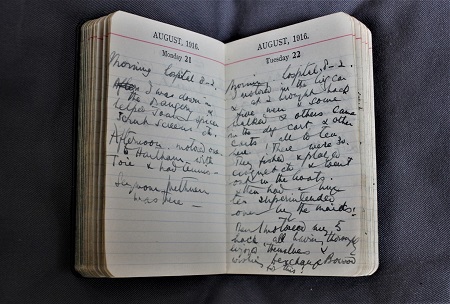
Joan was born on 29th September 1891, to Audley Walter Washbourne Money-Kyrle. He was a wealthy man who owned Whentham House near Calne, was also an army Major, and the Lieutenant for Herefordshire which was the location of his other family home. The young twenty-two-year-old demonstrated instant determination to contribute to the war effort at the outbreak of the war, as she had scribbled down in her diaries several dates for Red Cross meetings and exams that she planned to attend. The qualifications that she received from these exams was all the experience and knowledge that she had when started volunteering at Bowood hospital in July 1916. To begin with, she worked from 8am to 2pm on Mondays, Tuesdays, and Thursdays, until eventually she was given night duty shifts. She became a trusted member of the team as she recorded in June 1917, that…
‘Violet and I went to Bowood Hospital together in the dog cart for a day at 8. Had great fun in the afternoon, as we were in sole charge!’ (WSHC 1720/720/13-16)
The entries in her diaries mainly consist of a young wealthy woman’s day to day life of shopping, paying calls and playing tennis with friends. Of course, her diaries mention the typical roles of a military nurse which consisted of changing dressings, administering injections, and cleaning the hospital from top to bottom. Most interestingly and importantly however, her diaries reveal that the staff at Bowood Hospital went above and beyond making the place a wonderful environment for the patients that had seen all sorts of horrors, as well as making it excellent place to work for themselves. The staff provided hours of entertainment for the men. Joan reminisces of days playing cricket with them in Bowood grounds, and of times where she hosted tea parties for them at her own home! At one of these tea parties on 22nd August 1916, she writes that:
‘They fished and played croquet… and went out in the boats…Then I motored by five back [to the hospital] all having thoroughly enjoyed themselves and wishing to exchange Bowood for this!’ (WSHC 1720/720/13-16)
Over thirty men attended this party, five of which she even drove there herself! On one occasion there was even a ‘quite amusing’ concert that took place in Bowood Park for the men. What is rather wholesome to read, is that clearly friendships developed between the staff and the patients. In May 1917, Joan writes that she:
‘Drove to Chippenham for my singing lesson and took 3 men from Bowood hospital.’ (WSHC 1720/720/13-16)
Lady Lansdowne herself also showed great determination in trying to make the hospital an excellent place to recover and to work. Newspapers from the summer of 1917 reveal that in the August she organised a fete to raise money for the hospitals comfort fund and, judging by the vast number of fun activities available at the fete, it was also aimed as a fun day for the men and visitors.
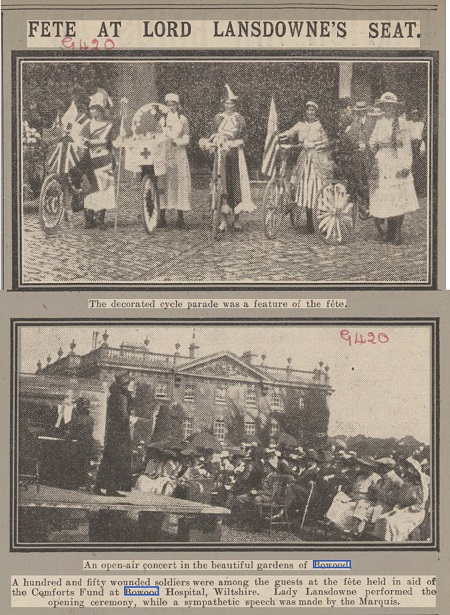
The day included two concerts in the Italian gardens, a horse jumping competition, a grand auction of gifts (where people could bring unwanted objects to sell), an egg and spoon race, a three-legged race and even a cycling parade in which participants were required to decorate their bicycles and cycle in fancy dress! Newspapers frequently advertised the fete in the weeks prior and as a result, the attendance was huge. Approximately five thousand people turned up, 150 of which were wounded soldiers, and £301 was raised which was an astonishing amount for the time! The Mayor of Calne and Lord Lansdowne himself made a speech thanking Lady Lansdowne for her selfless work. According to the Wiltshire Times and Trowbridge Advertiser from Saturday 11 August 1917, Lord Lansdowne stated in his speech that:
‘The success which has been obtained would have been unobtainable but for the devoted services of the hospital staff.’ (Wiltshire Times and Trowbridge Advertiser, 11 August 1917)
[Lady Lansdowne] ‘owes a debt to the hospital for the interest and happiness which it has given to her during the last three years of our lives.’ (Wiltshire Times and Trowbridge Advertiser, 11 August 1917)It is thus doubtless that Lady Lansdowne’s hospital was a huge success that was widely appreciated and loved by both men and staff. Even within the first year of the hospital’s life, it was something special. At the opening of a brigade camp on their grounds in May 1915, in the presence of 2,500 yeomanry soldiers of the South-West Mounted Brigade, Brigadier-General Edwards pressed his thanks…
‘On behalf of all ranks of the Brigade to Lord Lansdowne for the splendid camping ground he had given them, and to Lady Lansdowne for the excellent hospital which she had fitted up for them.’ (North Wilts Herald, 4th June 1915.)
On 10th October 1918, Joan excitedly wrote in her diary that it was her last night shift at the hospital and that ‘the men are so thrilled at the thought of peace.’ (WSHC 1720/720/17)
Less than a month later, on 11th November 1918, the armistice was signed, and the war was over.
After the war, the house ceased to be a hospital, but recognition was given to some hospital nurses across the country. Many were awarded the Royal Red Cross under the Red Cross Society by King George V. It is unknown whether Joan received this, but Lady Lansdowne was awarded the ‘Most Excellent Order of the British Empire’ by the King for her contribution to the war effort by running the truly fantastic hospital.
If you are interested in any more information on the hospital at Bowood, then Bowood is absolutely worth a visit. The house and gardens are typically open from April to November.
Sophie Bunce, Community History Advisor
Share this post
About Us
Research Tools
What We Do
Contact us
Wiltshire and Swindon History Centre
Cocklebury Road
Chippenham
SN15 3QN
E: heritageadmin@wiltshire.gov.uk
T: 01249 705500


