

Oftentimes, archives (especially the Wiltshire and Swindon History Centre) can be the perfect place to explore collections with a focus on recreation and tactile engagement. Indeed, we often find recipes, fabric samples, and even patterns, ‘hidden’ among the documents.
During a recent Treasures from the Archives session, we did just that. In our first session of the ‘Creative Archives’ series, the group and I explored several exceptional documents that documented the rich history of textile production (focused mostly on knitting) in Wiltshire households and schools.
A document highlight from this session was the ‘sample book’ produced by a student at the College of Sarum St. Michael. This book contained several neat and beautiful sewing and embroidery samples. What caught my eye, though, was the incredible miniature knitted jacket (similar to the jacket of Father Christmas!) Here, we studied the neat stitches, colour changes, and construction of the jacket.
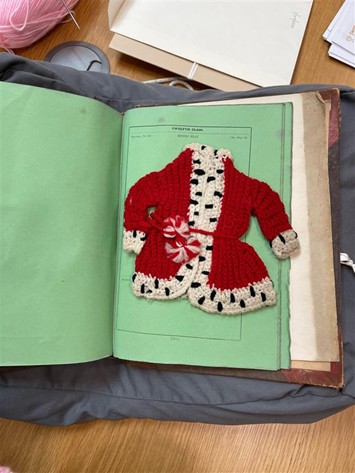
This exquisite piece of workmanship comes from reference number 1585/148 c.1854 ‘Simple directions in needlework and cutting out intended for the use of the national Female Schools of Ireland, Two volumes with samples by Salisbury students.’ The Diocesan (Teacher) Training School was established in 1841, and became known as the College of Sarum St. Michael in 1966, closing in 1978. The college originally opened with the intent to provide female teachers to the Church of England Schools in the area.
Inspired by the tangible character of this document, I began to explore further into the documents we hold that may allow for additional explorative research. It was then that I was able to identify in the WSHC’s catalogue several knitting patterns in the 18th-19th century household books of the Ashe Family of Langley Burrell (ref: 118/148). In total there were 15 identified knitting patterns, three of which I transcribed and researched. When sampling one of the patterns, it was important for me to identify the materials used and the colloquialisms that individuals may have used during these periods. For this, I used several resources including the WSHC’s local studies collection, as well as internet resources, to identify what the standard needle sizes would have been, as well as the historical changes which would have changed the way in which materials would have been produced.
Sampling the honeycomb pattern was an enlightening experience on how our ancestors may have created their garments and how I needed to direct my research when recreating this pattern. Needles, for example, were typically made of wood, bone, or (often) steel. As industrialisation set in and began to shift the way in which people created, we, as researchers, are guided to a wider variety of primary sources. One source I found to be invaluable was the British Newspaper Archives, freely available at all Wiltshire Libraries. I was able to keyword search, and filter through 18th and 19th century printed advertisements from across the country to see what needles were popular, the size variations, and their popularity. The 12th July 1862 publication of the Lady’s Newspaper and Pictorial Times advertises ‘Mr Walker’s Needle Pillar’ to its readers.
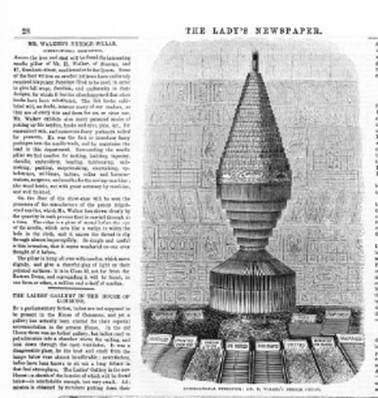
Displayed are thousands of needles available to purchase (or 1.5 million as the article suggests) made with steel and iron. This advertisement identifies needle size through its intended use, highlighting needles for netting and knitting, as well as a variety of fish hooks of ‘every size and form for sea or river use.’ So, what were the standard sizes of needles in the 19th century? Fortunately for us, it was in this century that George Chambers developed the ‘Chambers Bell Gauge’, a system which resulted in what is essentially the standardisation of knitting needle sizes. Patented in 1847, the bell gauge allowed knitters to match needles to their chosen yarn accordingly; I wonder if the Ashe family had one of these in their possession to help with their knitting.
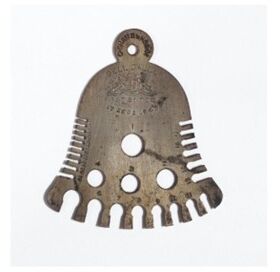
©The Victoria and Albert Museum Museum, Bell Gauge 1847-1899
The sampling process was, as expected, the most exciting part of the entire process. Reading the instructions of Mrs Ashe and attempting to re-create from the words written was an interesting experience, and I believe a helpful one to my research. Using double pointed needles (an attempt to somewhat mimic the standardised needle shape, as the ‘stops’ at the end of needles only became common towards the end of the Victorian era) I chose a light double knit to recreate the pattern.

What is interesting about this pattern (which seems to have been intended for a shawl), is the choices of yarn. The honeycomb pattern lends itself to heavier and lighter yarns, and while I found myself struggling with the needles using a double knit, I was soon able to see the reasoning as to why a heavier yarn would have been used. Fully knitted up with Wiltshire wool, I imagine this shawl kept its wearer warm and protected against the winter elements.
Gianna Torchia, Community History Advisor
Share this post
About Us
Research Tools
What We Do
Contact us
Wiltshire and Swindon History Centre
Cocklebury Road
Chippenham
SN15 3QN
E: heritageadmin@wiltshire.gov.uk
T: 01249 705500


