

It’s clear from TV programmes how much scientific techniques are used in archaeology to analyse bones, pottery and organic remains. Similarly in building recording, dendrochronology (tree-ring dating) has been developed to pinpoint the date of construction by matching the widths of the annual growth rings of the timbers against a master sequence. Wiltshire Buildings Record, a voluntary society housed at the History Centre, began a project in 2009 to sample timbers from early buildings in the county. The aim was to study the carpentry techniques which had been used. Under this project 44 buildings have been dated so far and the results have been interesting.
However, the process is not cheap and a number of separate grants have funded it. It also has failures. The master sequence of rings is just for oak trees and many Wiltshire buildings are constructed of elm wood. It relies on slow growth such as you get when the tree is surrounded in a wood. Lone trees, especially those regularly coppiced, are no good.
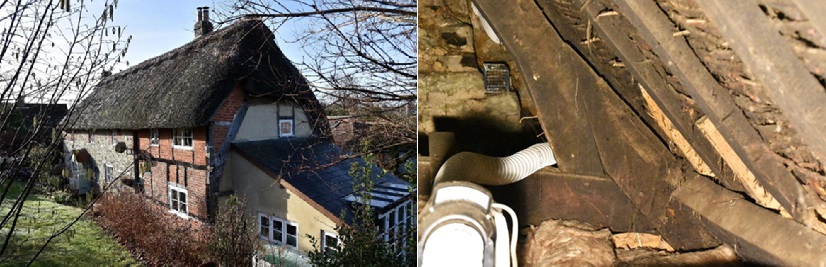
One of our failures was Little Orchard, at Barford St. Martin. This cruck-built cottage was one of the village farmhouses in the late medieval period. It has oak timbers but they were quick-grown. The roof has thatch laid on a mat of hurdles, a technique used for a while in the west country. The thatch at this house had already been dated by John Letts as part of a study of the types of corn preserved in sooted medieval thatch. He had used carbon-14 dating, suitable for organic remains. This had given a date of about 1460-70. We could have accepted this as the date of the building but one of the roof trusses is a two-tier cruck; a pair of small crucks perched on top of a cruck base. All previous known examples of this type of structure date to the 14th century. Was the existing thatch put on 100 years after the building was constructed? We had some money left in our dendro fund and decided to try something new. This is oxygen-isotope dating, pioneered by Swansea University. Two samples from Little Orchard were taken by our dendrochronologist Robert Howard and sent to Swansea where the date came out as c.1480. This is a surprise in that it shows that the two-tier cruck truss dates from a long time after the other known examples. We are now looking for a grant to use iso-dating on a few 13th and 14th century interesting buildings which were previous failures.
Pam Slocombe, Wiltshire Buildings Record volunteer
Share this post
About Us
Research Tools
What We Do
Contact us
Wiltshire and Swindon History Centre
Cocklebury Road
Chippenham
SN15 3QN
E: heritageadmin@wiltshire.gov.uk
T: 01249 705500


