

From maps and manorial records to architectural drawings and deposition books, our archives are home to a wide variety of documents that require careful attention when it comes to storage.
As a Conservation Assistant I am lucky enough to assist our paper conservator, Sophie, in creating archival-quality storage boxes for the more vulnerable items in our collection. Deterioration and frequent handling can increase the chance of damage, so it is important to identify any documents which are at risk and think of the best way to rehouse them in something that is secure and well supported.
To create a safe and secure box, we must consider:
- Size and weight of document
- Storage and accessibility in the strongrooms
- Thickness and type of boxboard required
- Format of the box, such as –
- Clamshell
- Four-Flap enclosure
- Bespoke design

Examples of archival boxes
Recently I have started making enclosures to house a set of architectural drawings of churches, by architect Harold Brakspear (1870-1934). Although he was born in Cheshire, Brakspear set up an independent practice in Corsham in 1893 and was called upon to create plans for the restoration of important ecclesiastical buildings such as Malmesbury Abbey, Lacock Abbey and other prominent churches in Wiltshire.
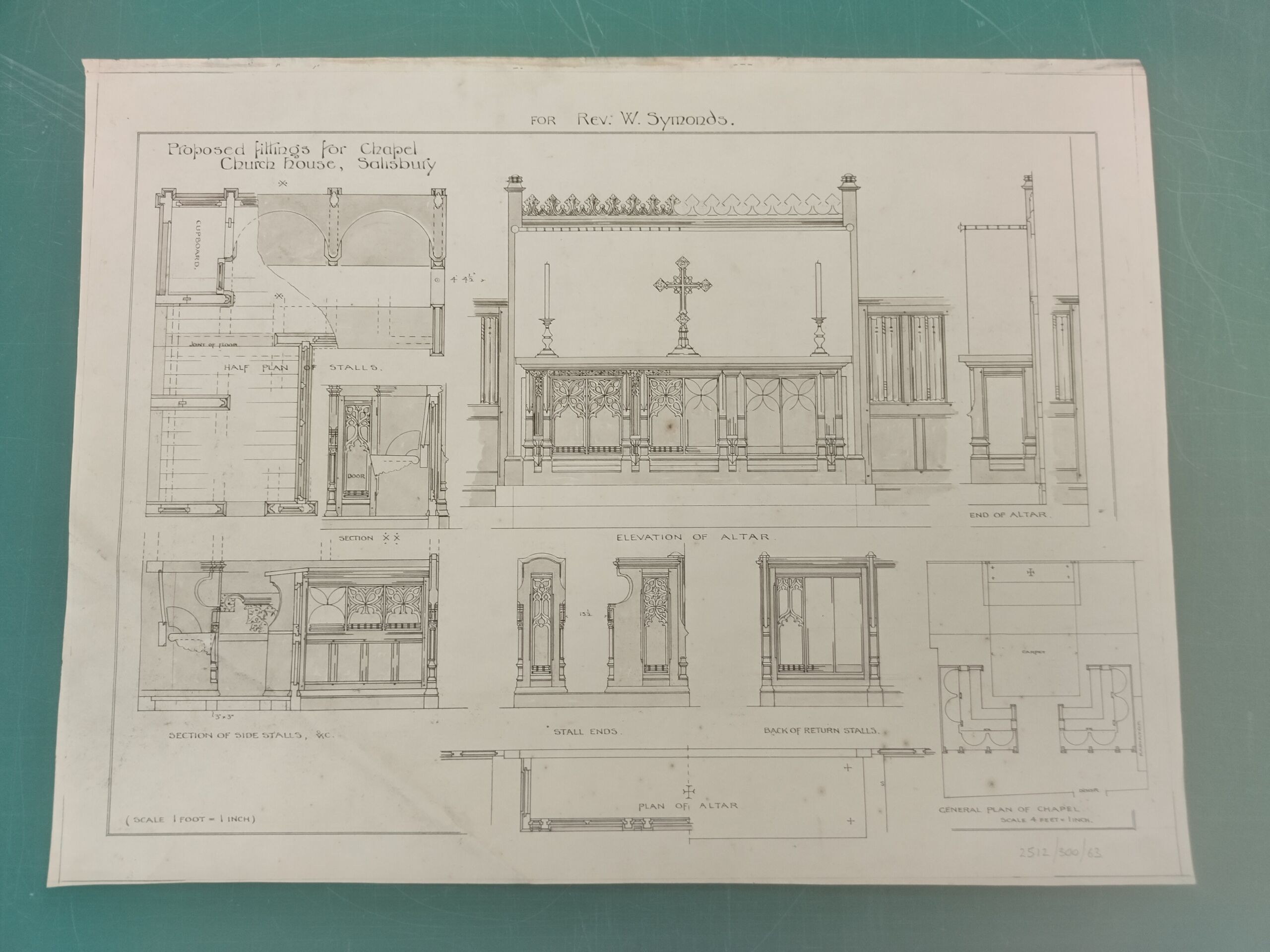
Architectural plans of ‘Proposed fittings for Chapel of Church House, Salisbury’
These drawings are beautifully executed with ink, on oiled paper; however, this type of material is particularly vulnerable and can dry out over time. Combined with the frequent use of these documents due to their popularity with researchers, it was decided that each set of drawings needed to be kept in its own enclosure to make it easier to remove from the drawer where they are stored flat.

Picture of documents in storage
Because of the unique size and shape of the plans, it was decided to create bespoke boxes using both 300 and 650 micron boxboard – this meant we could keep the box as thin as possible, but with a strong base for stability. It also allowed us to use offcuts of board, aiding our sustainability goal to reuse materials.
To make the box, I follow the below steps:
First, I take accurate measurements of the height, width and depth of the document before marking out the base, lid and 3 sides.
Extra board is measured out at the sides where the edges will be affixed to the base, before each section is cut out.
Edge sections are then creased with a bone folder so they are ready to be folded over at the end of the process.
Next, the sections are turned over and laid out on top of each other so that the corners can be marked and cut diagonally, to prevent the board overlapping.

Layered sections with weights on top of them
The sections will then be pasted together on the outer sides of the box, and held down with weights on top. Once the paste is dry, the documents can then be put into the enclosure, with sides and lid folded over – it may be decided at this point to taper the edges of the sides that are folding in, to prevent them from catching when being closed.
Finally, the box is then labelled and marked correctly with the catalogue reference for the archive, as well as any important information such as ‘Fragile’.

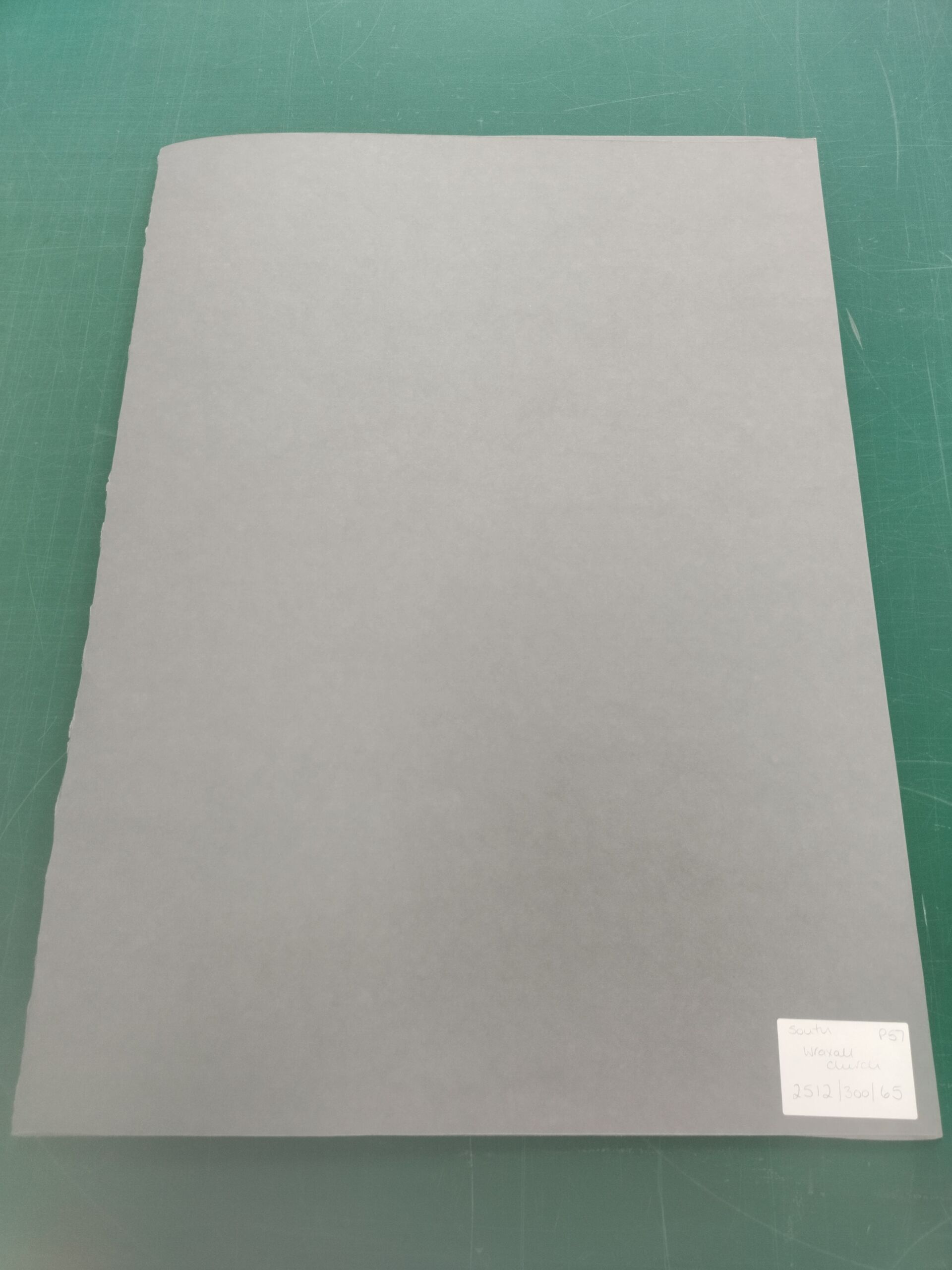
Assembled box design with document, open and closed
As any history lover will know, it’s very easy to get absorbed in the context of why a particular document or object was created! In this instance it was interesting to find out that Harold Brakspear also worked on such prolific projects as Westminster Abbey and St. George’s Chapel, Windsor. He was involved in, and committed to, the extensive research and preservation of medieval architecture, where his detailed documentation and restoration plans were a valuable point of reference for both architects and historians of future generations.
After working with such significant documents, I feel pleased and privileged that I can provide a safe home for these important documents, that allows them to be safely stored and handled for years to come.
We are looking for practical volunteers to help us make boxes to protect our archives. All training and materials provided. If you are interested please contact wshc.volunteers@wiltshire.gov.uk
Images are of documents taken from collection 2512/300/40-77. If you would like to view these documents or find out more about the collection, please contact archives@wiltshire.gov.uk
Nikki Simpson (Conservation Assistant)
The Conservation and Museums Advisory Service (CMAS) aims to promote excellence in the care and use of collections by providing conservation advice and practical treatments to heritage organisations and the public. We also support museums in Wiltshire to meet professional standards and become sustainable, resilient organisations.
If you have a conservation query, want a quotation to carry out some work, or would like to book a free appointment for one of our conservation surgeries, we would love to hear from you! You can contact the team by email cmas@wiltshire.gov.uk or why not follow us on twitter for more updates on our activities.
Share this post
About Us
Research Tools
What We Do
Contact us
Wiltshire and Swindon History Centre
Cocklebury Road
Chippenham
SN15 3QN
E: heritageadmin@wiltshire.gov.uk
T: 01249 705500


