

In 2024, Treasures from History (formerly View the Treasures) was born from a desire to help both new and returning visitors engage creatively with the archives. What began as an exploration of our collections soon became a source of regular inspiration, as we discovered the surprisingly imaginative ways historic documents, often two-dimensional and not obviously instructional, could be interpreted and brought to life.

Creative engagement with archives can deepen people’s understanding of history in ways that simply reading a document often cannot. By recreating, making, baking, or experimenting with evidence from the past, participants gain a more tangible connection to the lives of the people behind the records. Activities such as following a seventeenth-century recipe or trying a historic craft encourage participants to think about the skills, resources, challenges, and daily experiences of previous generations. In doing so, archives become more than sources of information; they become gateways to empathy, curiosity, and a richer understanding of how people lived, worked, and learned in the past.
Over the past 18 months, group members and History Centre staff have explored a wide variety of historical activities that once took place across Wiltshire. From knitting, sewing and smocking to brewing beer and much more, each session has uncovered fascinating aspects of everyday life in the county’s past. Along the way, we have also highlighted documents and collections that many visitors were previously unaware of.
One topic, however, proved more popular than any other: recipes.
Across the many centuries of recipe books preserved in our archives, the ingredients remain remarkably familiar. Flour, butter, milk, eggs and sugar appear again and again, connecting modern kitchens with those of the past. Yet, because Treasures from History sessions are usually held only once a month, and because there are so many exciting themes to explore, it was simply not possible to dedicate every session to historic cooking.
It was from this challenge that the idea for a remote-access booklet emerged.
Wiltshire Council’s Our Wiltshire Plan 2025–2035: Vision outlines a commitment to encouraging lifelong learning and community-based education, a principle that is taken seriously at the Wiltshire and Swindon History Centre. By developing a remote-access learning and engagement resource for Treasures from History, we hoped to create opportunities for those who may be unable to visit the History Centre in person, or who might feel apprehensive about attending, to engage with the history of the county from their own homes.
Developed over several months, the first Treasures from History: Remote Access booklet explores the recipes of Ann Talbot from her 1642 recipe book, held within the Lacock Collection (reference 2664). A number of generous volunteers tested the recipes, providing invaluable feedback, and, in some cases, photographs of their delicious results.
One young historian, with the supervision of a parent, tested the recipe for “drop biskets”. Her mother had this to say:
I am naturally a very visual, hands-on person who also loves eating, so I couldn’t resist trying out some of the recipes in the archives from the Treasures from History kit. My four-year-old daughter and I regularly bake together—she is our resident egg-cracker (and surprisingly good at it!)—so we decided to test the waters with Mrs Minehull’s “drop biskets”.
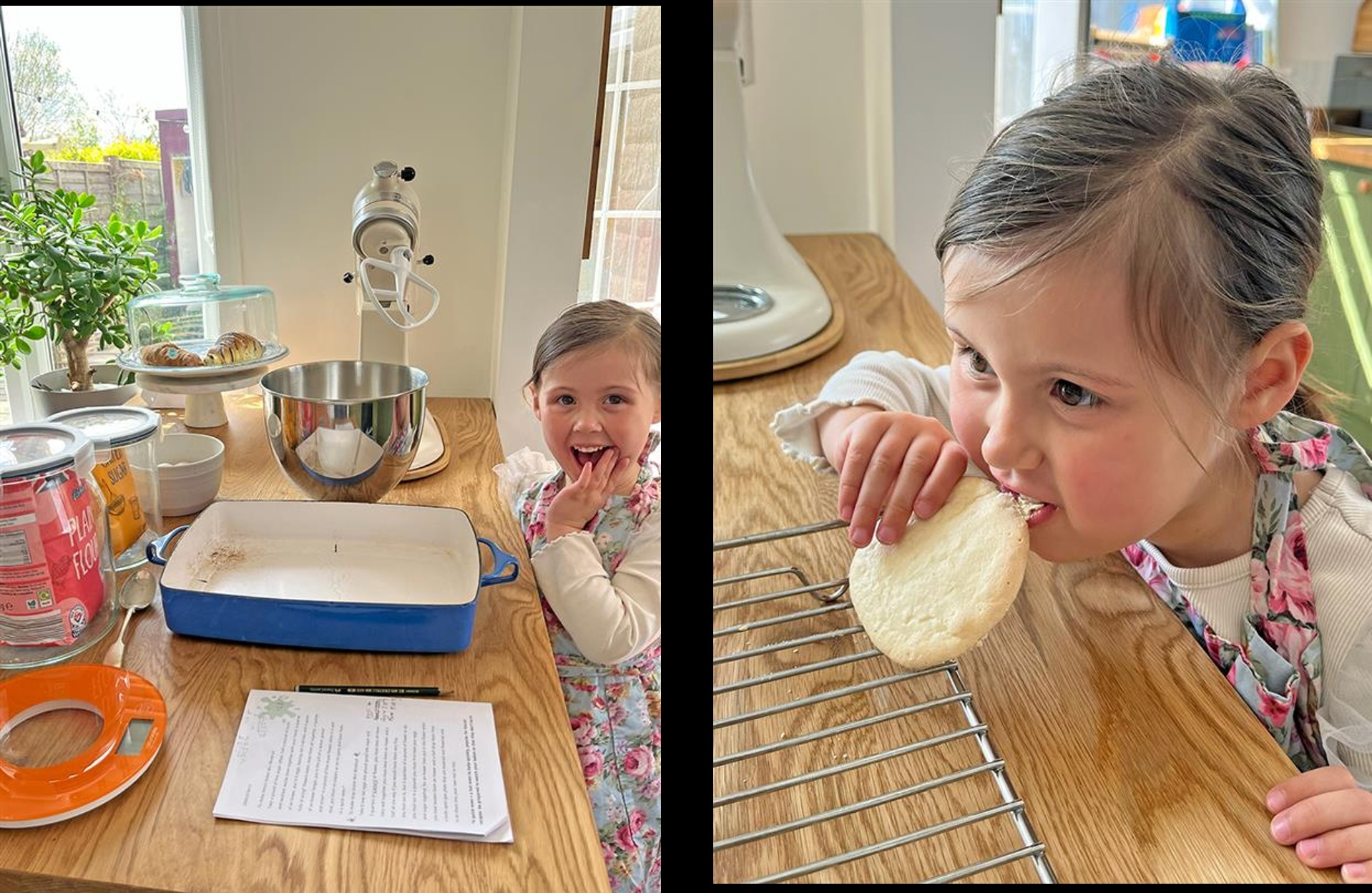
The introduction was visually engaging, and I particularly enjoyed reading the old-English recipe aloud to my daughter, even though neither of us understood some of the words. The glossary of terms is a beneficial addition for those new to historic texts. Although, personally, I enjoyed investigating the unfamiliar language and adapting the methods to work in a modern kitchen.
My daughter loved getting hands-on, and we were both surprised by how sweet and delicious the end result was—especially considering we didn’t beat the batter for the “hower and a half” specified. Thank goodness for the KitchenAid!
Much like finely chopping vegetables into a bolognese so my daughter doesn’t notice them, I loved the way I could quietly introduce history and research into a familiar, everyday activity like making biscuits. She is still a bit young to fully understand the context, but on our next visit to Lacock Abbey I will be able to reinforce the learning and add even more meaning—perhaps alongside some of the seed cake featured on page eight.

Part of the fun of testing historical recipes lies in interpreting and adapting them for modern kitchens. We certainly don’t blame this tester for choosing not to beat the batter for “a hower and a half”, although we suspect seventeenth-century cooks may have had forearms worthy of Popeye!
Another tester highlighted the joy, and occasional comedy, of exploring historical recipes across generations:
Fun with grown-up daughter. Lively discussion in Waitrose as to whether butter should be salted or not.
Daughter has just called through, “So what was a pound again?” I feel old.
We thoroughly enjoyed recreating – insofar as you can from supermarket shopping – Mrs Minehull’s Lemon Biskets.
I’m not sure that our village shop would have Orange Water … must check!
The quantities were a little daunting. I should explain that my mother never really adjusted to the end of rationing, so lashing out with quite so many eggs and so much butter went a bit against the habits instilled from my childhood.
Salted or unsalted butter? We decided salted because guessed the ‘well washed’ direction would be to remove excess preserving salt. Didn’t wash ours tho’.
However, I did enjoy the pounds and explaining imperial measures to my metric-born daughter. We both wanted to follow the recipe for the first baking and we will make the biskets again; possibly adjusting the quantities. It makes SO many. Delicious though they are!
We even checked the history of meringue before making some with the two egg whites.
I grew up with a gas oven, and it had pretty much a mind of its own; my daughter is more accustomed to precise temperature control. We shared a lot of stories and laughter. Thank you for that.
Our labrador was fascinated. He has heard of spit-dogs, and although doesn’t fancy the exercise he was ready to share the results of 17th century baking.
The booklet is great and explains the extensive collection of commonplace books and other resources at WSHC very well. I hope folks are inspired to explore the archives and to attend the brilliant ‘Treasures from History’ sessions.
I’ve read about Seed Cake in books and novels. Now we know how to make one!
By the way, your Lardy Cake at the last session was delicious.
We will have a go at drop biskets next, if my friend’s hens can be persuaded to produce ‘8 new lad eggs’.

These comments perfectly capture what we hoped to achieve with Treasures from History: Remote Access: making history accessible, enjoyable, and relevant through shared experiences, curiosity, and a little experimentation.

The Treasures from History: Remote Access booklet is available to borrow from the following libraries:
- Amesbury
- Bradford-On-Avon
- Calne
- Chippenham
- Corsham
- Devizes
- Homes Mobile Service
- Malmesbury
- Marlborough
- Royal Wootton Bassett
- Salisbury
- Trowbridge
- Warminster
- Westbury
- Wilton
Gianna Torchia, Community History Advisor
Share this post
About Us
Research Tools
What We Do
Contact us
Wiltshire and Swindon History Centre
Cocklebury Road
Chippenham
SN15 3QN
E: heritageadmin@wiltshire.gov.uk
T: 01249 705500


