

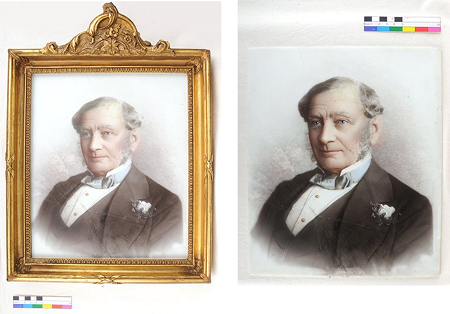
A rather interesting object arrived in the lab a few months ago, which at first glance appeared to be an intricately detailed portrait painting on a milky-white opaque glass (known as opaline glass), displayed in a gilded frame. The portrait was of Daniel Gooch (1816-1889), an English railway locomotive engineer, responsible for identifying the site of Swindon Works and designing the first complete locomotive to be constructed there in 1846.
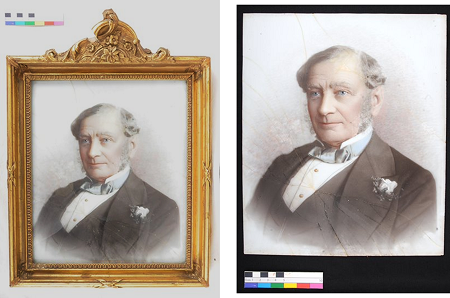
Assessing the object more closely, out of its frame, I was immediately concerned by its poor condition. It had previously shattered into multiple small pieces and been adhered back together with a glue that was now yellowing and failing. The glass was ‘stepped’ in multiple locations where the joins were not well-aligned. My eye was also drawn to the disruption of the original paint around the fractures, which had been dissolved in the process. There was a ‘smudged’ appearance to the image, particularly visible around the edges where the black background thins and blends into the glass. It was clear that any further handling and conservation treatment going forward would run the risk of damaging the piece further, and that great care would be needed. Understanding the materials used for creating the piece, and for restoring it, was also vital to determine if, and what, could be done to stabilise it.
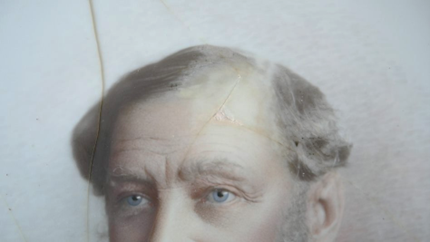

A painted portrait on opaline glass of this size, and from this period, was not something I had seen in collections elsewhere, and it took a bit of detective work to learn more about it. As luck would have it, the clue was literally written on the object itself, in the form of a barely visible company name in the bottom right corner, hidden within the black smudges: “Hills & Saunders”. Hills and Saunders, I soon found out, was in fact a prestigious Victorian photographic firm, and it took a bit more research to realise I was not in fact looking at a painting on glass after all but a photograph or, more correctly, an ‘opaltype’.
Opaltypes are relatively rare as they had a short production period, between c. 1860-1940 and, as we have seen, are prone to damage and loss. In brief, an opalype is a positive photographic image on opaline glass, commonly with paint applied to it. Whilst there were slight variations in materials and approach, this opaltype appears to have been produced using a carbon transfer image, hence the ‘smudged’ appearance. Carbon pigment was suspended in gelatin and sensitised with a chemical that hardened on exposure to light. This emulsion was applied to a plate and either exposed in a camera, or in contact with a negative. The plate was then developed and hardened, the portions not hardened washed away, resulting in a positive image. This process produced a film or tissue, which could then be transferred to another medium, in this case glass. The finished image could be tinted with oil, water colours or dry colours (pigments).
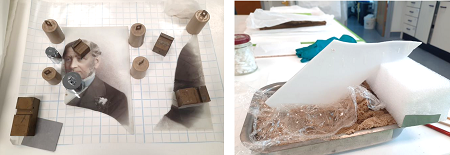
The sensitivity of the paint (solubility tests indicated it was in fact watercolour) and the gelatin to water required avoiding water-based substances for treatment, and it was with some relief that the yellowed repair adhesive was identified as an epoxy resin, swellable in non-water based solvents. There was still considerable risk that removal of the adhesive might disrupt one or more of the complex layers of the piece, just by mechanical action alone, so a method was used to expose the adhesive to a ‘solvent atmosphere’, softening and swelling the epoxy by use of vapours without the need to apply the solvent directly as a liquid.
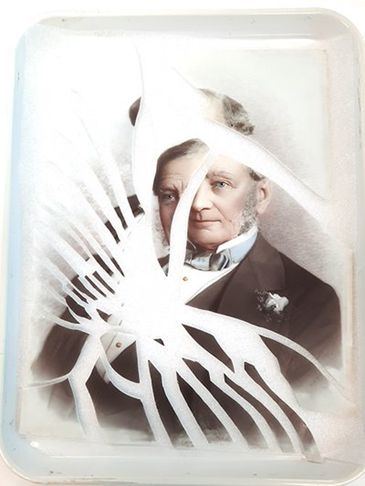
Taking the object down was just the first step. Putting it back together proved to be even more tricky, not least because the glass did not lie flat and it had ‘sprung’ when it had broken, resulting in the pieces no longer joining perfectly to each other. I now realised why there had been some misalignment in the previous restoration. I used a combination of vertical and horizontal assembly methods, depending on the ‘flatness’ of the pieces being joined, and used a conservation-grade epoxy resin to re-adhere the broken pieces, which would enable my own work to be taken down again in future without disrupting the paint or gelatine. In more severe areas of springing I opted to leave a gap rather than create a step, as the latter would put stress on the piece when mounted within a frame. Filling and in-painting of losses was kept to an absolute minimum, and only where the loss was particularly visible and distracting, as the mechanical action of levelling a fill and cleaning any excess material put the image at risk of loss and staining from surface dirt. Usually a piece is thoroughly surface cleaned before adhesion and filling, but this had not been possible due to the sensitivity of the materials. No attempts were made to restore the lost and disrupted paint from the previous restoration. I do not have the skill of the original artist, and any interventions were likely to be very visible, and to result in further loss of the original if someone wanted to remove them in future.
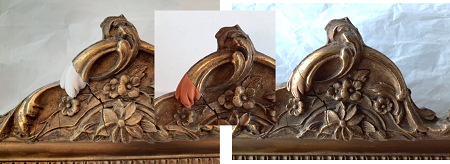
Minor conservation modifications were made to the frame, including the creation of spacers within the rebate to prevent the opaltype from touching the framing glass, and substituting UV-filtering glazing for the existing glass, so protecting the light-sensitive watercolour paint from fading in the future. Corroding iron fixings were also replaced with more stable copper-alloy alternatives. A visually-distracting loss in the moulding of the frame was modelled and cast, and a layer of clay ‘bole’ applied beneath gold leaf, to mimic the layers present on the frame. Some staining and ‘distressing’, using shellac, acrylic paints and dry pigments, was required to integrate the new gold with the old. Being asymmetrical, there was no detail present on the frame that could be used to cast the missing piece, and the shape therefore had to be made up, taking the existing acanthus-derived foliate decoration as inspiration, and modelling a shape that would blend well with the existing, without appearing to be original. The piece was made and finished away from the frame, and then adhered in place, thus able to be removed in the future, if required.

All-in-all, the conservation of this piece was challenging, and compromises to the aesthetic appearance of the object had to be made to ensure that any interventions undertaken by me would not be damaging to the object and could be removed in the future. However, the project was fascinating, and I learnt a lot about photographic processes and materials along the way.
Alison Dwyer, Senior Conservator
Conservation and Museums Advisory Service
Share this post
About Us
Research Tools
What We Do
Contact us
Wiltshire and Swindon History Centre
Cocklebury Road
Chippenham
SN15 3QN
E: heritageadmin@wiltshire.gov.uk
T: 01249 705500


