

The Association of British Columbia Archivists, defines ephemera as ‘those every day, impermanent items’ like ‘brochures, tickets, programmes, published reports, handbills, menus, advertisements, posters, and other miscellaneous printed or published items.’ Ephemera are not quite archives (which are original, unique and irreplaceable) but are often mass-produced materials which are seen as ‘disposable’ at the time of creation. Despite this difference however, ephemera is a highly valuable research source, as it vividly captures social history, popular culture, and the lives and thoughts of everyday people that have sadly been neglected in archives throughout the centuries, due to archives being written by the literate and the privileged.
Our Local Studies Ephemera Collection here at the Wiltshire and Swindon History Centre comprises of hundreds of folders, all of which have been catalogued and categorised by Wiltshire parish and subject classification. They contain a rich variety of fascinating material, and in this blog, I will share some of the ‘goldmines’ that I have found in the collection!
Firstly, newspaper articles are a frequent resident in ephemera folders. Although we have an extensive collection of Wiltshire Newspapers available to view on microfilm, these are not indexed by parish, subject or article, so finding material can be quite time consuming! Therefore, finding interesting newspaper articles relating to specific parishes in ephemera folders can be extremely helpful. Articles housed in ephemera typically comprise of topics such as special parish events, historical events, archaeological finds, political happenings and so on.
In the ‘CHP. 940: History in Chippenham’ ephemera folder you will find a charming extract from the Illustrated London News, dated 21st September 1850, which describes (and beautifully depicts!) the festivities that took place in Chippenham at the opening of the cheese market on the High Street and its subsequent additions. This article effectively captures just how important market culture was for working class individuals in Victorian Wiltshire.
The cheese, corn and cattle market, and the Market Hall (which was built by local MP Joseph Neeld), were established in 1835. Sixteen years later, Neeld added an exchange room and a brand-new cheese shed ‘of most commodious dimensions’, which could hold over 400 tonnes of cheese! In response, the population of Chippenham rejoiced and hosted a welcome procession for Neeld. Cheers, the sweet sound of church bells, and deafening canon fire echoed along the High Steet.
The article describes:
‘Fir trees, planted for the occasion, lined the streets and road; triumphal arches were erected at almost every available point; festoons of evergreens and flowers extended across the streets in thick succession, whilst almost every house was profusely ornamented with laurels, flowers, and mottoes of welcome: it was a universal jubilee.’
There was even a public banquet to celebrate the occasion!
The article also states that since the opening of the market as an established place to sell produce, approximately £402,000 worth of cheese was sold and generated for the town’s revenue!
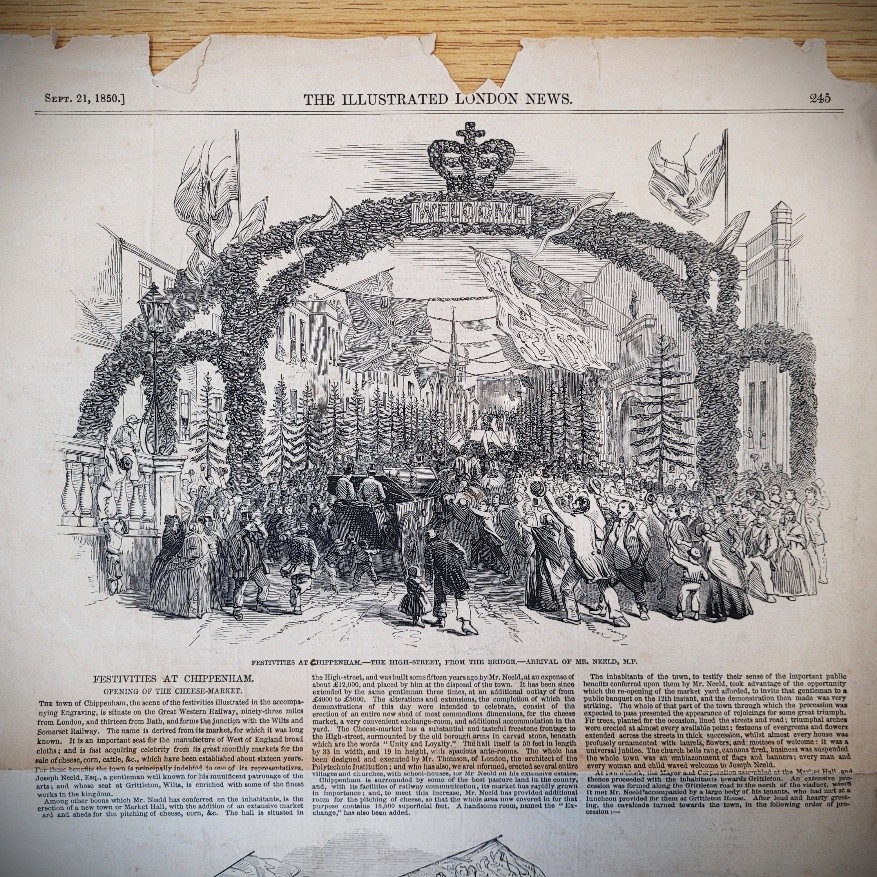

WSHC: Ephemera, CHP.940: Depictions of the festivities: The Illustrated London News, 21 September 1850.
Also contained within the ‘CHP. 940: History in Chippenham’ ephemera folder is an article from Chippenham News, dated 16th July 1976, which reports on the history of Chippenham Library and demonstrates the increasing popularity of public libraries in Wiltshire between the 1920s and 1970s.
The first library in the town was opened in 1926, in a small room inside Chippenham town hall, and was open to the public on Tuesday and Friday evenings. The library was evidently an instant hit, as by 1927 there was ‘an average nightly issue of 130 books!’
By 1933, the library had over 34,000 books, so it migrated to a larger premises on the ground floor of the Jubilee Building in the Market Place. With ever-increasing stock and popularity (with over 200,000 books being issued in 1971), in the late 1960s, the town pleaded for another new library. Finally in 1973, the purpose-built library building (which we have today!) opened its doors on Timber Street. The article states that:
‘The service has suffered from a poor public image in the past giving the impression that only the terribly well-read and literacy people use libraries. Even if this was once the case, today it is just not so. Libraries are provided as an essential public service, financed through local rates, from which they take a very small percentage, and they are there to be used by all.’

WSHC: Ephemera: CHP.940: Articles reporting on Chippenham Library, Wiltshire Gazette and Herald, June-July 1973, and Chippenham News, 16 July 1976.
Programmes for various parish events and national events can also be found in ephemera. Located in the ‘CAL:004- Life in Calne’ ephemera folder, you will find the town’s coronation programmes for George V and Queen Mary (dated 1911) and Elizabeth II (dated 1953). These are enchanting depictions of spectacle and pageantry and demonstrate the changing social attitudes towards Royalty in Wiltshire since the early/mid twentieth century.

WSHC: Ephemera, CAL.004: Coronation Programmes for George V and Queen Mary and Elizabeth II.
The programme for George V and Queen Mary describes mortars being ‘fired on the green’, the ringing of church bells and a parade of cart horses. A public declaration of loyalty to the King, which included a royal salute and the playing of the National Anthem, was also read on the Calne Strand. At the recreation ground (now nicknamed the REC), school children participated in maypole dancing, a bonfire was lit on the Green, and other weird and wonderful activities, including a ‘top-hat, umbrella and night shirt race’ took place!

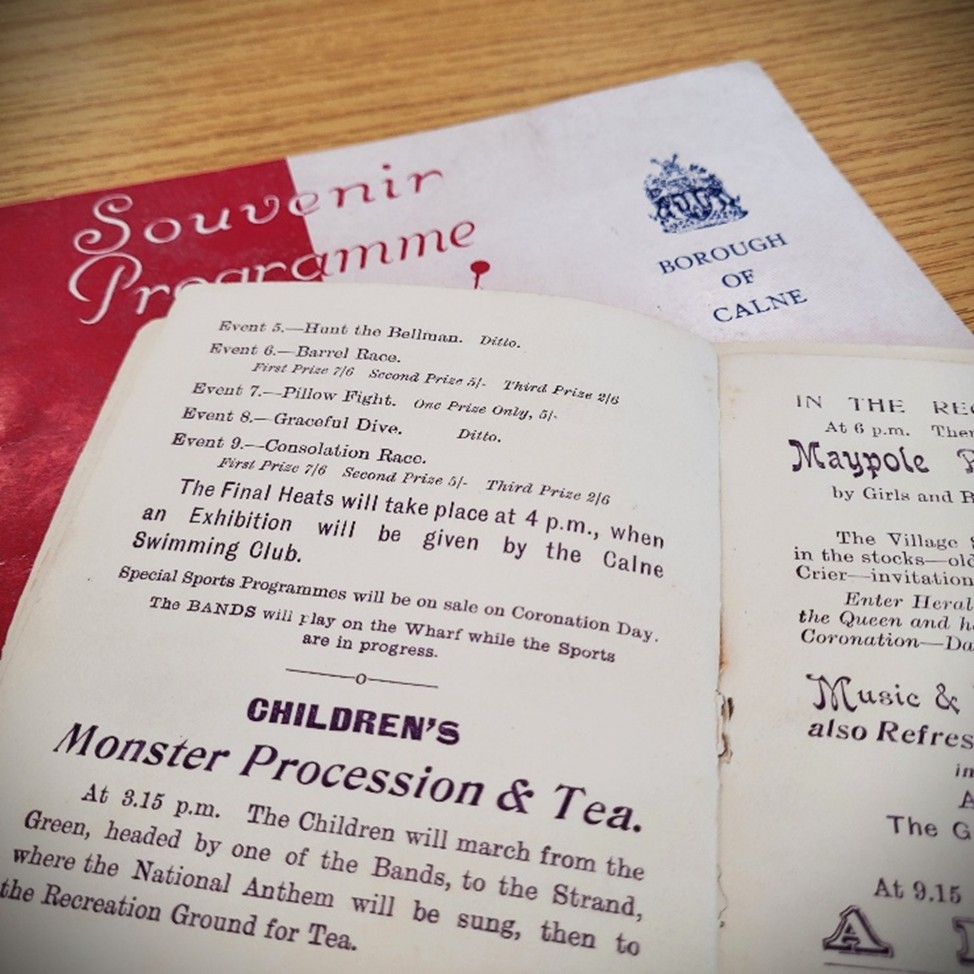
WSHC: Ephemera, CAL.004: Fun activities listed in the George V programme, 1911.
Elizabeth II’s programme shows that celebratory activities in Calne spanned an entire month from 22nd May to the 27th June!
Activities included, a ‘Boxing and Fencing Display’ and a live performance from the R.A.F band at the Calne Recreation ground, which was organised by the Royal Air Force stationed at Compton Bassett and Yatesbury. From 5th-9th June there was dancing in the town hall (from 9pm to 1am in the morning!), a carnival procession (which included a competition for the best decorated private car and the best costume on horseback), a veteran car club rally on the Green, a Royal Salute of 21 guns, maypole dancing, football matches, a torchlit procession and much, much more!
Finally, booklets and miscellaneous prints like the one found in ‘ASH.004: Life in Ashton Keynes’ about the ‘The Cotswold Bruderhof German Peasant Colony’ can also be found in our ephemera collection. This booklet, which is reprinted from the Times Newspaper, details the life of the religious German Bruderhof community who peacefully resided on a farm situated on the road between Ashton Keynes and Somerford Keynes, between 1936 and 1942. It is a striking example of how Hitler’s persecution of communities even reached small villages across the seas in Wiltshire.
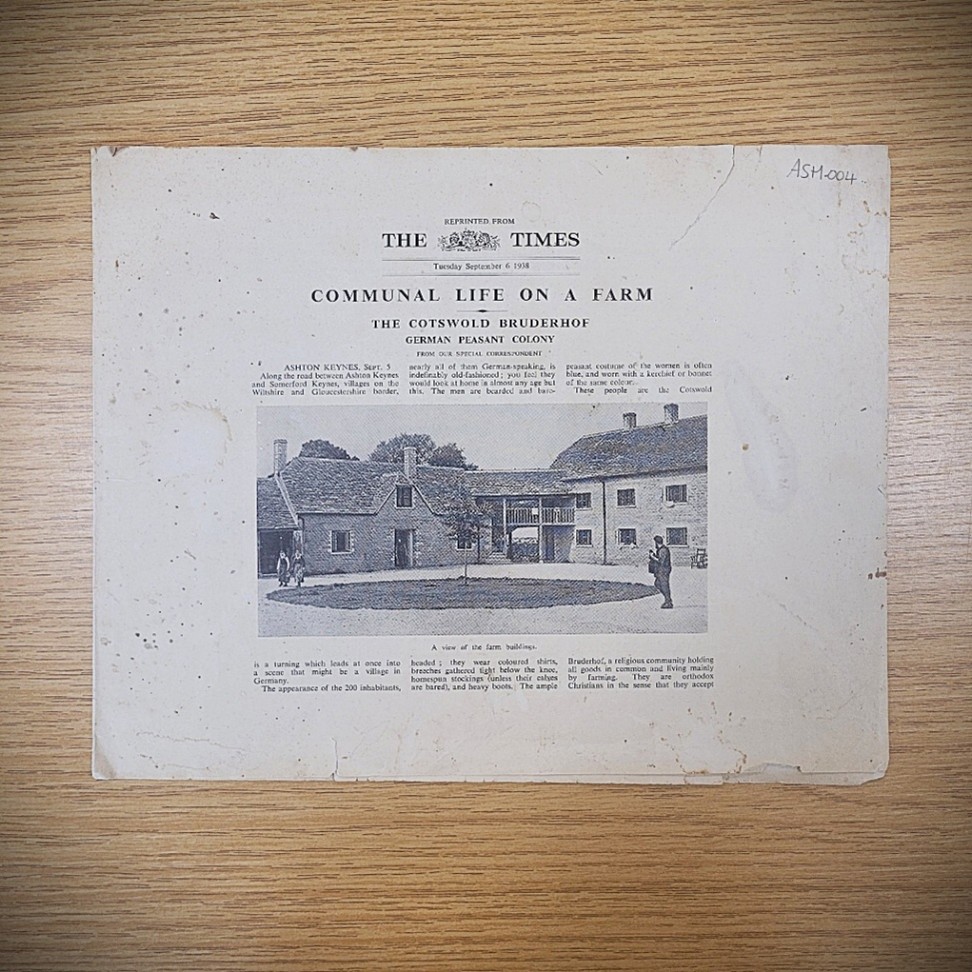
Re-printed from the Times, Tuesday 6th September 1936, a booklet with information about the Briderhof Community in Ashton Keynes, WSHC: Ephemera, ASH.004
The Burderhof (which still exist today) are a religious community of orthodox Christians which was established in 1920 by Protestant theologian Eberhard Arnold, in the village of Sannerz in Germany. The Bruderhof live simple lives, refuse the social hierarchies imposed on society, and reject the ownership of private property. They also preach forgiveness, compassion, and a love of enemies, and are dedicated pacifists that refuse military service. Arnold’s pacifism was established when he visited the trenches in the First World War and witnessed the horrors of war first-hand.
In inter-war Germany, which saw the paying of reparations, hyperinflation, striking poverty, and the rise of Hitler, Arnold’s community was hated by the Nazis who believed them to be ‘opposed to National Socialism’ and patriotism. The Ashton Keynes farm was purchased in early 1936 when members of the Bruderhof fled Germany because of these rising tensions. A year later, the Gestapo presented the Bruderhof with an ultimatum. Leave Germany within 48 hours or be thrown in prison.
The establishment of the Ashton Keynes Bruderhof farm was an impressive achievement in such a short amount of time. Within two years, the farm consisted of 121 adult members and 92 children (over 40 families), the original farmhouse had been transformed into a dwelling house (complete with a communal kitchen), and the old byre and stables had been fully converted into flats! Also built was a hospital and kindergarten, as well as a meeting house where families dined together every evening. The community, who preached simple living, were highly self-sufficient and grew their own vegetables, harvested their own corn for making rye bread, and milked their own cows. In 1938 over 50 cattle, 120 sheep and 1000 chickens resided on the farm.
With the outbreak of the Second World War in 1939, the local community of Ashton Keynes grew suspicious of the German community and debates were held as to the fate of the community. In an extract from the Wiltshire Times, dated 28th June 1940, the matter was discussed in the house of commons. The Parliamentary Under Secretary stated that the Bruderhof make ‘a valuable contribution to the production of food’, and other members stated that they were peaceful and ‘violently anti-Nazi.’ Nonetheless, the farm was boycotted and the Bruderhorf’s of Ashton Keynes sought refuge abroad in Paraguay.
For more information, visit the Bruderhorf website’s historical timeline on their website: History of the Bruderhof — Bruderhof
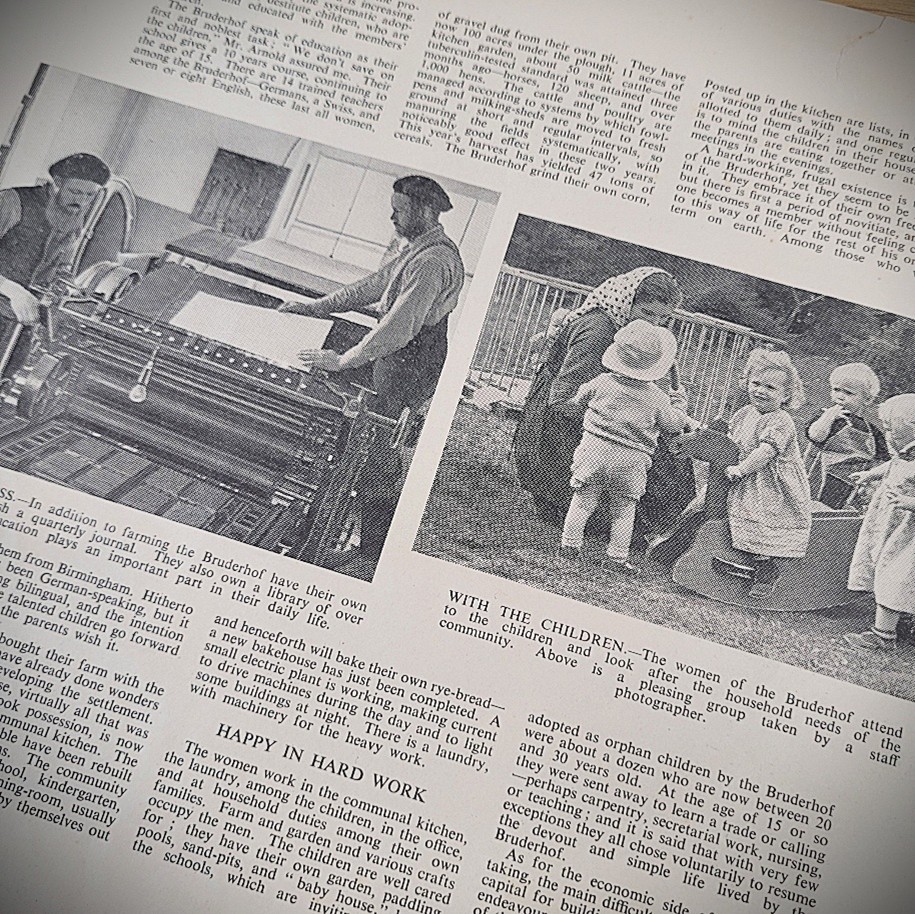

WSHC: Ephemera, ASH.004: Images of Bruderhorf men printing their community journal, (known today as ‘the Plough Journal’) and oxen pulling a wooden cart.
As such a rich resource for social history, popular culture and the lives and thoughts of everyday people, I would recommend ephemera as a resource to your research!
Ephemera folders can be searched for using the Wiltshire Libraries catalogue and requested by filling out a blue Local Studies Document Request Slip in our Search-room.
Sophie Bunce, Community History Advisor
Share this post
About Us
Research Tools
What We Do
Contact us
Wiltshire and Swindon History Centre
Cocklebury Road
Chippenham
SN15 3QN
E: heritageadmin@wiltshire.gov.uk
T: 01249 705500


