

Introduction:
A recent discovery made by a member of the Wiltshire Council ICT department, Wayne Dicker, of a piece of wood hanging in the storeroom at Devizes Library prompted Ian Hicks, the Collections Manager at the Wiltshire & Swindon History Centre, to research the history and provenance of this artefact. During this research he discovered the origins of the Wiltshire Library Service and a few unexpected twists along the way.
Part One:
Lieutenant Harry Colebourn: A Canadian veterinarian and soldier, First World War and a bear called Winnie.
This story has two parts. The first part begins in Canada in 1914 with Lieutenant Harry Colebourn, a veterinarian and soldier with the Royal Canadian Army Veterinary Corps.
On August 24, 1914, as he was heading across Canada by train to join the Canadian troops at the training camp at Valcartier, Quebec, where he was to embark for England, he stopped at White River, Ontario, where he met a hunter who had killed an American black bear and was selling her cub. Harry purchased the cub for $20 and named her “Winnie” after his hometown, Winnipeg. Winnie stayed with Harry for the journey across the Atlantic to England on board the SS Manitou and then onto Salisbury Plain.
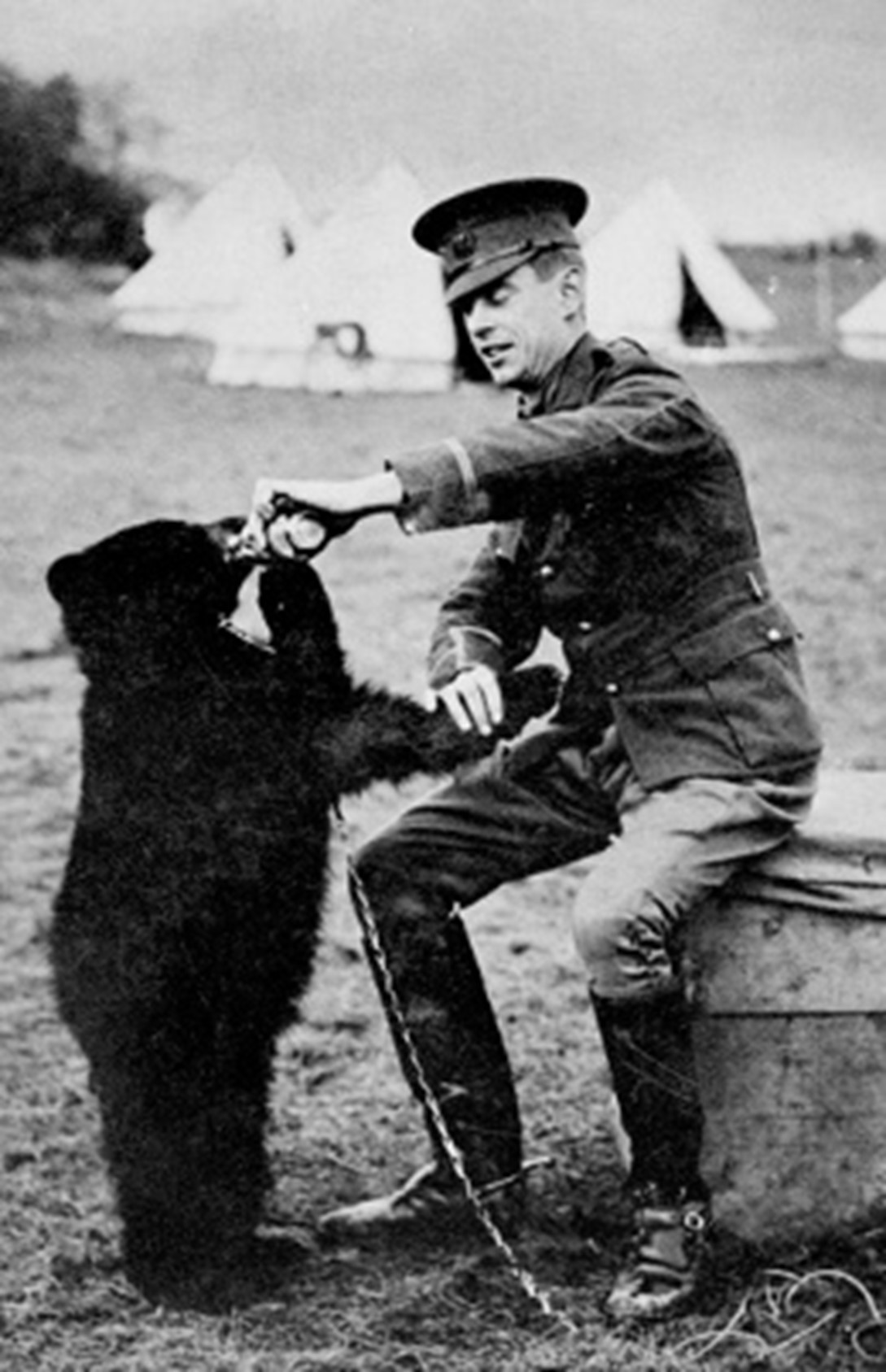
Wikimedia Commons File: Harry Colebourn and Winnie.jpg
They arrived on Salisbury Plain on October 17, where they remained together until December 1914.
During this time, she became a firm favourite of the soldiers and was adopted as one of several mascots for the Royal Canadian Army Veterinary Corps.
Harry and Winnie’s time on the Plain was during one of the wettest winters in decades and must have been very challenging. Due to the appalling weather conditions, plans were submitted to the War Office to move the Canadian troops out of the tents and into hutted camps. Unfortunately, the poor weather conditions, lack of materials and a shortage of workers were significant hurdles. Field Marshal Lord Kitchener’s goal of housing all the Canadians in huts before the end of November was not met, with huts still being erected in January 1915.
The standard wooden hut that was being erected for the troops was called the ‘Armstrong’, after Major Bertie Armstrong, a Canadian in the Royal Engineers who had been tasked with finding a solution to accommodate the thousands of soldiers.
Winnie’s New Home: Winnie’s life at London Zoo and her friends A A Milne and Christopher Robin.
When the time came for Harry to leave for France, he was unable to take Winnie with him. On December 9, 1914, Harry left Winnie at the recently opened Mappin Terraces in London Zoo so they could look after her while he was fighting in Europe. When the war was over, Harry initially intended to collect Winnie from the zoo on his way back to Canada; however, the zoo had taken such good care of Winnie that she had become a beloved figure among the visitors, bringing joy and happiness to all. Recognising her popularity, he decided to donate Winnie to the zoo.

Winnie’s keeper feeding her one of her favourite treats, a spoonful or two of golden syrup.
Image courtesy of the London Zoological Society
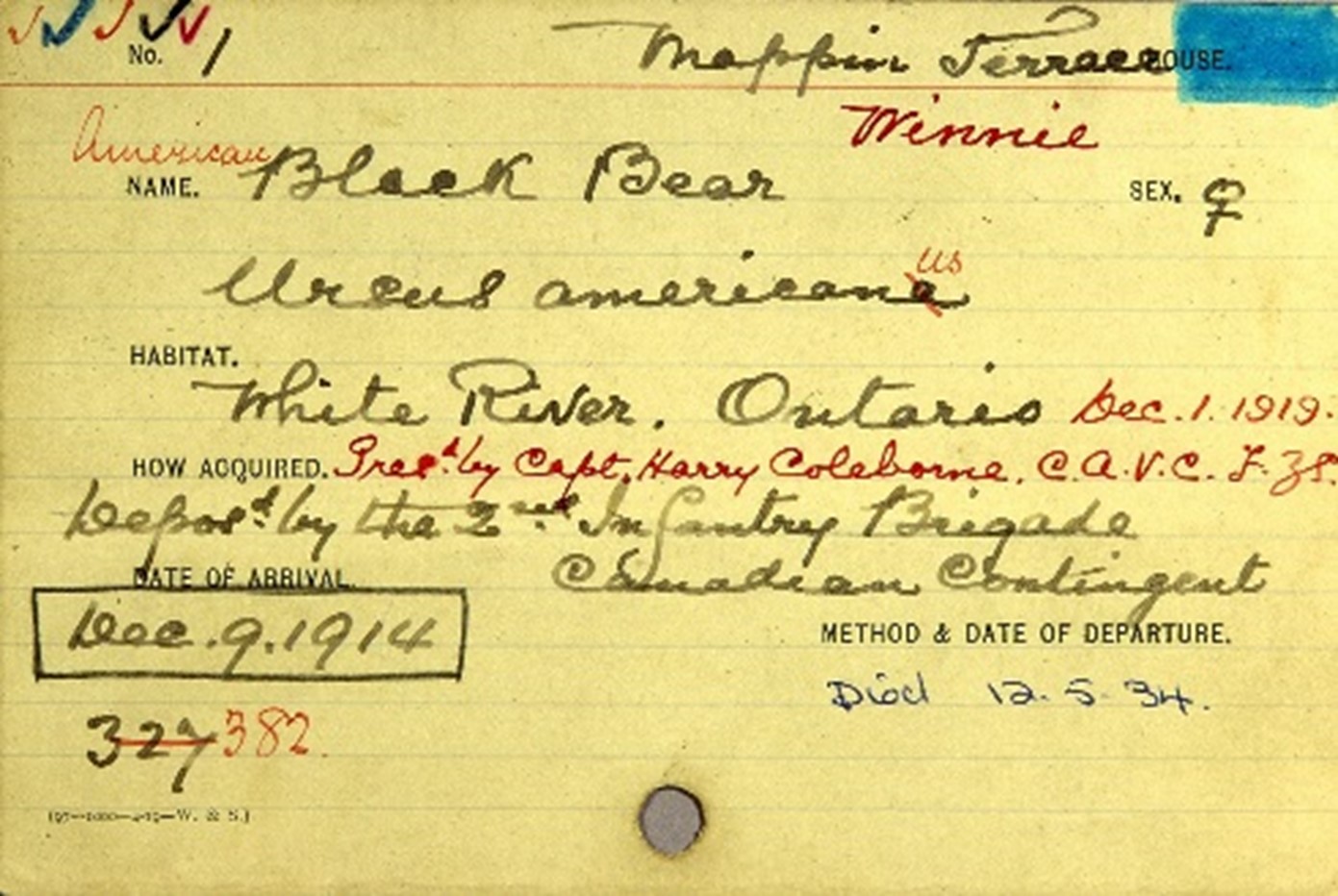
Winnie’s registration card, giving details about her and how the zoo acquired her.
Image courtesy of the London Zoological Society
With her gentle and friendly nature, Winnie was a delight to all. She welcomed visitors’ touch and even gave children the joy of a ride.
Winnie’s charm and good nature were not lost on A A Milne, who regularly took his son, Christopher Robin Milne, to see her. It was Christopher’s deep affection for Winnie that sparked the creation of the beloved fictional character Winnie-the-Pooh.
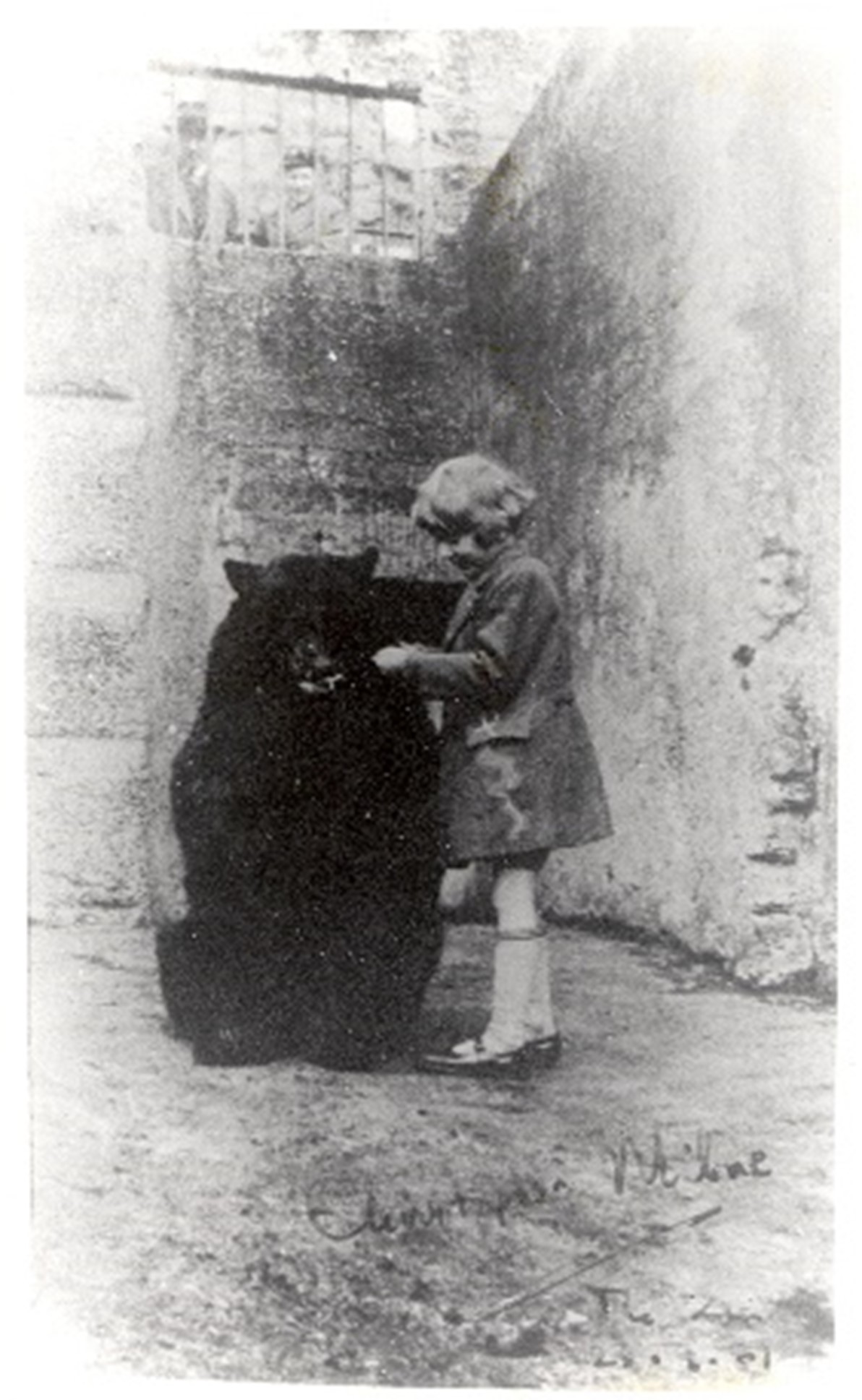
The young Christopher Robin feeding Winnie some condensed milk on one of his visits to London Zoo. A A Milne can just about be seen behind the bars in the background, keeping a close eye on Christopher from a distance, of course!
Image courtesy of the London Zoological Society
Winnie died at the zoo on May 12, 1934. In 1995, the people of Manitoba, Canada, presented the zoo with a statue of Harry and Winnie.
Part Two:
The Hut, aka Maple Leaf Villa: An ex-Canadian Army hut from Salisbury Plain, becomes the first Wiltshire Library Headquarters.
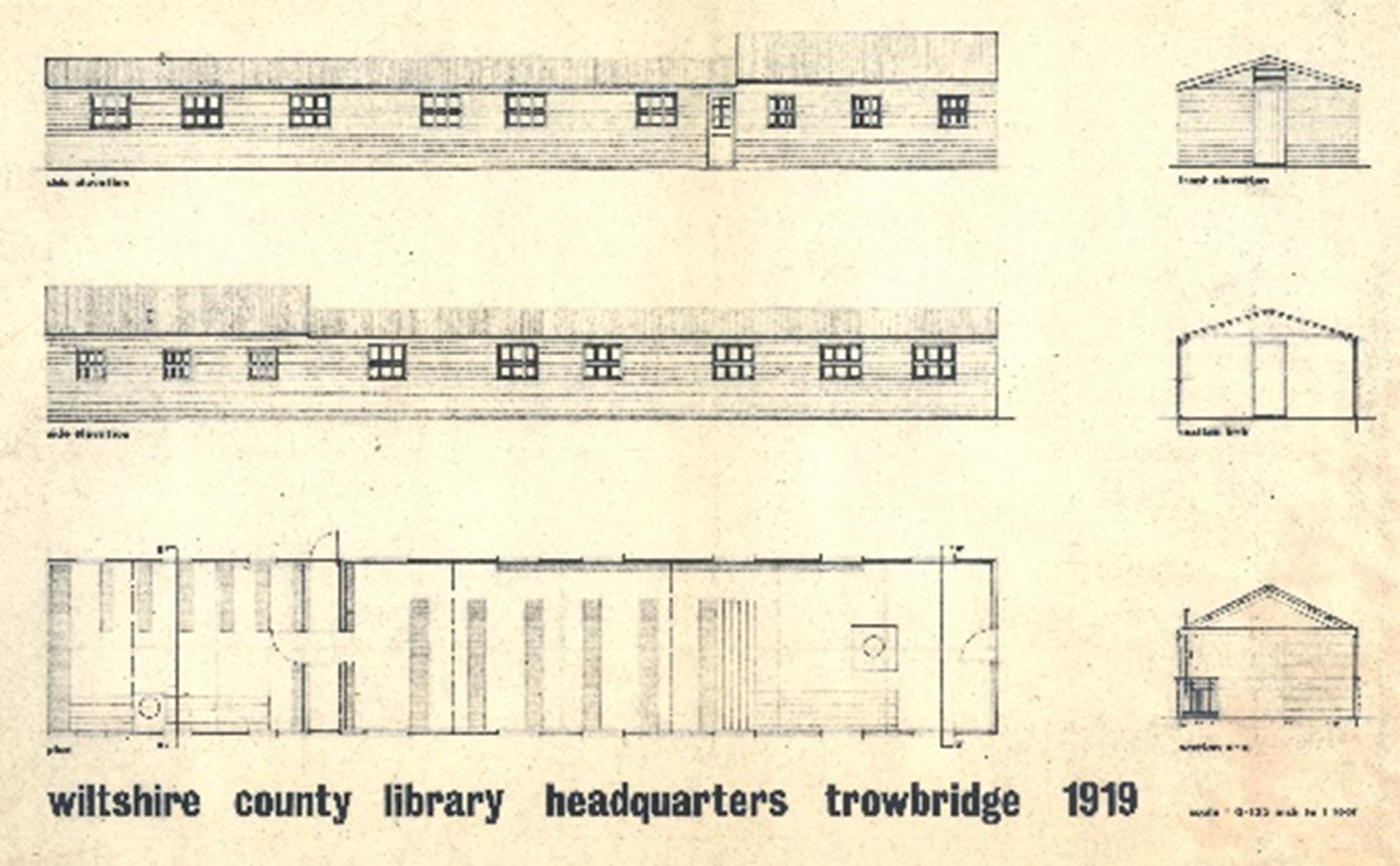
Architectural plans showing the hut’s elevations and the interior layout. Dated 1919.
WSHC F10/100/271/2/8HC
After the war, hundreds of the Canadian Army huts were sold off. There are various mentions in the Wiltshire County Council (as it was then) minutes of the council purchasing these huts for use around the county. One such hut was purchased in 1919 with a grant from the Carnegie United Kingdom Trust to cover the establishment expenses and part maintenance of a library scheme for eight years. After this date, the scheme was to be financed entirely out of council funds. The council paid £100 for this ex-Canadian Army hut from Old Sarum Aerodrome.

The third edition Ordnance Survey map of 1924, sheet number 38/7, showing the hut on the grounds of Trowbridge Adcroft Council Boys’ School on Prospect Place.
Image courtesy of WSHC
The hut was re-erected and furnished ‘by a man from Salisbury’ on the grounds of the Trowbridge Adcroft Council Boys’ School on Prospect Place, at a total cost of £150. The hut provided an office, a packing area, and shelving to accommodate 7,200 books. An additional small hut was erected and used as a storeroom.
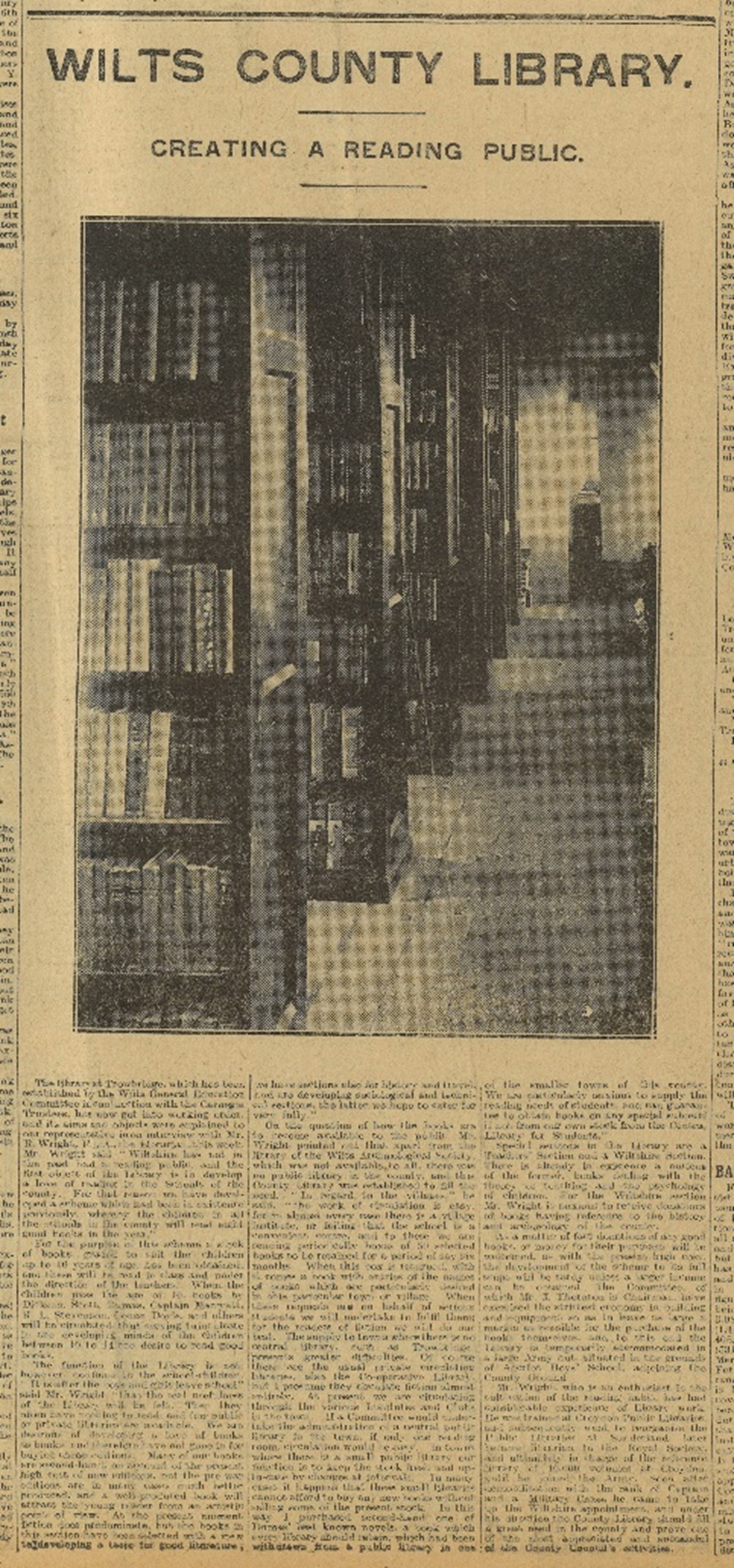
A report in the Wiltshire Times on the new County Library. Dated 17 January 1920. Mr Wright, the newly appointed County Librarian, was asked by the reporter the question of how the books are to become available to the public, to which he replied, ‘there was no public library in the county, and this County Library was established to fill the need.’
Image courtesy of WSHC

WSHC, Wiltshire Photographic Collection P17010
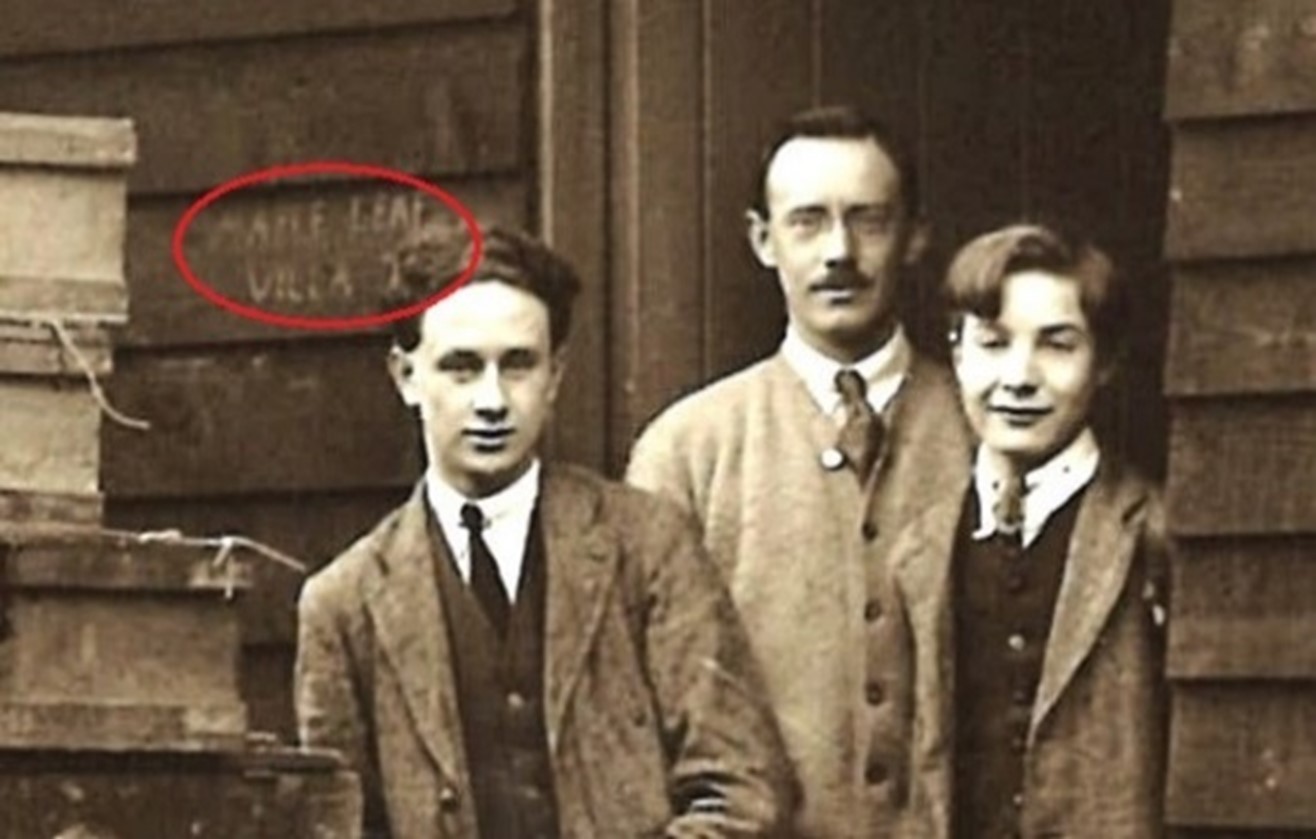
From its modest start in 1919 with the first County Librarian, Captain R Wright MC, and two assistants, Stanley White and the junior Tom Pepler, the County Library had grown significantly, employing over 30 staff at its headquarters 50 years later.
Captain Wright was appointed in July 1919 at a salary of £250 per annum. He trained at Croydon Public Libraries and went on to reorganise the Public Libraries at Sunderland. Later, he became a librarian at the Royal Society Library before returning to Croydon as a Reference Librarian.
The first quarterly library report, presented by Mr Wright in May 1920, marked a significant milestone in the early stages of the library scheme. Wright’s report detailed the progress of the scheme, he writes:
‘The books at the repository have been made available to local teachers and students. There are now about 100 borrowers taking advantage of the privilege. The type of reading is good.’
Staff: From Three to Thirty.
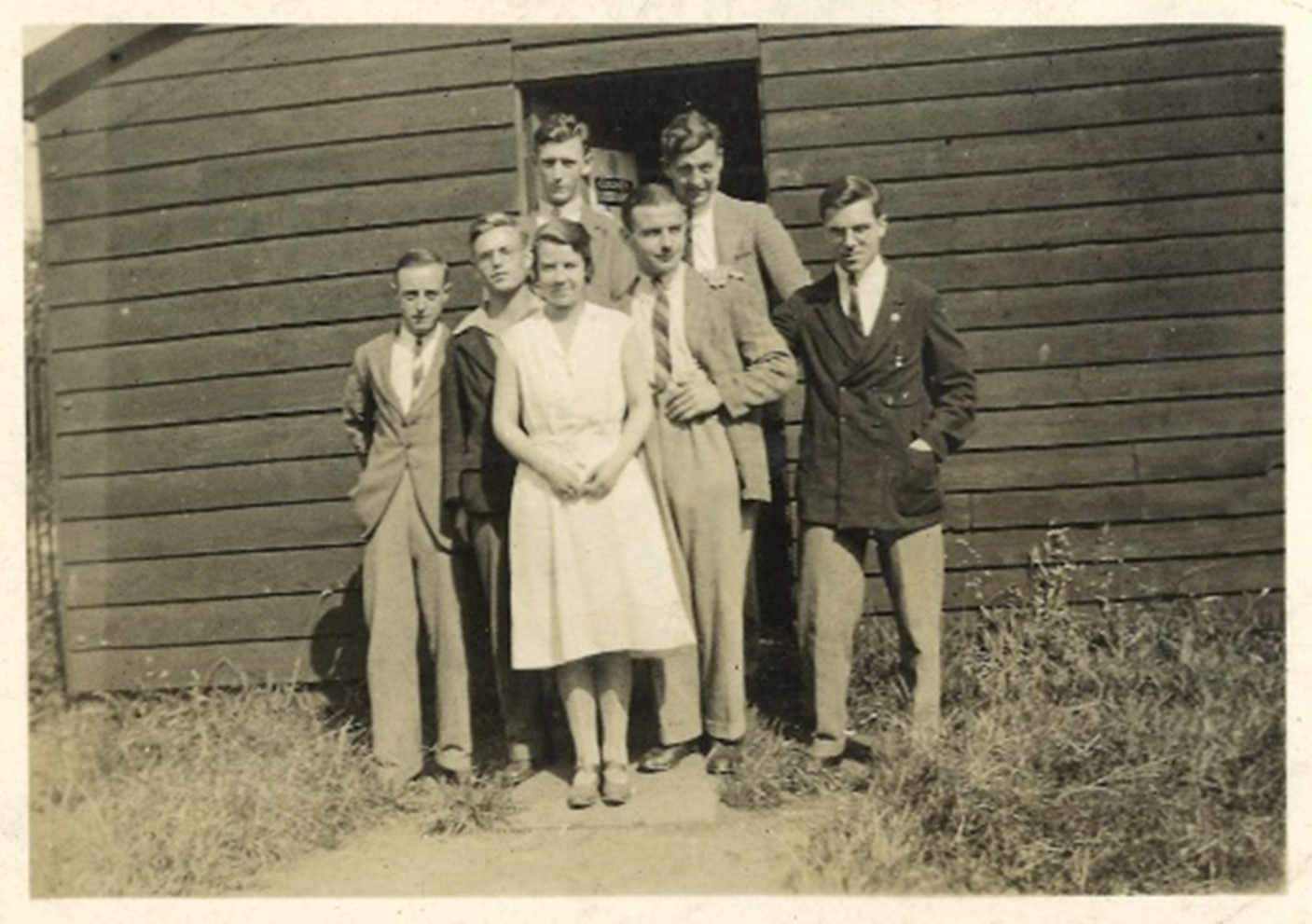
Headquarters Staff in front of the hut.
From left to right: back row; Steve, Les Long. Middle row; Raymond Richards, George Webb, Eddie Smart, Reg Newton. Front row; Olive Champion. Dated 1932.
WSHC, Wiltshire Photographic Collection P41553
The 1934 Prospect Place Extension: The inadequacies of a hut and the rapidly growing library service.
WSHC, Wiltshire Photographic Collection P17041
The hut was initially intended to provide temporary accommodation; however, its construction was not without challenges. Six years after its erection, it was reported that the wet winter:
‘had made everything so damp that by March, we found it impossible to keep the books from becoming covered with green mould.’
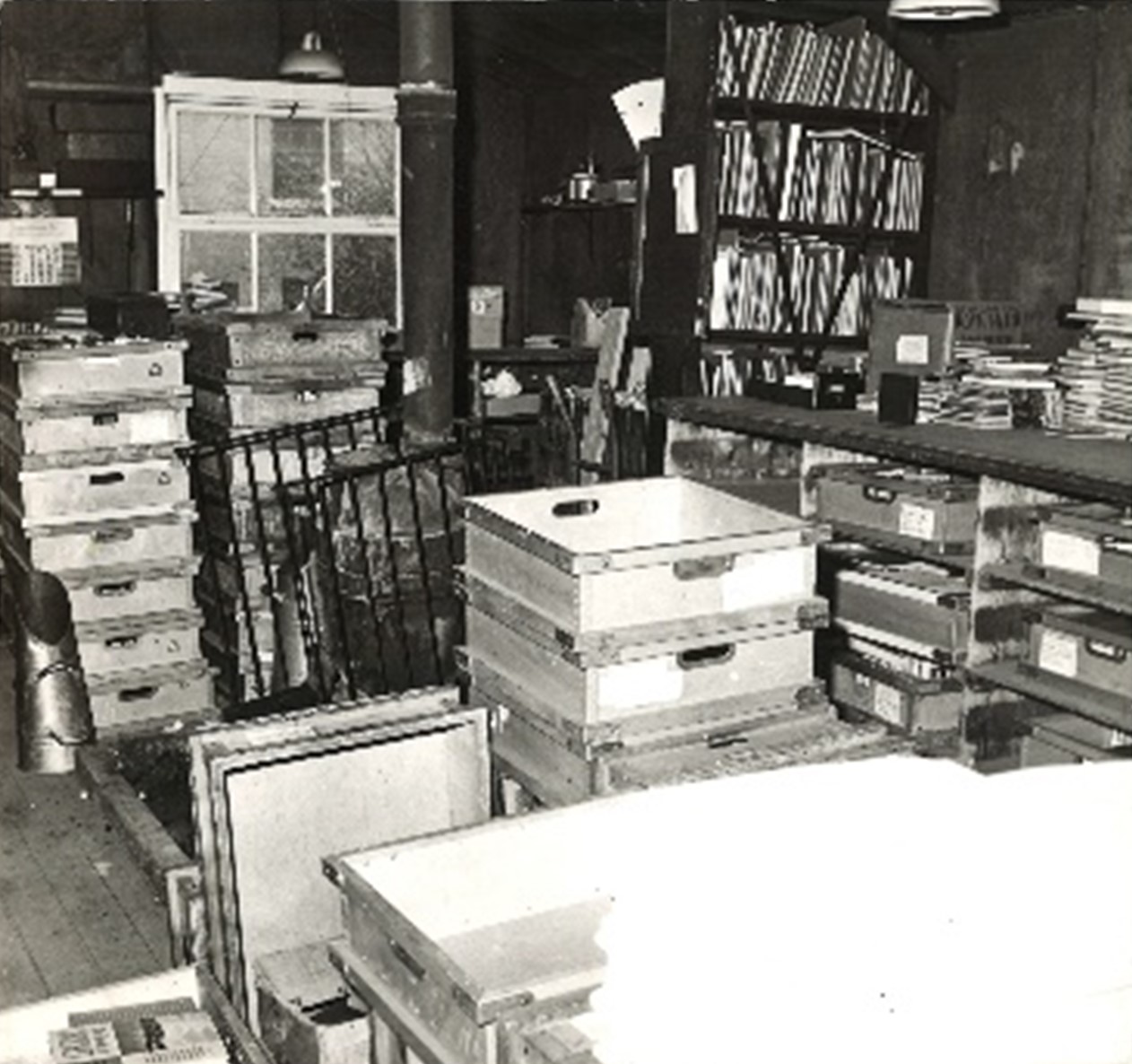
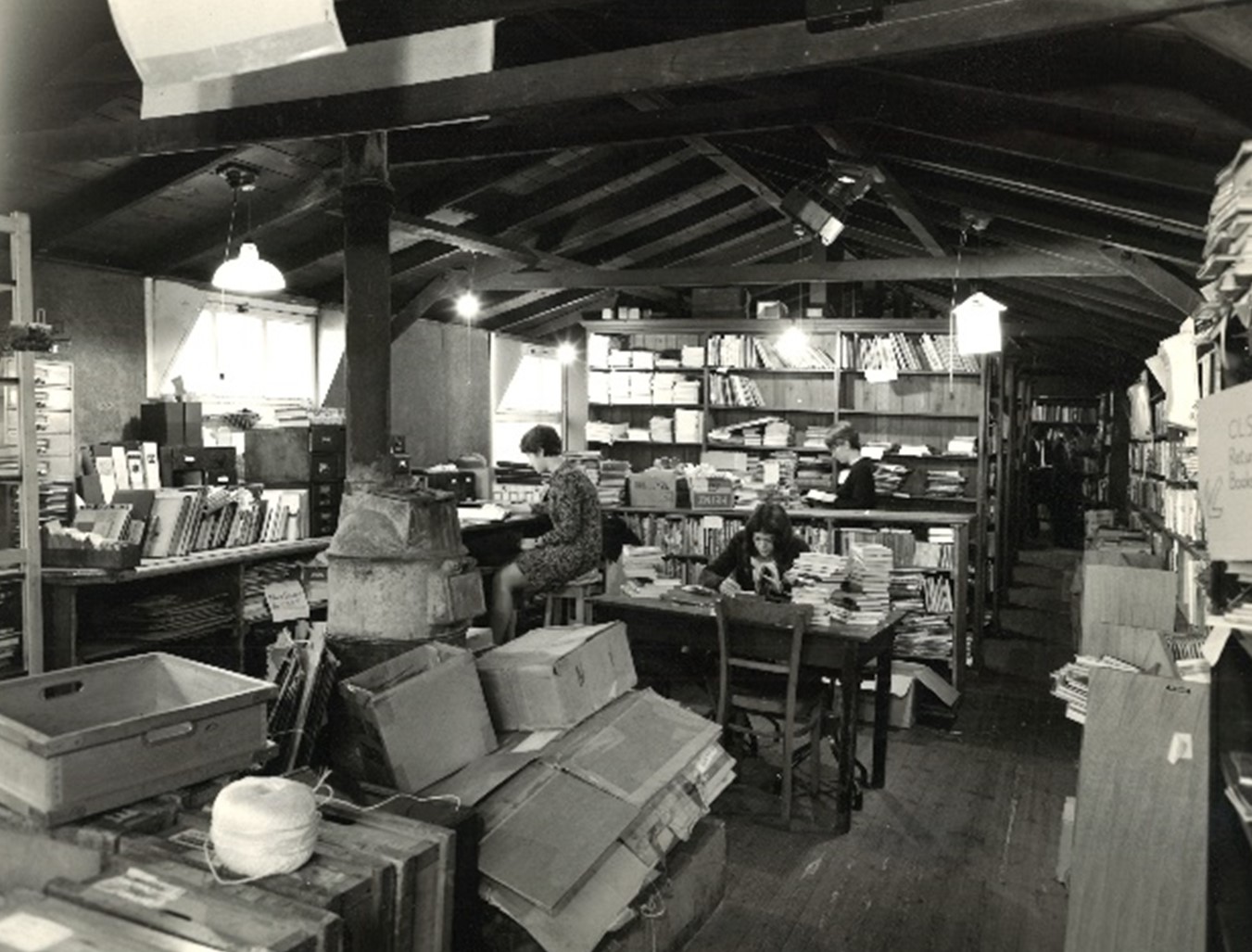
The interior of the hut, showing the lack of space to work with piles of books and book boxes. In the background is a coke stove.
WSHC, Wiltshire Photographic Collection P17050
By 1932, it was apparent that the hut had become ‘manifestly inadequate’, with leaks and the ‘perpetual nuisance from dust created by the coke stoves’ that ‘every book has to be cleaned before use’ More shelving was needed for the rapidly growing stock and room for the day-to-day processing work. In response to these challenges, in 1934, an extension was built adjoining the hut, providing the much-needed space and facilities. However, it was decided that the hut could still serve a purpose, and it continued to be used alongside the new building until 1969.
The extension was opened in June 1934 by Mr E Slater Davies, Chairman of the Library Committee of the Carnegie United Kingdom Trust, who noted:
‘a new and good-looking building has been erected to supplement the old army hut in which for too many years that precious store of books known as the County Library has been stored.’
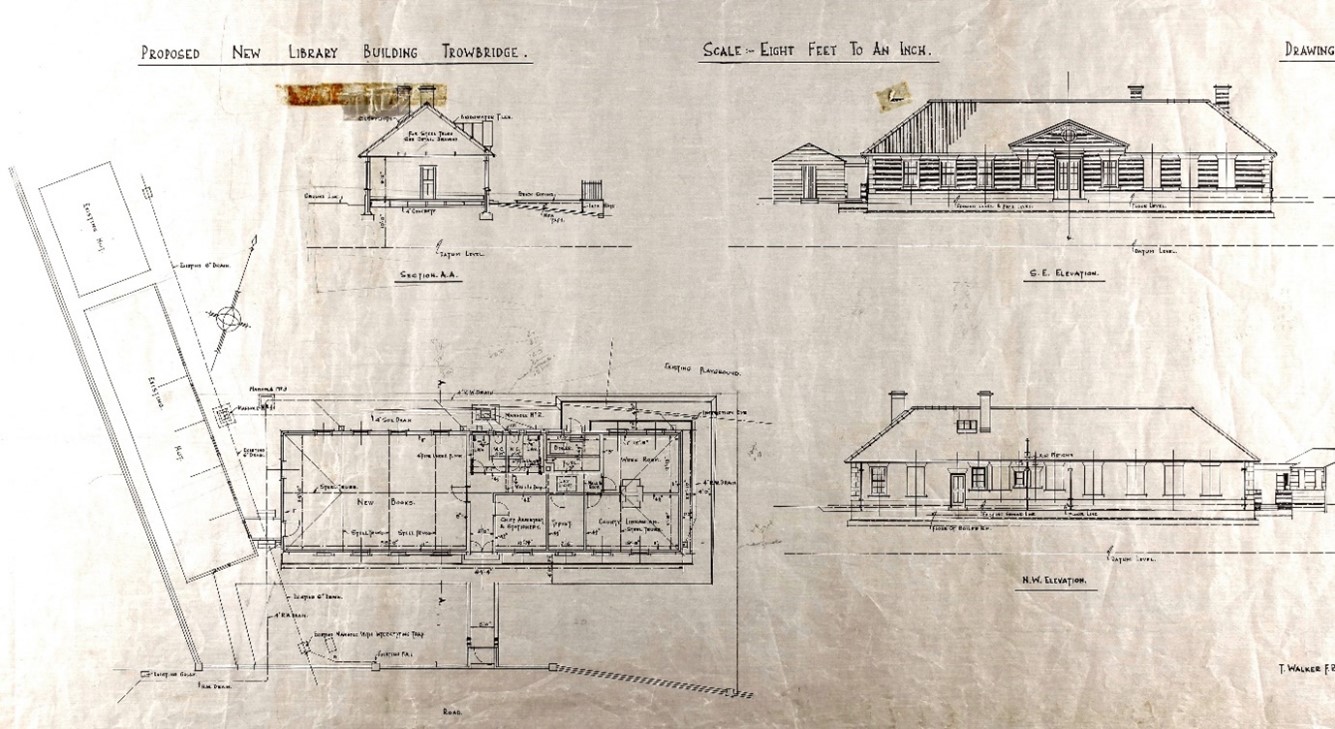
1934 architectural drawings for the extension. The hut is shown on the left of the new extension with a covered walkway joining the hut to the extension
WSHC F11/100/271/28HC

WSHC, Wiltshire Photographic Collection P17013

Headquarters staff outside Prospect Place. Dated 1952. WSHC Wiltshire Photographic Collection P17330
From left to right: back row; A W Shephard, C C Ellis, F J R Blissett, R S Gowen, V J Kite, L P Towsend, R W D Stevens. Middle row; S R Thomas, R L Newton, F Hallworth, Miss B Watts, Miss M B Coughlin, H Kay, E W Davidson, J D Todd. Front row; Miss N M Hobbs, Miss E M Chapman, Mrs B M Newton, Miss J Aylett, Miss G E Farmaner, Miss L R Andrews (County Librarian, 1934-1952), Miss E Sutton, C A Philips, Miss M A Collier.
This purpose-built, single-storey brick building was erected next to the hut. It provided the staff with a luxury they had not experienced before—a toilet, which was unavailable in the hut. This was a significant improvement in the staff’s working conditions!
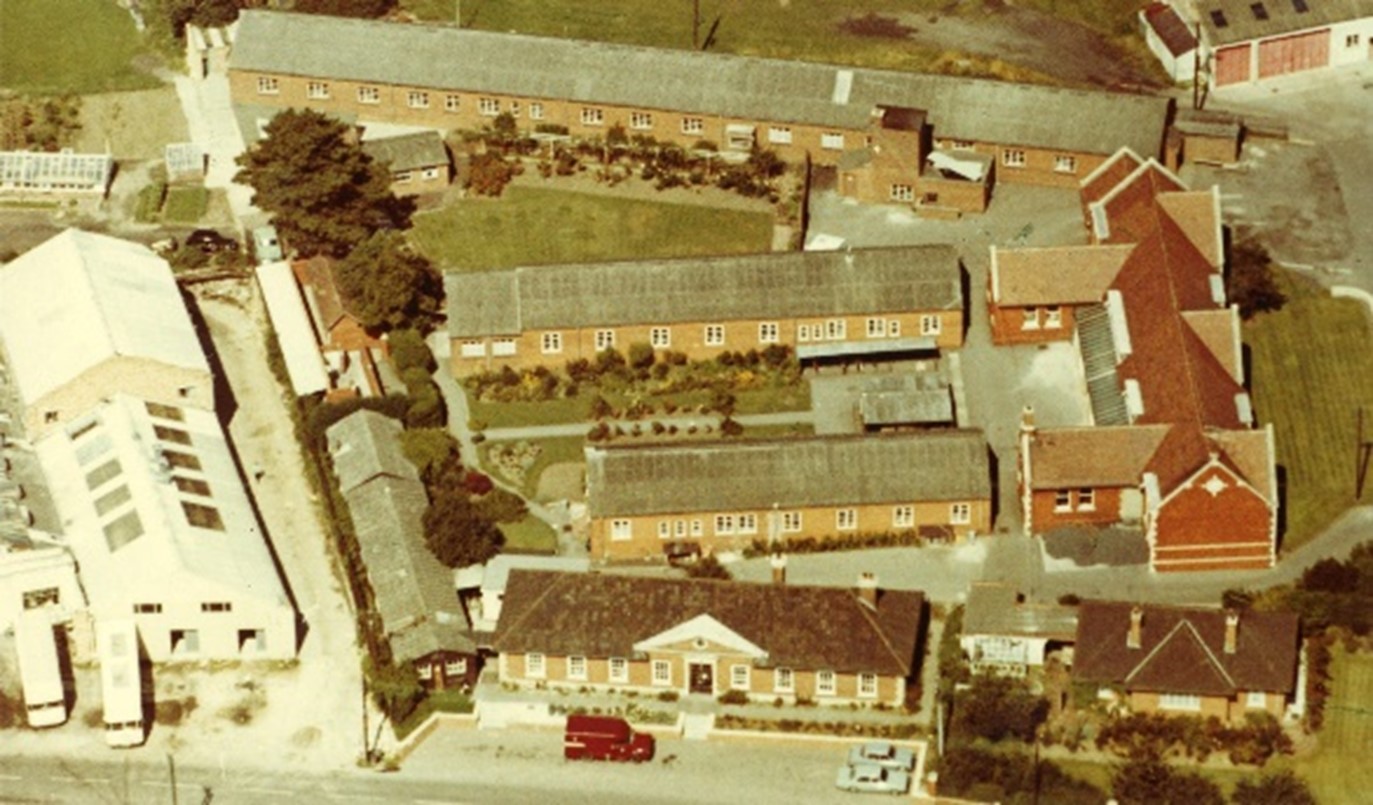
An aerial photograph shows the hut adjoining the new purpose-built library headquarters. The hut continued to be used until 1969. The dark red coloured vehicle in the foreground is a mobile library. WSHC Wiltshire Photographic Collection P17011
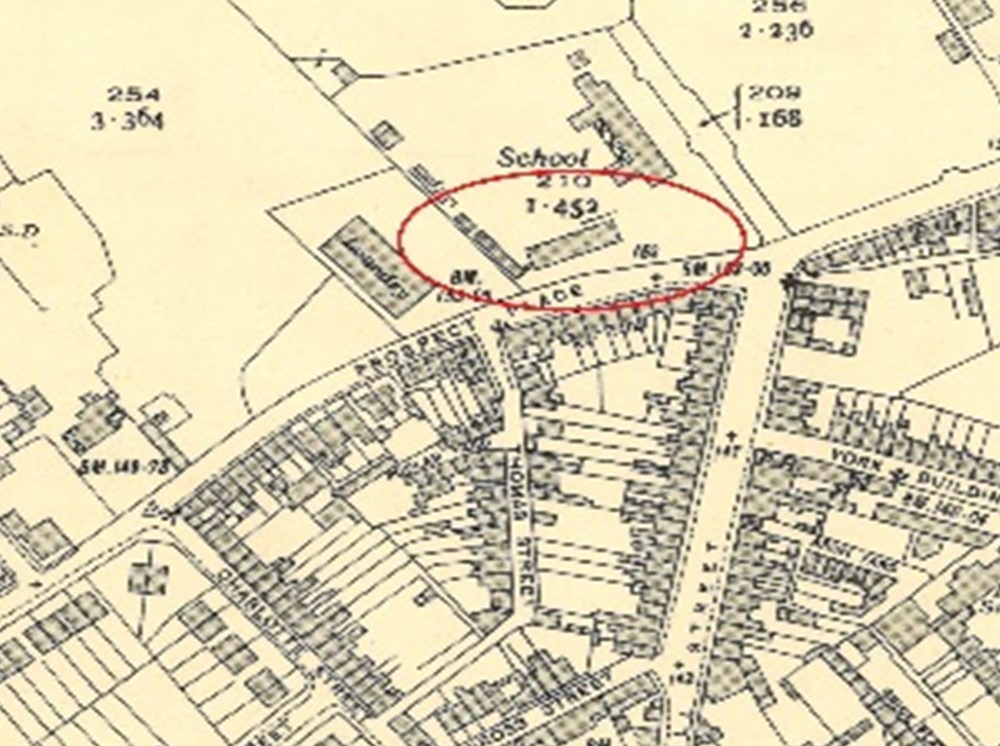
The revised third edition Ordnance Survey map of 1936, sheet number 38/7, showing the newly built extension with the hut on the left.
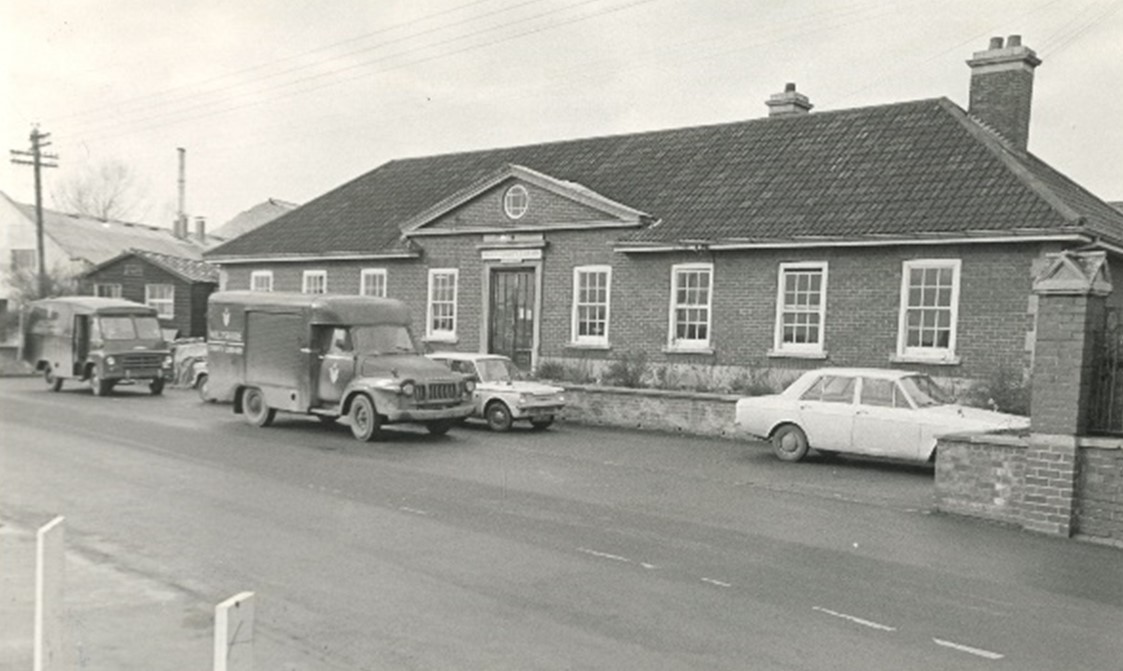
WSHC, Wiltshire Photographic Collection P17012

Headquarters staff outside Prospect Place. Dated 1968. WSHC Wiltshire Photographic Collection P17329
From left to right: back row; Sylvia Middleton, ?, Marianne Chubb, Pat Maslin, Sheila Jones, ?, ?, ?, Sandra Francis, ?, Elizabeth Beeden, ?, Rita Hewlett. Middle row; Lesley Webb, Christine Townsend, Pat Bray, Pam Grant, Penny England, Margaret Reed, Jeanetta Bradley, Linda Knight, Julie Adams, Doreen Greenland, Mary Liddle. Front row; Robin Bluhm, Walter Franklin, Frederick Hallworth (County Librarian, 1952-1982), Peter Pickup, Ken Wood, Maurice Webb.
1969 and the move to Chapman’s: From purpose-built facility to an old mattress factory.

Interior of the new headquarters, Chapman’s. The assistant director, Peter Pickup, is seated in the foreground, hard at work sorting through index cards. The lady operating the large typing machine to the right of Peter: could this be Julie Adams?
WSHC, Wiltshire Photographic Collection P17059
By 1968, the hut and the adjoining purpose-built building needed to provide more space for the rapidly expanding library service. At the beginning of 1969, the headquarters moved from Prospect Place, where it had been for nearly 50 years, to the former Airsprung mattress factory called ‘Chapman’s’ after the factory founder Hedley Chapman, on Bythesea Road opposite County Hall.
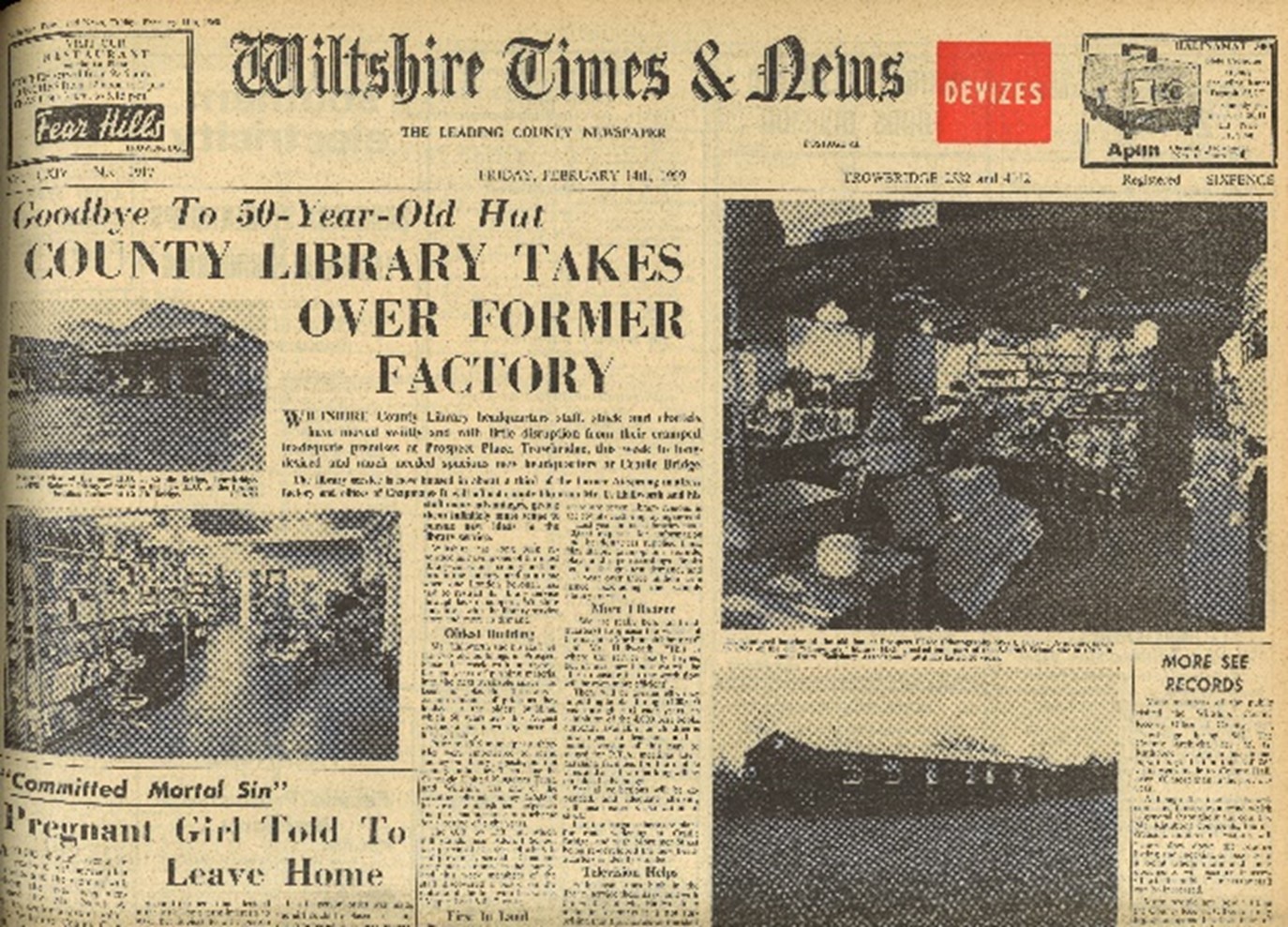
Wiltshire Times & News, 14 February 1969. Front page headline, ‘Goodbye To 50-Year-Old Hut: County Library Takes Over Former Factory’
The new site provided more space and better facilities for the service, including a much-needed loading bay with outside space for the delivery vans and mobile libraries, as well as ample parking. It remained until 2016 when it moved to Devizes Library, where operations continue today. Before the staff left the site on Prospect Place, they took a significant object with them. The hut’s name, given by the Canadian Army in the winter of 1914/15, had faded and was nearly lost until the vigilant library staff members decided to rescue the name board and take it to the new library headquarters. It was mounted onto a bookshelf and hung on the corridor wall. The following words are noted on the new mount:
‘The original name board of the first library H.Q. to be erected in Great Britain. A 1914-18 War Canadian Army hut from Salisbury Plain. Re-erected in Trowbridge in 1919 and vacated by Library H.Q. in 1969.’
The ‘Maple Leaf Villa’ plaque is now on permanent display at the entrance of Trowbridge Library.

Conclusion:
Today, we are still investigating if, after 110 years, the hut still stands on the same site where it was erected in 1919 on Prospect Place…
Acknowledgements:
A special thank you must go to Wayne Dicker, who found the plaque and brought it to everyone’s attention, Wendy Barker, the Librarian at Trowbridge Library, and Wayne Robson, the contracts and works manager for Wiltshire Council, without whose expertise and enthusiasm this project would not have been possible. I also want to acknowledge the significant contribution of the London Zoological Society, whose images of Winnie’s time at the zoo added a rich and authentic dimension to our project.
Ian Hicks, Collections Manager
Share this post
About Us
Research Tools
What We Do
Contact us
Wiltshire and Swindon History Centre
Cocklebury Road
Chippenham
SN15 3QN
E: heritageadmin@wiltshire.gov.uk
T: 01249 705500


