

Letters from soldiers, sailors and airmen of the First World War are often quite formal in their style and the things they say. But of all the hundreds of letters I have read from the archive over the past few weeks, most of the writers are united by one subject – the importance of socks.
To help you do your job, no matter how unpleasant, basic comforts are the priority. For the servicemen of the First World War, freezing a lot of the time in a trench, at sea or in the air, having warm dry feet was a daily challenge.
No unfairness intended, it just so happens that all of these letters are from the chaps. So far I have only found letters from service men.
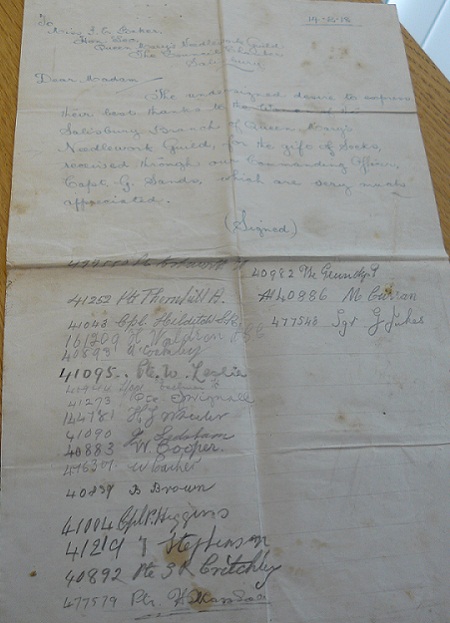
They asked for socks, they said thank you for socks, they requested more socks, their commanding officers organised gifts of huge parcels of socks, and individuals wrote lyrical descriptions of the glorious feeling of a bath and a clean pair – of socks.
Captain George Sands, a friend of one of the Guild’s officers, wrote:
‘I don’t know if you will think it great cheek on my part writing thus to you but you must please forgive me. When one is more or less personally responsible for a great number of men in this wilderness one has to be cheeky in appealing for them. …Could you help us in the matter of socks? We have 500 men in our company…and they are very badly off for socks. They get the usual issue but their work wears them out very quickly (that of digging mostly) and the need of new one is always with us. There is nothing so comforting to a man after getting home to camp (after a hard and long day’s work in the pouring rain, and a long hard march along mud tracks) as to be able to dry his feet and put on a dry pair of socks. These labour companies are composed of men who have been wounded and so are unfitted for further work in the actual front line (although we are not far away from it; our casualties are very heavy) also men of low category, and they very often do not possess the physical stamina to withstand wet and cold that prevail at the present time.’
A Private Wainwright wrote, with great honesty in 1917:
‘During the recent great activity it has been impossible in most cases to obtain a change of clothing and when I tell you that until a fortnight ago I had not had a bath or change for about eight weeks, you will be able to draw your own conclusions.’
Twenty soldiers signed the following note, written in May 1918:
‘Dear Madam, the undersigned desire to express their best thanks to the Women of the Salisbury Branch of the QMNG for the gift of socks received through our Commanding Officer’
Captain George Sands must have been a regular recipient of parcels on behalf of his men. In February 1918 he wrote:
‘Ref the little parcels of wool enclosed in it for darning. This is really a great boon. My Quartermaster Sergeant who has had a lot of experience says it is the most sensible idea he has ever struck in France. You would know what a boon it is if you could see some of the darning that is done with thread, string etc.’
And all through all these messages of gratitude there is the underlying message, that the men at the front were struggling to do their jobs as well as they could under terrible conditions. Their health suffered even when they managed to stay alive and unhurt, and the conditions they lived in made even minor problems far, far worse. The Red Cross Hospital in Salisbury dealt chiefly with cases of ‘Trench Nephritis’ and ‘Trench Fever’, both of which are infections due to lice and ticks, carried by rats and exacerbated by trench conditions in general.
Care of the feet was also vital to avoid Trench Foot, which could disable a soldier enough to require hospital treatment. Soldiers were instructed to keep an eye on each other, and ensure that they greased their feet and change their socks regularly.
One Salisbury man took his foot comfort a stage further. Private Jeans wrote in November 1915:
‘No doubt you will have read of the football match in the Salisbury Times of 19.11.15 in which I played…we got a team together in our spare time. Could you kindly get me a second hand pair of football boots size 7-8 – only it hurts your feet to play in your trench boots…’
Now I’m off to search the Newspaper archive to find this report!
Kate James
MA student from Bath Spa University
Share this post
About Us
Research Tools
What We Do
Contact us
Wiltshire and Swindon History Centre
Cocklebury Road
Chippenham
SN15 3QN
E: heritageadmin@wiltshire.gov.uk
T: 01249 705500


