

News from the Conservation Laboratories
Our conservation teams have been working on a diverse range of fascinating projects, from historic artefacts to archival treasures. Here are some highlights from across the laboratories.
Objects Conservation
Decorative Arabic-Style Spoon
A striking decorative brass spoon from North Hertfordshire Museum recently underwent conservation treatment in preparation for display. Careful cleaning carried out under magnification gradually revealed the original brass surface beneath accumulated deposits.
Objects such as this were often produced as souvenir pieces, combining decorative craftsmanship with practical use. The treatment has restored the spoon’s appearance while ensuring its long-term preservation for public display.

Images above: details from spoon before conservation

Image above: spoon after conservation
Walter Sickert’s Lay Figure
Conservator Kayleigh has been working on the treatment of a historic lay figure associated with the artist Walter Sickert (1860-1942).
This articulated mannequin is believed to have inspired Sickert’s The Raising of Lazarus series (1929-1932) and is said to have previously belonged to the renowned eighteenth-century artist and satirist William Hogarth. In 1942, Sickert gifted the figure to the Bath Academy of Art, now Bath Spa University, where it later became affectionately known as “George”.
Ahead of a forthcoming exhibition tour spanning Salisbury, Chippenham and Bath, Bath Spa University entrusted George to CMAS for conservation treatment. Work includes surface cleaning and improved storage and packing. The conservation process is also being documented, offering visitors valuable insight into the work undertaken behind the scenes to prepare significant objects for exhibition.

Image above: the lay figure before conservation
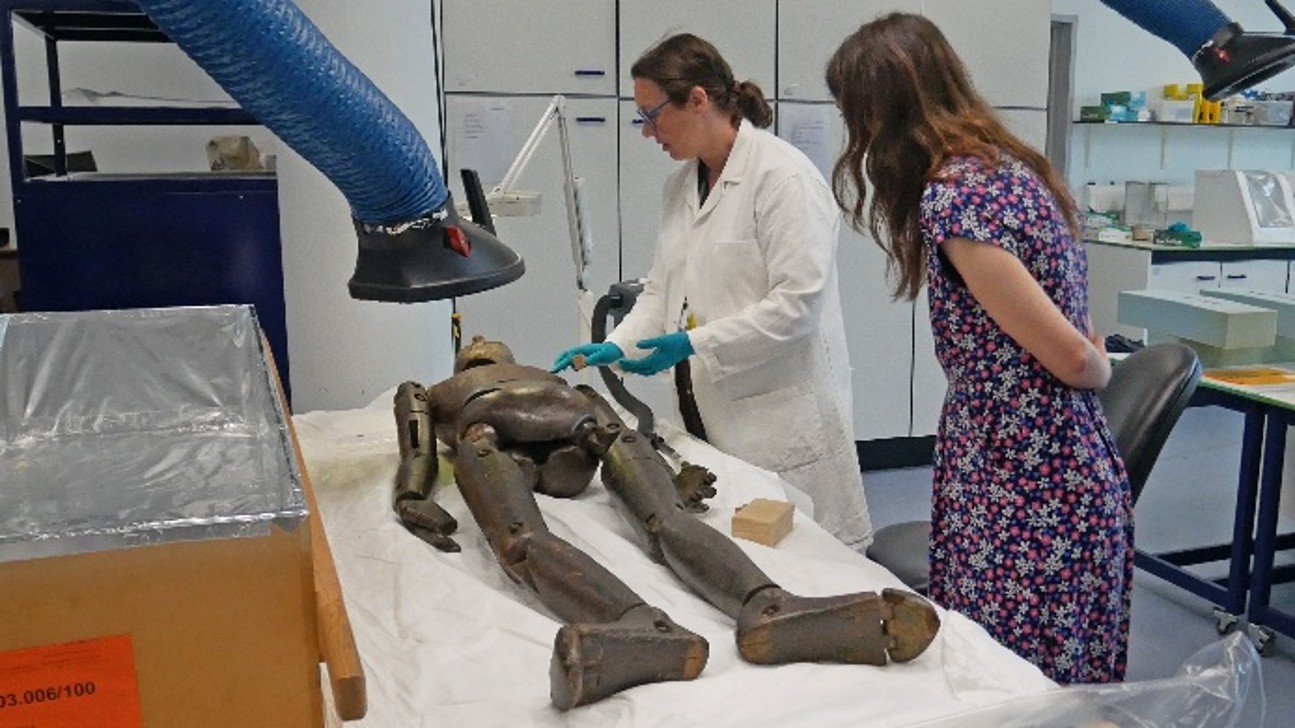
Image above: the lay figure during treatment
Medieval Slipware Bowl
Conservation student volunteer Jasmine has been working on a beautiful medieval slipware bowl belonging to Chippenham Museum.
The bowl had fractured after earlier historic repairs failed, requiring careful dismantling and reconstruction. Jasmine meticulously reassembled and stabilised the ceramic, filling losses with colour-matched conservation materials to restore the object’s appearance while respecting its historic character.
The project has provided valuable practical experience for an emerging conservator whilst helping to preserve an important local heritage object.

Images above from left to right: bowl before conservation, the bowl during treatment
Archive Conservation
Conserving the Arundell Manorial Court Rolls
Work continues on the conservation of the Arundell Manorial Court Rolls, a significant collection of historic documents. Four of the twenty most severely damaged rolls have now been conserved, with preparations underway for a volunteer programme that will support the cleaning and repackaging of the remaining material.
The project aims to improve both the preservation and accessibility of this remarkable collection, and further updates will be shared as work progresses.
Help Us Unlock the Collection
We are currently seeking volunteers with Latin language skills to assist in translating the court rolls. Contributions from volunteers will help make these important records more accessible to researchers and the wider public.
For further information, please contact sophie.coles@wiltshire.gov.uk.

Image above: close-up of a repaired corner of one of the court roll pages
A Six-Metre Map Conservation Challenge
Archive Conservator Sophie is currently undertaking the repair of an extraordinary map dating from 1834. Measuring more than six metres in length and constructed from multiple sheets joined together, the map records a proposed railway route between Basing (Basingstoke) and Bath and forms part of the Court of Quarter Sessions archive.
The route was promoted by the London and Southampton Railway as a potential link between London and Bristol but was ultimately superseded by the Great Western Railway Main Line. As a result, the map offers a fascinating glimpse into an alternative chapter of Britain’s railway history.
Years of storage in a rolled format, combined with repeated handling, have resulted in damaged edges, torn sections and surface dirt. Current conservation work is focused on stabilising vulnerable areas and preventing further loss.
The scale of this project has presented a unique conservation challenge, with treatment required along the map’s full six-metre length. Sophie has now reached the final section of the roll and is completing repairs to the end sheet before the map is repackaged in a bespoke storage box designed to provide long-term protection and easier handling.
Watch out for Sophie’s forthcoming blog at the end of August to find out more.

Above images clockwise: part of the map unrolled with areas of heavy surface dirt, the end section of the map with large tears and lost pieces, the conservator repairing the damaged map edges
Archives Hold More Than Paper
One recent conservation project highlights the surprising variety of objects found within archive collections.
Among the St John family archive from Lydiard House is a beautifully crafted nineteenth century greeting card in the shape of a folding fan. What initially appeared to be a straightforward repackaging project soon revealed an intriguing story about the object’s manufacture.
Microscopic examination identified subtle moulding marks, suggesting the fan was made from an early plastic rather than materials such as bone or animal skin. Further investigation uncovered faint lettering that appears to reference Dobbs, Kidd & Co., a prominent nineteenth-century manufacturer of greeting cards.

Images above from left: the fan in its bespoke box with Plastazote surround, a closeup of the fan through the microscope showing the word ‘Dobbs’
The Conservation and Museums Advisory Service (CMAS) aims to promote excellence in the care and use of collections by providing conservation advice and practical treatments to heritage organisations and the public. We also support museums in Wiltshire to meet professional standards and become sustainable, resilient organisations.
If you have a conservation query, want a quotation to carry out some work, or would like to book a free appointment for one of our conservation surgeries, we would love to hear from you! You can contact the team by email cmas@wiltshire.gov.uk
Share this post
About Us
Research Tools
What We Do
Contact us
Wiltshire and Swindon History Centre
Cocklebury Road
Chippenham
SN15 3QN
E: heritageadmin@wiltshire.gov.uk
T: 01249 705500


