

As Halloween approaches, it seems the perfect time to look back at one of the more unusual projects to pass through the conservation studio. Sometimes we have the opportunity to work on artefacts that reveal a darker side of the past. One such project involved the conservation of several Roman curse tablets from Corinium Museum in Cirencester.
Roman curse tablets, also known as defixiones, were small sheets of lead inscribed with messages intended for the gods. Rather than offering prayers of gratitude or devotion, these tablets typically contained requests for revenge, justice, or misfortune to be visited upon another person. Once inscribed, they were often folded or rolled and deposited in sacred locations such as pools, wells, temples, or graves, where it was believed the message would be delivered to the divine realm for action.

Image: One of the lead tablets under raking light. Can you spot the inscription markings?
The curse tablets are not only unsettling in the messages they contain, but also in the material from which they were made. Lead is a potent neurotoxin that can accumulate in the body over time, causing serious harm to the brain, kidneys, and nervous system. The corrosion products that form on lead objects present an additional challenge, as they can transfer easily during handling and may become airborne if disturbed. To minimise these risks, our conservator worked under extraction and wore personal protective equipment, including gloves and a lab coat. The treatment approach was also carefully adapted to reduce the generation of loose particles, ensuring the tablets could be conserved safely while protecting both the objects and the conservator…. If the curses themselves weren’t enough to worry about, the lead certainly provides its own horror story.
The tablets have survived for nearly two millennia and, although they had been unfolded following excavation, the creases and fold lines created in antiquity remained clearly visible. These physical traces provide valuable evidence of how the tablets were prepared, inscribed, and deposited, offering a fascinating glimpse into the ritual practices of Roman Britain.
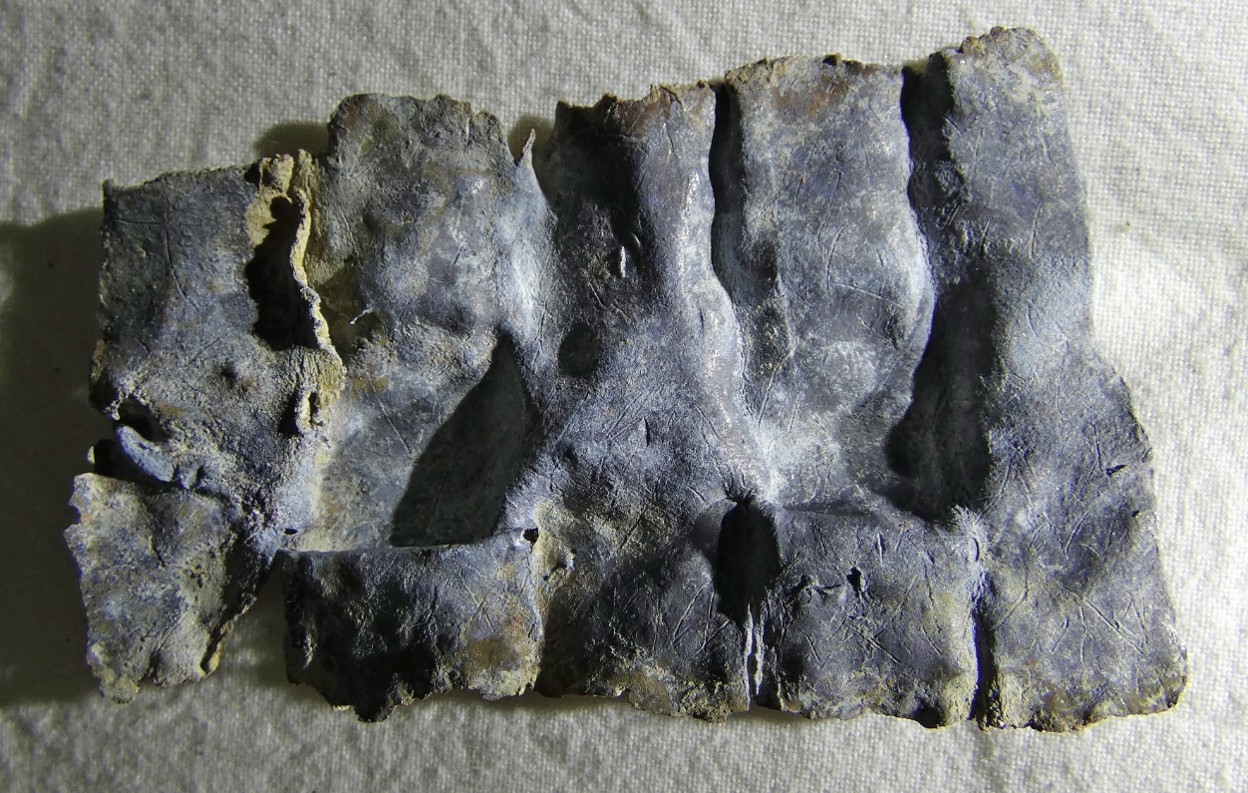
Image: One of the lead tablets under raking light. Can you spot the inscription markings?
Before treatment, the tablets displayed significant a layer of cream, white and brown corrosion products across the surface. The corrosion and surface deposits obscured details on the tablet and threatened their long-term stability. Conservation work focused on carefully cleaning and stabilising the lead while preserving the original material. Treatment involved immersion in a Rochelle salt solution, made up of Rochelle Salts, Sodium hydroxide and deionised water. The surface was then rinsed with deionised water, placed in a bath of Acetone followed by the careful removal of loose corrosion products, before allowing to air dry. The process was repeated until a stable surface was revealed.
In areas where heavier red-brown corrosion deposits were present, thought to be lead sulphides, a carefully controlled localised EDTA-based treatment was used to improve surface stability.
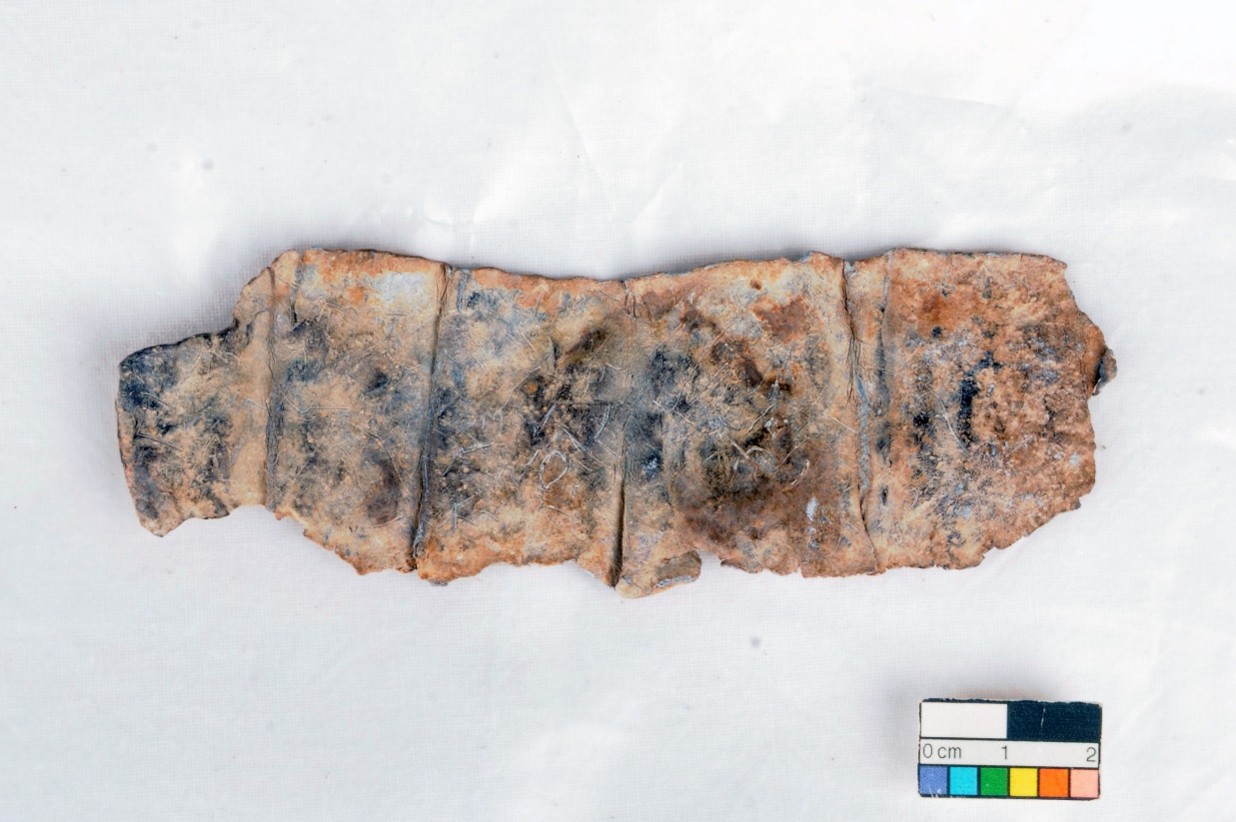
Image: Before conservation, showing a significant layer of surface corrosion deposits.
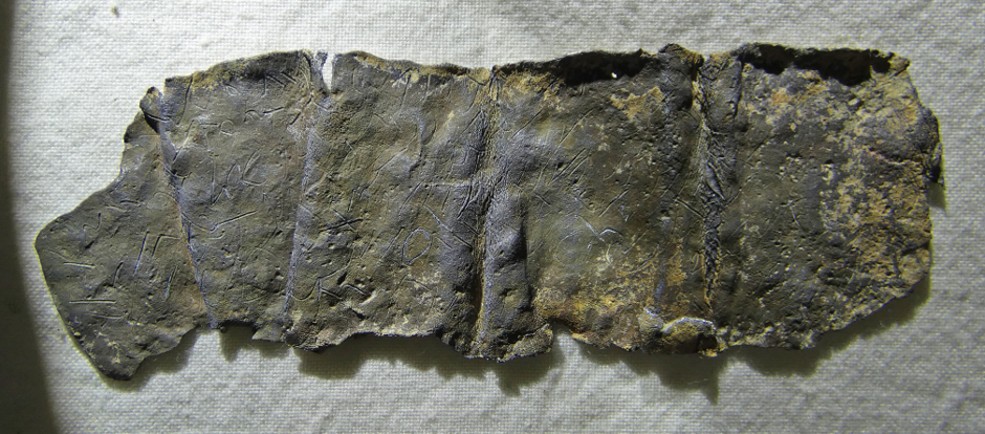
Image: After conservation, the majority of the corrosion has been removed.
Some corrosion products were left in place due to the risk of damaging the tablets if removed. Although visible, these remaining compounds were considered stable, and further removal could have risked damaging the original surface or obscuring the inscribed text. Similarly, no protective coating was applied after treatment, ensuring that future research and conservation options remain open.
One of the most fascinating aspects of the project was the opportunity to examine the inscriptions themselves. Viewed under raking light, lettering that can be difficult to see under normal illumination becomes much clearer, revealing messages written almost two thousand years ago. Through these inscriptions, the tablets provide a direct connection to the concerns, disputes, fears, and beliefs of the people who created them.
Fortunately, no curses appear to have been directed at the conservator and, as far as we know, Kayleigh has not been inspired to create any tablets of her own… at least not so far. 👻
The curse tablets will be on display at Corinium Museum, Cirencester in 2027.
The Conservation and Museums Advisory Service (CMAS) aims to promote excellence in the care and use of collections by providing conservation advice and practical treatments to heritage organisations and the public. We also support museums in Wiltshire to meet professional standards and become sustainable, resilient organisations.
If you have a conservation query, want a quotation to carry out some work, or would like to book a free appointment for one of our conservation surgeries, we would love to hear from you! You can contact the team by email cmas@wiltshire.gov.uk.
Visit our LinkedIn page https://www.linkedin.com/company/conservation-and-museum-advisory-service to see more examples of projects we’ve worked on.
Share this post
About Us
Research Tools
What We Do
Contact us
Wiltshire and Swindon History Centre
Cocklebury Road
Chippenham
SN15 3QN
E: heritageadmin@wiltshire.gov.uk
T: 01249 705500


