

Conservation of a Register of Admissions, Old Manor Hospital 1890-1892 (J7/170/8)
Among the many treasures held in our archives, some arrive in a state that seems beyond repair. The register of admissions from the Old Manor Hospital was one such example. Dating from 1890 to 1892. This fragile volume, catalogued as J7/170/8, was once used to record the names and details of patients admitted to the hospital—many of whom were suffering from mental illness at a time when understanding and treatment were very different from today.
The Old Manor Hospital was based in Fisherton Anger outside the city of Salisbury and began life as a private “lunatic asylum”, as mental health hospitals were known as the time, in around 1813. Unlike the County Asylum at Roundway, which was run by the Wiltshire Court of Quarter Sessions, the Old Manor remained privately run until 1954 when it was absorbed into the National Health Service. The hospital was run by Dr Finch and his descendants (and later by the Chubb family, who were also the last private owners of Stonehenge) and by the late nineteenth century it had become the largest private mental health hospital in the country, licensed to care for almost 700 patients. Many of the patients were paupers whose treatment was paid for out of government funds; others were more well-to-do and paid for their treatments themselves (or with the help of their families). Both classes of patient could be sent to the hospital from outside Wiltshire. In fact, after the establishment of the County Asylum most Wiltshire paupers were transferred to Roundway and so most pauper patients came to Fisherton from outside the county, primarily from the London area but often from much further afield and largely because the local asylums were full. However, the hospital also cared for a third category of patients: mentally ill convicted criminals who were subject to indefinite detention. In the 1850s and 1860s Fisherton Asylum took in so-called “criminal lunatics” who were not considered dangerous enough to be held at Bethlem Hospital (also known as Bedlam) in London; after the establishment of Broadmoor in 1863, many criminal patients were transferred there.
When the register came to the conservation studio, it was in extremely poor condition. Mould and water damage had caused extensive flaking across the front two quarters of the book. The spine had almost no sewing left, and the cover was missing entirely, leaving only some damaged marbled endpapers. At first glance, it looked unsalvageable.
But conservation often reveals hidden possibilities.
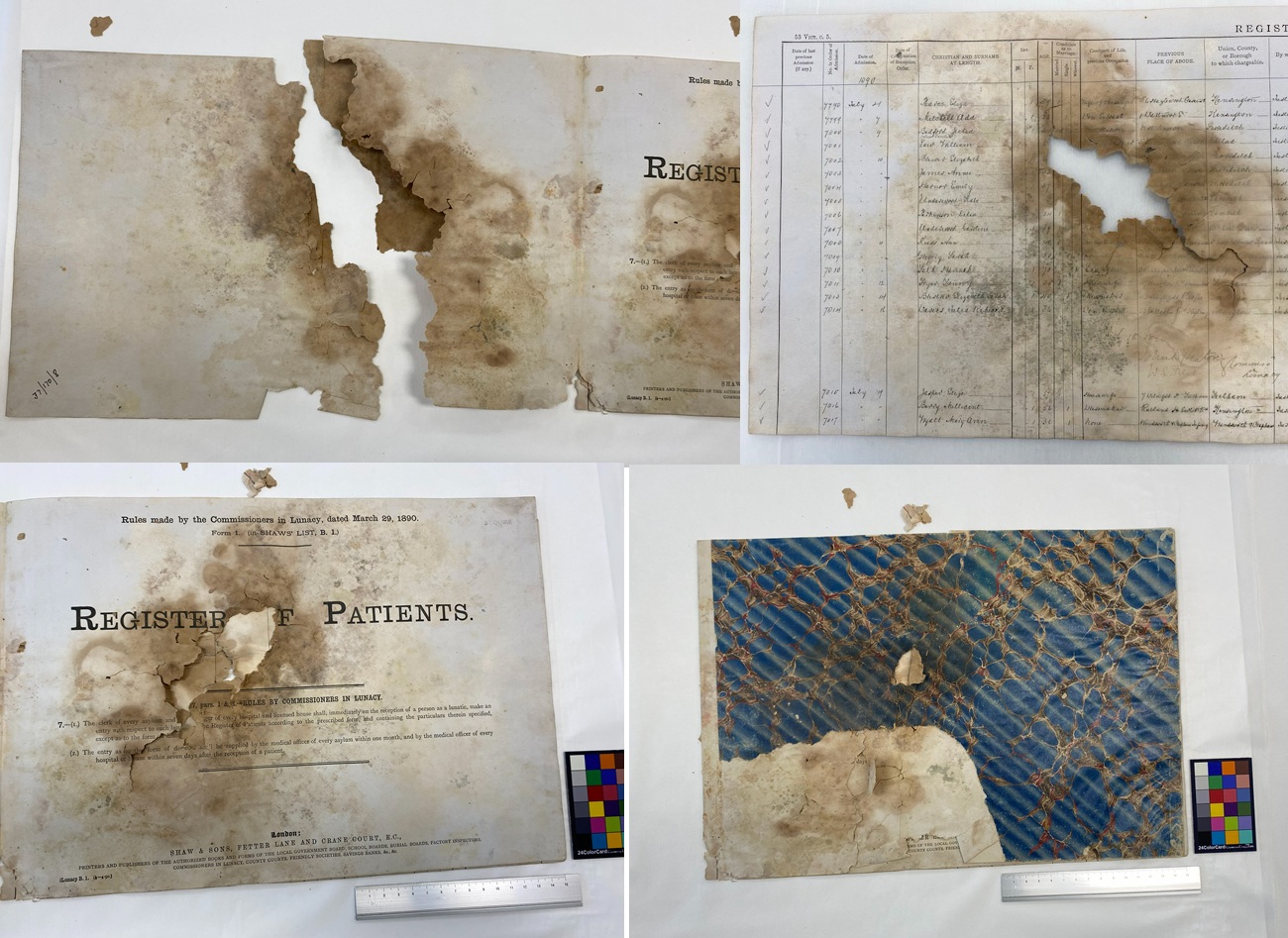
Images: deteriorated pages in the register
So, how do you repair the seemingly unsalvageable?
To begin, I added page numbers to each leaf to make sure the order of the pages was not lost during the conservation work. I then carefully dis-bound the remaining sewing which allowed me to treat each page individually.
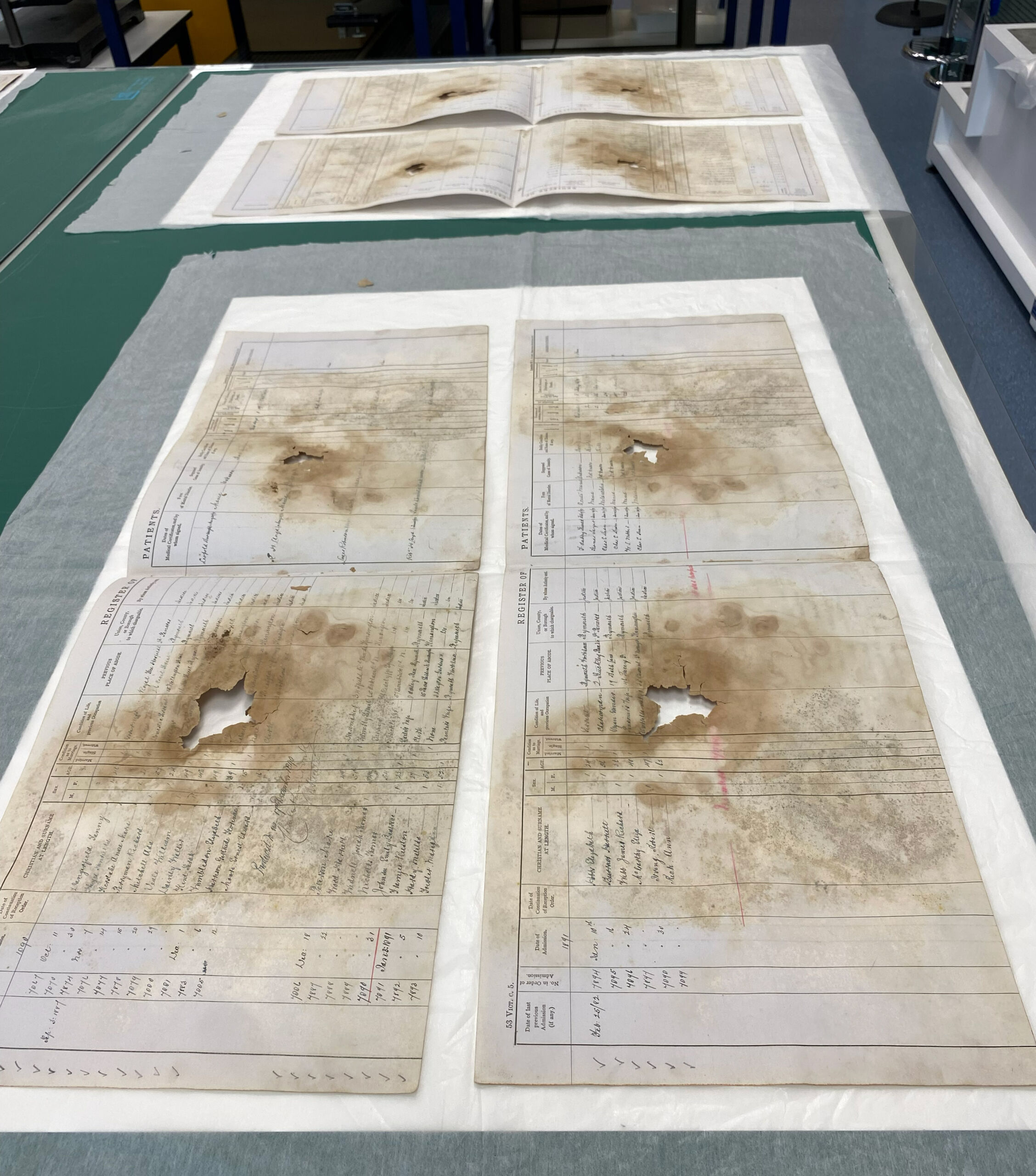
Image: Leaves laid out individually ready for treatment
Mould Cleaning
The first challenge was removing surface dirt and historic inactive mould—likely the result of past water damage. Mould poses a health risk, so I used a specialist vacuum with a HEPA (High Efficiency Particulate Arresting filter) and a soft brush to safely remove inactive mould remnants. Each page was then cleaned with a vulcanised rubber “smoke sponge” to lift general surface dirt, accumulated through years of use.
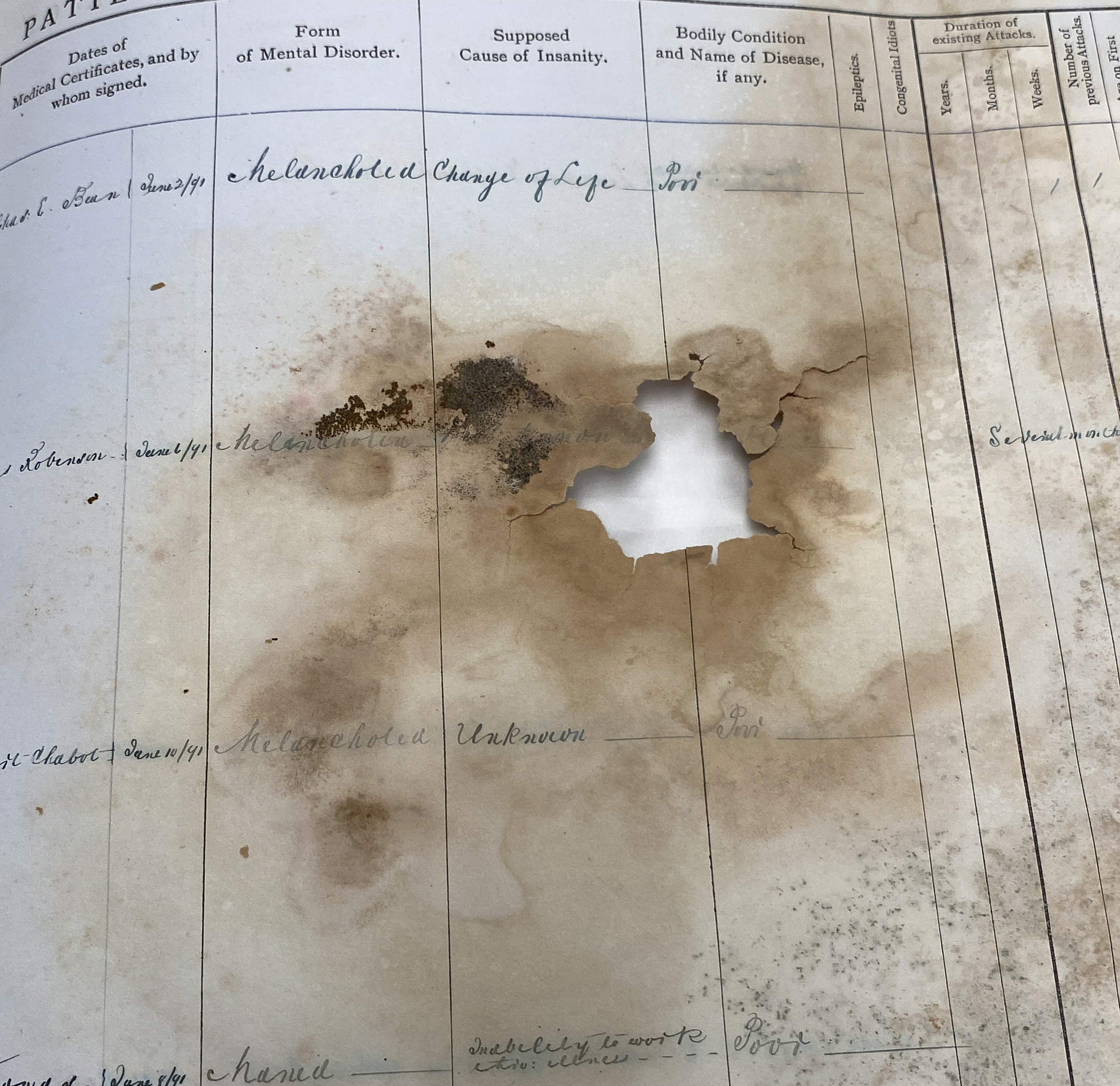
Image: surface dirt deposits
Ink Testing and Washing
Admissions books often contain a variety of inks, penned by multiple staff and many different pens and inks throughout the years. Before wet treatment, it was important to test the ink on each page to ensure it wouldn’t fade or wash away. Any loss of ink would result in information loss. Fortunately, all inks in this volume were stable, allowing me to safely wash each leaf to remove dirt and prepare the paper surface for further treatment.
Two pages at the front were partially stuck together. To clean and repair them properly it was necessary to carefully separate them using light moisture, a spatula and a large amount of patience.

Images: pages stuck together
Once this was done, I was able to safely wash each leaf to help remove dirt and flatten the paper ready for lining with tissue.
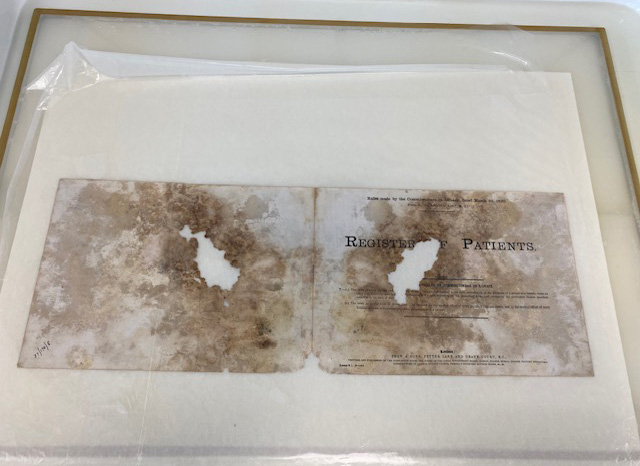
Image: A leaf being washed
Lining for Support
Due to the extent of damage, the paper was too fragile to handle. I used a conservation technique called lining—adhering a thin Japanese tissue (just 5gsm) to each page to provide support. Ideally you would apply a lining on the back or side of the document with the least information so that repairs have the least impact on the information on the paper. However, there are exceptions to this; for example, the admissions register had information on both sides of each page but was so damaged that it was not accessible for handling. The paper had become so weak from the damage that a lining was essential to enable access. Using a thin 5gsm Japanese tissue is nearly invisible so it was a good compromise to minimise obscuring the surface but support the weak paper enough that the register could be handled safely. After lining, each leaf was placed under blotter and weights to dry flat.

Images: lining in progress
Finally, I re-folded and reassembled the pages in their original order to recreate the admissions register.
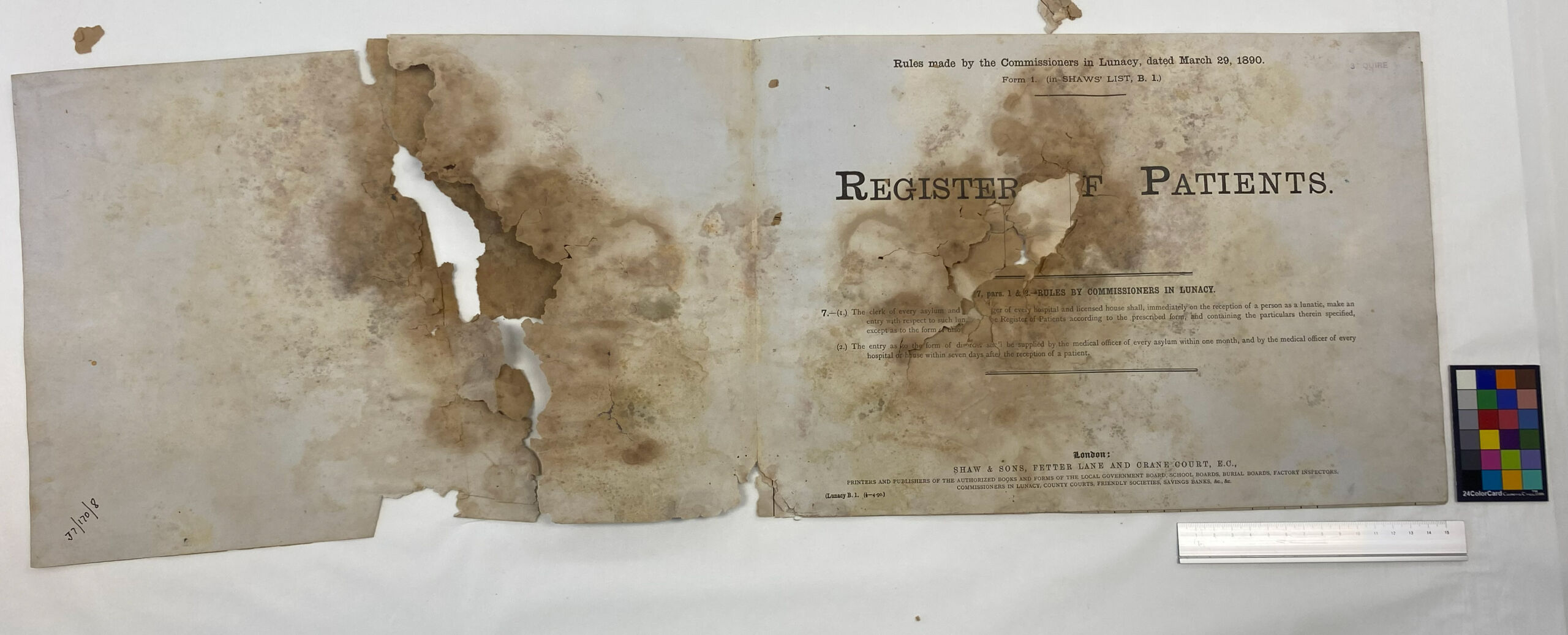
Image: Before treatment
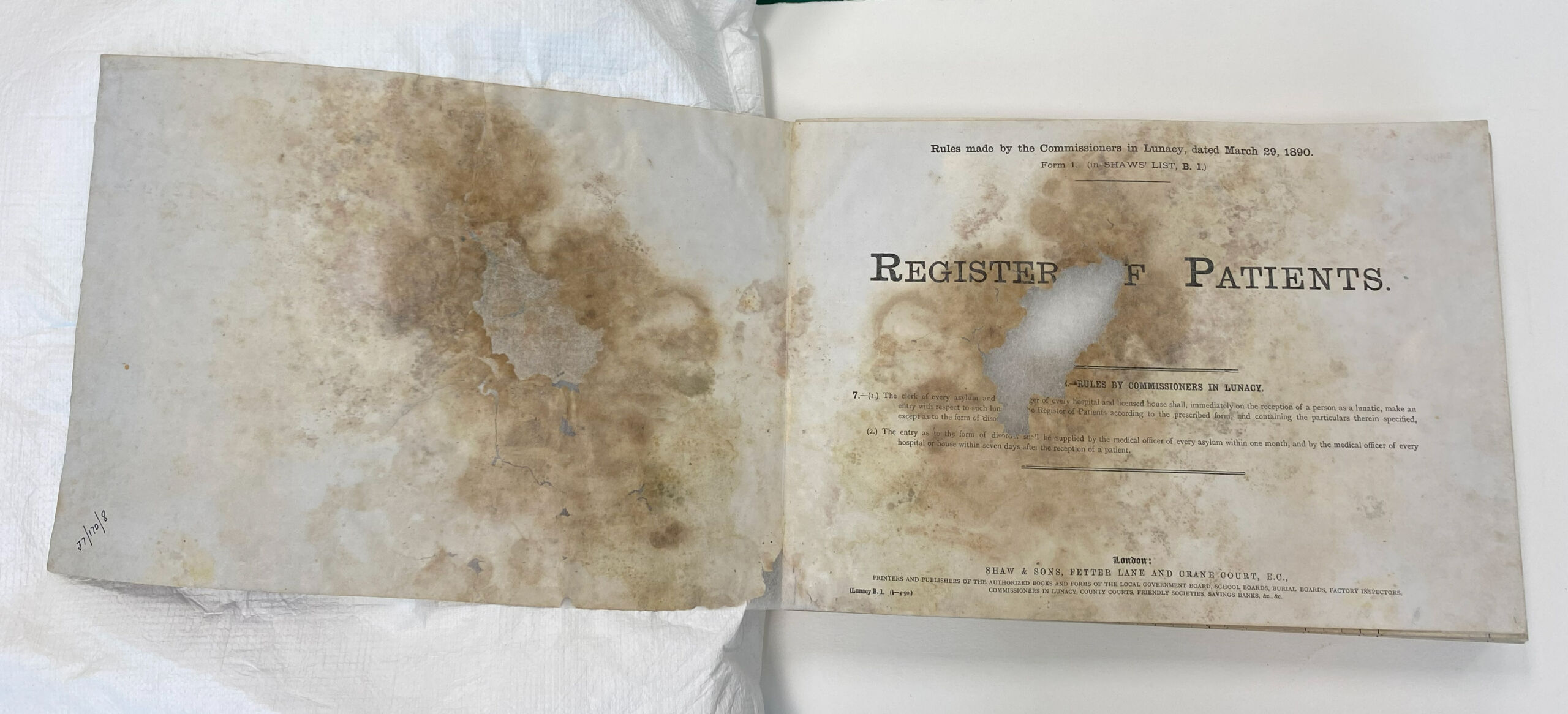
Image: after treatment
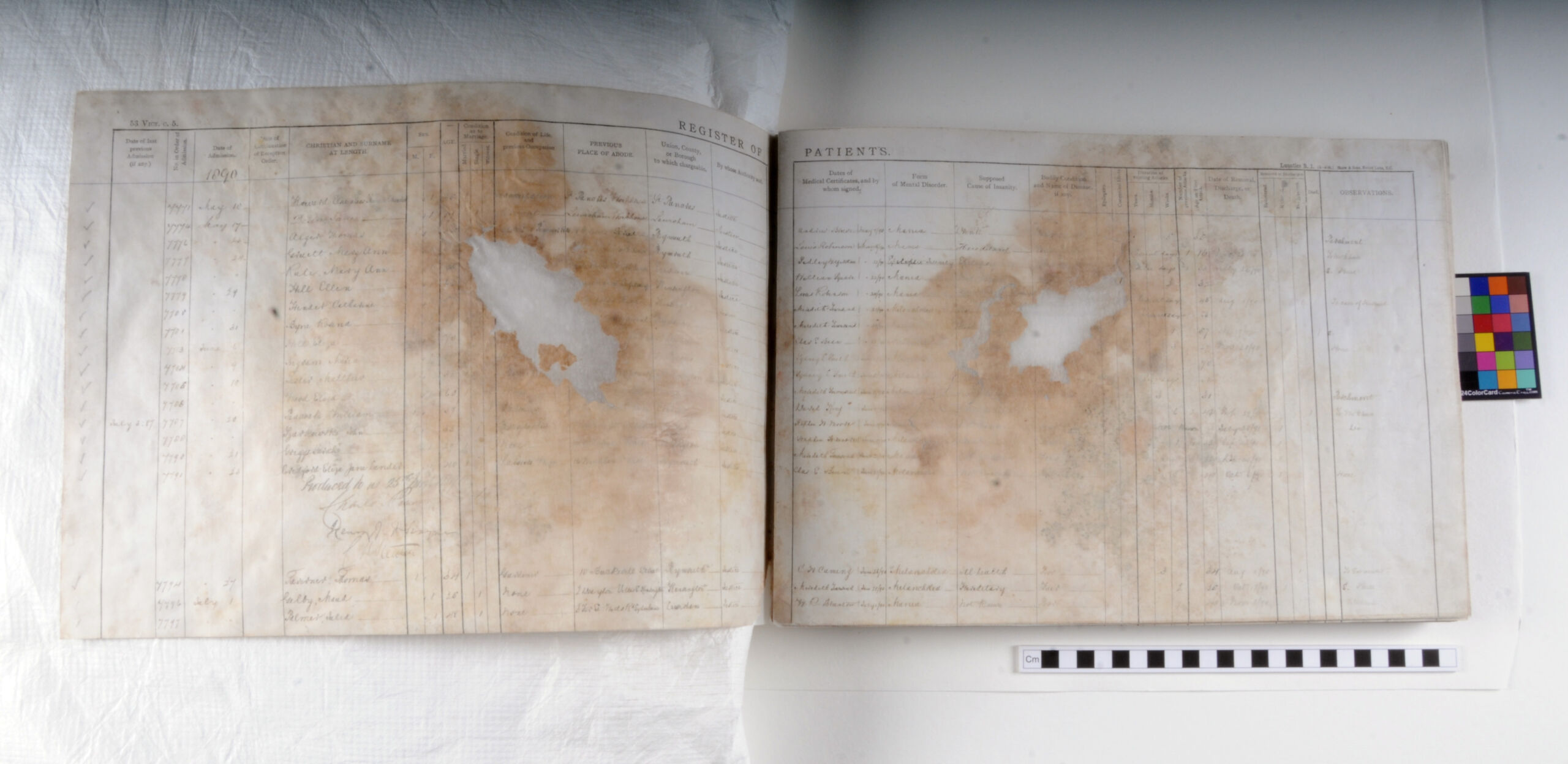
Image: after treatment
A New Chapter for the Register
The entire conservation process took 18 hours—equivalent to around £900 worth of work. While the volume may be re-bound in the future to improve handling, the treatment so far has made it accessible to researchers and readers once again. It now lives safely in a bespoke archival box, protected for future generations.
This register records admissions to the hospital in the early 1890s and gives some detail about the patients, but we are fortunate that the Old Manor collection also includes many volumes of patients’ case notes; the earliest of these date from 1845 and they continue intermittently until c1960 (medical records less than 100 years old are not on general public access due to data protection legislation).
Thanks to conservation, their records—and the history they represent—can continue to be explored. The admission records and case notes of records such as these give us information on the patients’ medical conditions and the treatment that they received at the hospital and offer us a voice, however small, to stories that are so often silent.
Sophie Coles, Archive Conservator and Tom Plant, Archivist
Share this post
About Us
Research Tools
What We Do
Contact us
Wiltshire and Swindon History Centre
Cocklebury Road
Chippenham
SN15 3QN
E: heritageadmin@wiltshire.gov.uk
T: 01249 705500


