

One of the highlights of my year so far was the careful unrolling of a statute roll dating from around 1300 to reveal a contemporary copy of Magna Carta.
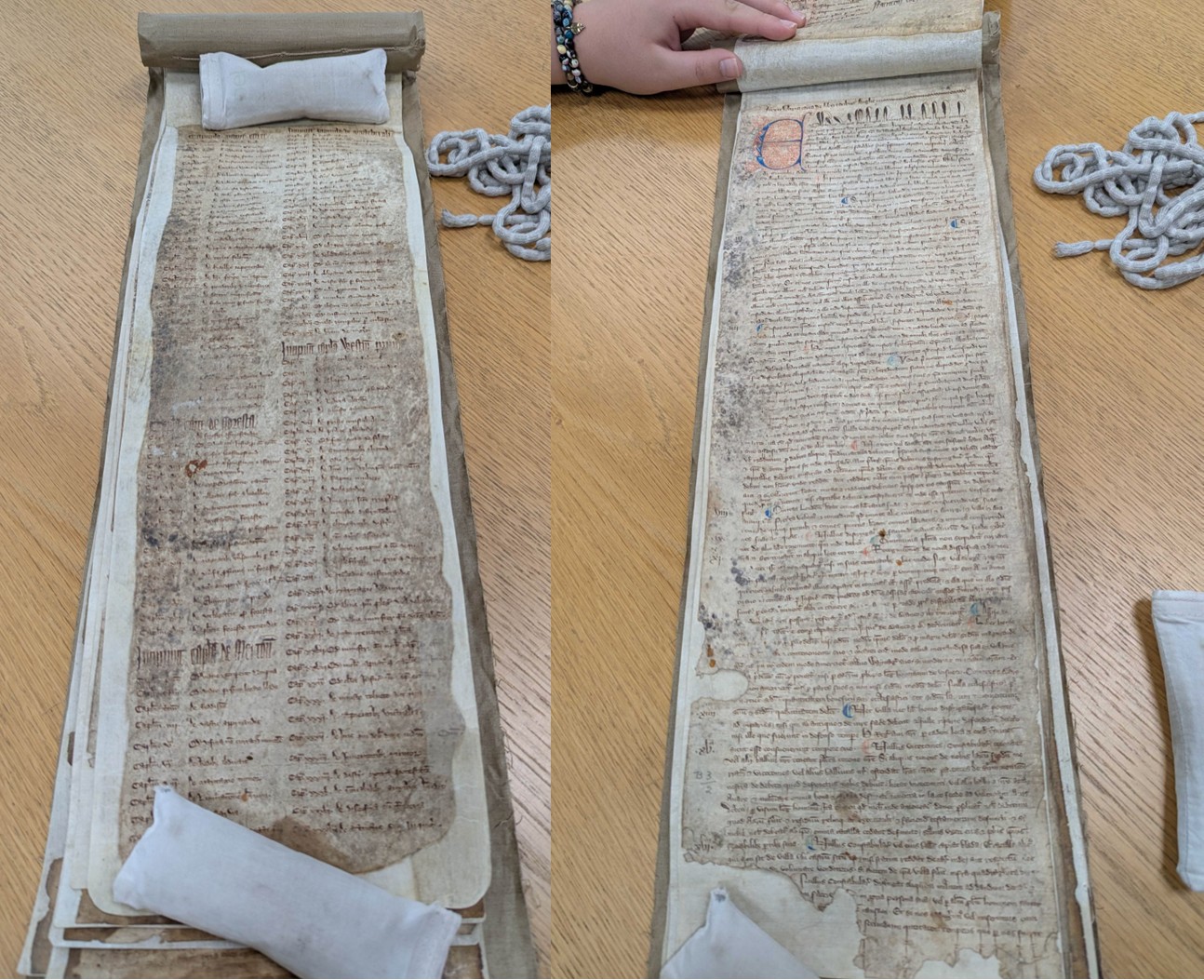
Contents page and Magna Carta in the Savernake statutes roll. (9/32/1)
This was under the watchful gaze of three work experience students, one of whom had decided to see what he could find in our archive catalogue relating to Magna Carta. Now, while I knew we had a range of documents relating to the Great Charter, and have explored some of them, I had never seen the statute roll from the Savernake collection. This was a moment of discovery for us all.

Detail of the copy of Magna Carta in the Savernake roll – the great charter of the liberties of England. The copy was made c1300.
It was also an opportunity to show the students another copy of Magna Carta from around 1300 in the splendid Liber Evidentiarum B – a book of charters and other documents copied out for the Bishops of Salisbury between the late 13th century and 16th century.
I could also have produced the Statute Book of the Borough of Marlborough. Like the Savernake roll it contains a copy of the 1300 Magna Carta plus other nationally important statutes – the Statutes of Merton (1236), Marlborough (1267), Westminster (1275 & 1285) and Gloucester (1278).
This year is an important year in the story of Magna Carta. On 11 February we marked the 800th anniversary of the issuing of what is known as the definitive Magna Carta – the 1225 charter that made its way onto our early statute books and, in a small part, remains in UK law today. It was also the year that a ‘copy’ of Magna Carta was revealed to be an original 1300 charter issued by Edward I. (For more on how the Harvard Magna Carta was authenticated read the university’s blog.)
Why so many charters? Surely King John issued Magna Carta in 1215 – one and done. But John’s charter – it was not then known as Magna Carta – was just the beginning of a process of setting down laws governing both ruler and the ruled. The charter was reissued in 1216, 1217 and 1225 during Henry III’s reign and then confirmed by Edward I in 1297 and 1300.
The 1215 Charter of Runneymede remained in force for a little over two months. At John’s request, on 24 August 1215, Pope Innocent III declared it ‘null and void’ and ‘illegal and unjust’ since John had been forced into agreeing its terms by rebel barons.
The abandonment of the charter left England in a state of turmoil. In 1216 the rebel barons effectively deposed John, inviting Louis, the eldest son of the King of France, to be ruler, although he was never crowned. By late October 1216 John was dead and his son Henry became king, crowned in a hasty coronation at Gloucester. Henry III was just nine years old, so the reins of power were effectively held his regent William Marshall, Earl of Pembroke, and papal legate Guala Bicchieri. A decision was made to issue a new version of the Runneymede charter in a bid to bring the rebel barons back on side. This was done in November 1216. The following May a final battle took place in Lincoln between Louis’ forces and those loyal to Henry III. (Among those fighting for Henry was William Longespee who is buried in Salisbury Cathedral.) The rebel forces were defeated and Louis returned to France.
To reinforce the new peace, a revised charter was issued in November 1217 alongside a new charter regulating the royal forest. It is at this point that we get Magna Carta, the Great Charter, to distinguish it from the Charter of the Forest. Both these charters, as with the 1216 issue, bore the seals of Marshall and Bicchieri and not Henry who was still too young to have his own royal seal.
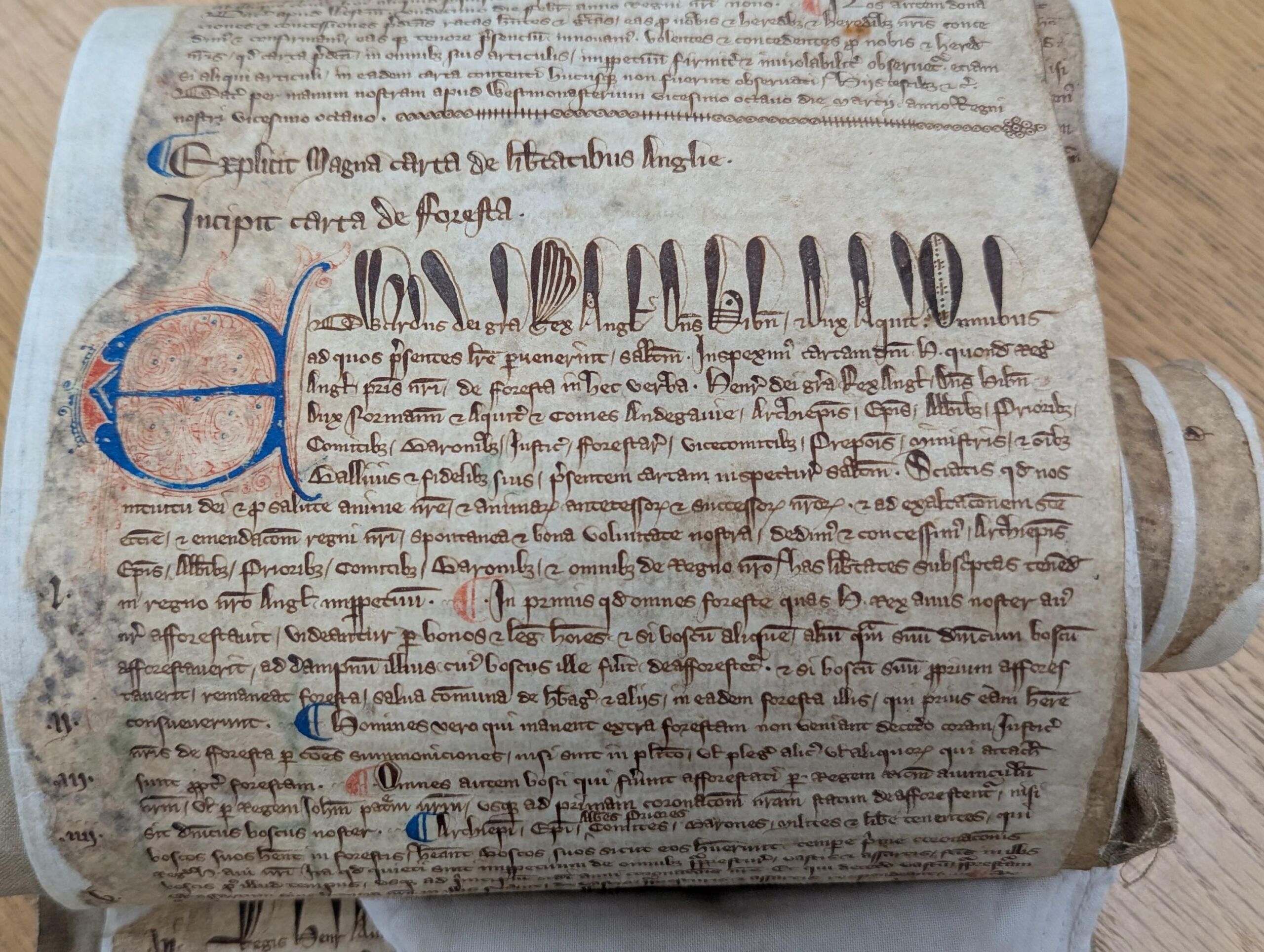
Detail of the beginning of the Charter of the Forest contained in the Savernake roll. Magna Carta and the forest charter from 1225 were confirmed by Edward I in 1300.
And so to 1225. Henry III was 17. He had his own royal seal and importantly he needed to raise money to defend the French territory of Gascony which was under English rule. A new charter was negotiated which included Henry freely making concessions in return for raising a tax. Crucially, the new charter was said to benefit ‘everyone in the kingdom’, not just the free.

Liber Evidentiarum B. This book with its wooden cover contains copies of statutes, including a copy of the 1225 Magna Carta. (D1/1/2)
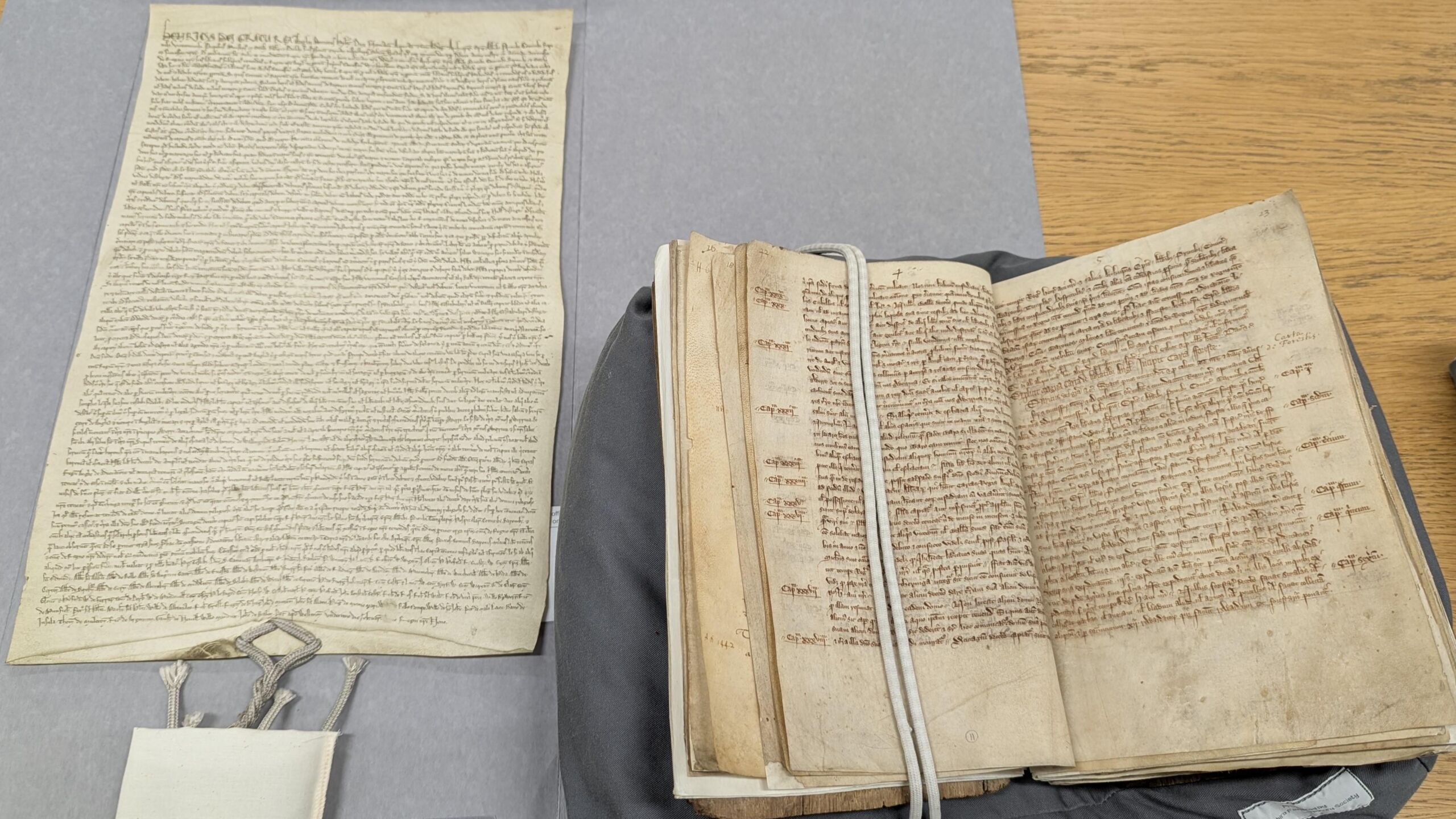
The Liber B copy of Magna Carta (D1/1/2) alongside the facsimile of the Lacock 1225 Magna Carta. (2664/3/1M/37PC)
It is this 1225 charter that becomes the definitive Magna Carta. Professor David Carpenter, who has researched and written extensively on Magna Carta, says the 1225 version ‘was easily the most copied’ by religious houses, knights and lawyers among others. And it is this version that Henry’s son Edward I confirms in 1297 and 1300, and copies of which appear in the Savernake roll, the Marlborough statute book and Liber B.
What of original issues of Magna Carta. Salisbury Cathedral holds one of four 1215 charters. One is in Lincoln and two are in the British Library. The British Library also holds Wiltshire’s 1225 Magna Carta which was gifted to the nation in 1944 by Matilda Talbot, owner of Lacock Abbey. Ela of Salisbury, who founded the abbey in 1232, had been Sheriff of Wiltshire following the death of her husband William Longespee, hence Magna Carta ending up at Lacock.
You can see a facsimile of the Lacock Magna Carta at the History Centre which acquired the Lacock archive in 2013. The Lacock collection also includes correspondence that shows Matilda Talbot had been approached to sell the charter to a private owner or dealer but was persuaded to gift it to the nation. The fear had been the charter would be sold abroad. In the event, the Lacock Magna Carta did travel to abroad, to the USA, where it went on display in the Library of Congress in 1946. An Act of Parliament was needed to allow the two-year loan.
Ruth Butler, Heritage Education & Digital Engagement
Share this post
About Us
Research Tools
What We Do
Contact us
Wiltshire and Swindon History Centre
Cocklebury Road
Chippenham
SN15 3QN
E: heritageadmin@wiltshire.gov.uk
T: 01249 705500


