

Off the back of our successful conference on South Wilts buildings held at Sarum College we have been able to advance our knowledge about some of the buildings visited. One of those was the Hall of John Halle in New Canal, Salisbury, better known as the Odeon Cinema.

Everyone is familiar with the black and white gabled front of 1880 by architect Frederick Bath, and the magnificent arch-braced and cusped 6-bay hall soaring overhead, now a lobby to the multi-screen complex beyond, which contains improvements by Pugin and Fisher made in 1834. The VAG had generously granted WBR the sum of £3,500 specifically for dendrochronology work to date key buildings to be visited by the conference. It was during sampling for dendro of the timbers on the gallery above the entry doors by Robert Howard, that a rare discovery was made. In the gloom a paint scheme on the first floor timbers was detected by Robert’s sharp eyes under the layers of staining.
Andrea Kirkham, a specialist conservator of wall paintings and polychrome decoration who happened to be a delegate on the conference was given special access to examine the scheme. She said that underneath the varnish and stains are the remains of a good arabesque scheme which undoubtedly continued across infill panels and timbers. Andrea likened the sinuous forms to designs by two well-known C16th designers of the period Jacques Androuet du Cerceau and Flőtner (designs below).
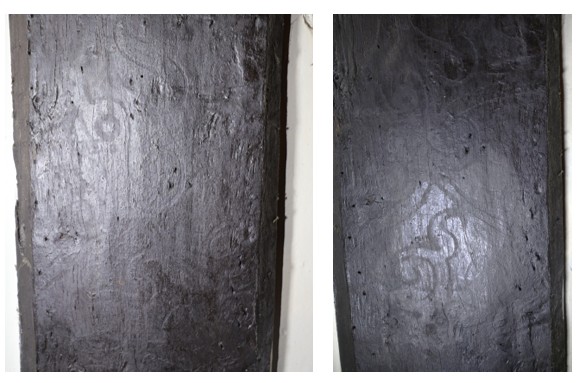

Reference source: Library of Ornament: Arabesques (copyright free), pub L’Aventurine, Paris 2000. Left: Page 127, du cerceau. Right: p88, Flotner
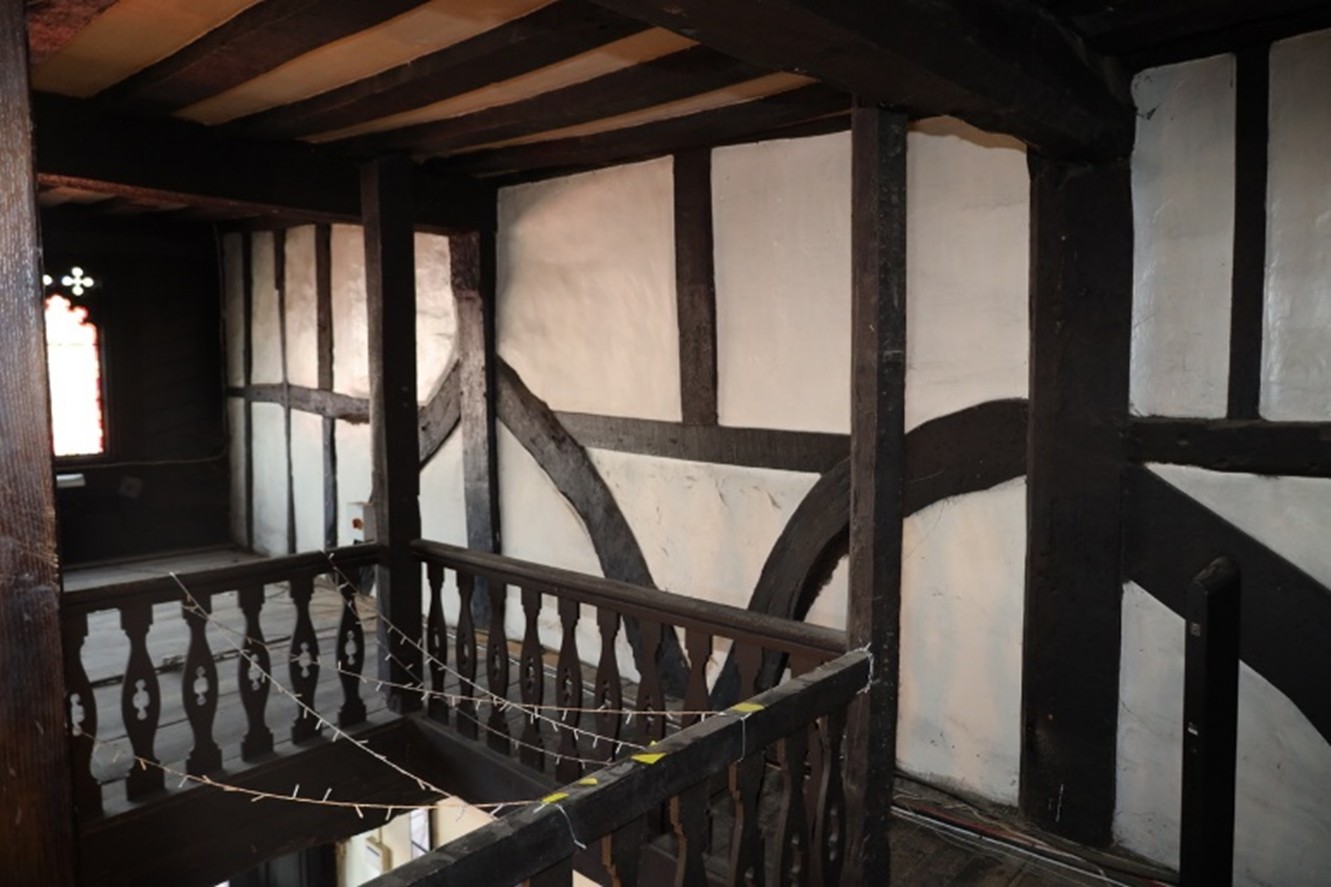
Photos: Andrea Kirkham 2025
This type of scheme is found in other urban contexts in the late C16th and early C17th. It is an important survival for Wiltshire where decorative painting is relatively rare compared to Suffolk and Essex. It is possible that further painting might be revealed under the layers of the infill panels. Because the gallery is not an area in current use, it has been left relatively untouched.
Amongst all this excitement, the date of this section at the front of the Odeon was determined as 1459. An extensive study of Salisbury made in 1980 by the Royal Commission on Historical Monuments determined that this was a merchant’s house of the 16th century, but it seems that this house was raised soon after John Halle purchased the site in 1455. The painted scheme must have been added at least 100 years later.
Dorothy Treasure
Wiltshire Buildings Record
Share this post
About Us
Research Tools
What We Do
Contact us
Wiltshire and Swindon History Centre
Cocklebury Road
Chippenham
SN15 3QN
E: heritageadmin@wiltshire.gov.uk
T: 01249 705500


