

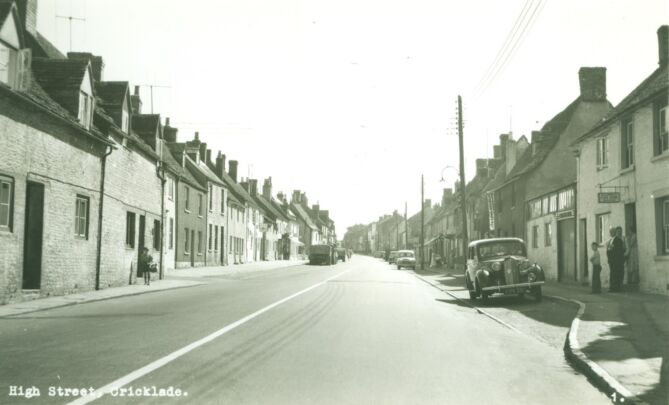
A horrifying and emotional end for the highwayman of Cricklade
When I think of crime in the eighteenth century, highway robbery immediately comes into my mind. The legend of Dick Turpin and Black Bess [...]
Australia’s Birth: The Founding Mothers
We often get an influx of our antipodean cousins in the early summer here at the history centre. Many of our internet and postal research requests hail from Australia and New Zealand. Do you ever wonder if your ancestors ever left Blighty for sunnier climes or were forced to leave these shores as punishment?
The transportation of prisoners to Australia rose to a climax during the late 18th century after a statute was passed during the reign of King George III. The standard sentence for transportation was for seven years but in more serious cases for life. Many escaped the gallows and suffered the inhumane conditions on board the prison ships. Not unlike those poor slaves that also had to endure months at sea in cramped and unsanitary ship hulks.
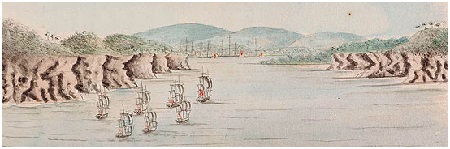
The first wave of the colonisation of Australia aptly named the ‘First Fleet’, took place in 1788. The 11 ships containing around 1500 men, women and children left Portsmouth in 1787 also laden with food supplies, clothing and livestock. The people on board were to be the founding fathers and mothers of the new colony, albeit a penal one.
The colony was established at a location now known as Port Jackson, further inland in Sydney Harbour than originally planned. Transported convicts were shipped in, in their thousands. The transportation of prisoners was abolished in 1868; by then a staggering 162,000 men and women had arrived on 806 ships.
Whilst exploring the archives at the History Centre on the subject of transportation, I discovered that we held some ‘Bonds and Contracts for the transportation of felons to the American colonies and plantations and elsewhere 1728-1789.’ Within these documents there are names of the Ships’ captains and felons; very useful information for those researching their convict ancestors.
I picked up the trail of a convicted thief, Sarah Varriner, in 1788. She was originally from Painswick, Gloucestershire but arrested, tried and sentenced in Wiltshire for the theft of gold and silver coins. The calendar of prisoners (shown below), lists her offence and committal in 1788.
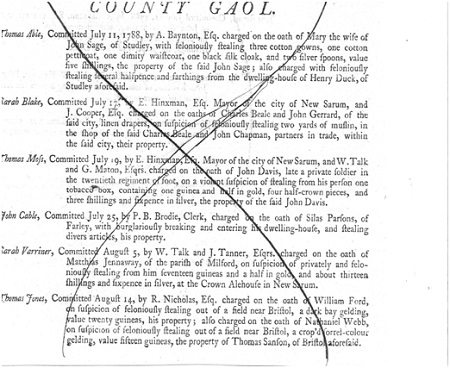
Sarah Varriner was sentenced to 7 years transportation to the ‘Eastern Coast of New South Wales or some one or other of the islands adjacent’. She was bound for the ship ‘The Lady Juliana’ which was to be the first all female convict ship to leave for the new colony in Australia.
Mary Jane Oland – from Shepherd’s Daughter to Career Criminal
I don’t think that I’m alone with my interest in historical crime and punishment. I was interested in seeing if I could piece together a criminal history of someone picked completely at random. With this in mind, I looked through one our archives from the Wiltshire Constabulary, a ‘Divisional Criminal Photographic Album, with particulars of crime and personal details. 1900-1916’. the date range I chose ensured that I didn’t breach the 100 year closed file rule; this allows anonymity which in this case is quite a sensitive subject.
I decided to choose a female prisoner, Mary Jane Oland, born on the 1st May 1870 in Kempsford, Gloucestershire- just over the county border. Mary was the daughter of a shepherd and his wife, Thomas and Harriet Oland. It appears that she was of average education; as well as can be expected for a labourers’ child, she would have definitely attended the local village school.
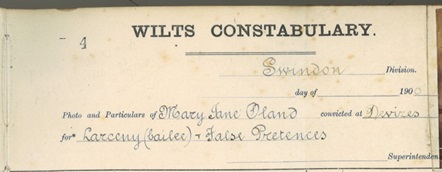
It is unclear why, Mary, turned to the life of crime, but it appears to have stemmed from a mental health issue. A taboo subject, especially during this period. Marys’ first conviction was on the 28th June 1883 at the age of 14, shockingly, she was bound over by Swindon Magistrates for an attempted suicide. To investigate this devastating start to Mary’s downward spiral, I looked at the Swindon Advertiser- newspaper reports often give a lot more detail than a criminal register or calendar of prisoners. On Saturday 30th June 1883, it was reported that Mary had cut her own throat in an attempt to avoid returning to service near Bath. She had stated that she had been cruelly treated by her employer Mr C Williams, a farmer. Prior to the incident, Mary had appeared to have gone AWOL with another young employee, a boy, whom she had taken to Bristol and Box over a period of about four days. Was this just an attempt to run away? There was no criminal intent by poor Mary; it was so obvious that she was unhappy.
The following year, Mary was accused of stealing items of clothing in both Swindon and Marlborough, these offences were swiftly followed by two offences of burglary.
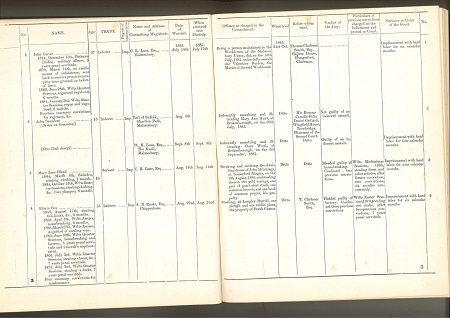
By the age of 16, Mary was breaking into dwelling houses and stealing jewellery. Her previous convictions of theft had seen her do hard labour, in those days this would have meant supervised physical work outside the prison walls. This new conviction gave her a custodial sentence with which hard labour was included. Mary was incarcerated in Devizes Bridewell Prison, where there was a large, multi-person treadmill installed. This treadmill was driven by the prisoners for long sessions and the wardens could tighten the screws to make the treadmill harder to turn. Hence prison wardens being dubbed ‘screws’.
About Us
Research Tools
What We Do
Contact us
Wiltshire and Swindon History Centre
Cocklebury Road
Chippenham
SN15 3QN
E: cmas@wiltshire.gov.uk
T: 01249 705500
For all conservation enquiries including quotations and object deliveries, please book an appointment in advance.


