


The Conservation Team Visit Salisbury Museums
Conservators from the Conservation and Museum Advisory Service at the Wiltshire and Swindon History Centre have been out and about visiting museums in Salisbury. Our time visiting local museums is used primarily to provide advice and guidance on specialist aspects of caring for a museum collection. Often this involves walking a fine line, balancing the need for conservation and long term preservation of a collection with the very important need for a museum to display and allow access to its collection. For the conservation of many objects the ideal storage location would be a cold, dark, sealed box. However this is obviously impractical, not only for any museum to achieve, but is contradictory to the reason for preserving collections: allowing people to see and access items for a long time to come. Collection care is therefore a balance of risks, between what is best for the collection item and how the item can best serve the needs of the museum.
Arundells, the former home of Sir Edward Heath KG MBE, Prime Minister and Statesman, houses a diverse collection. The museum maintains Sir Edward’s home as it was at the time of his death and so collection items such as a grand piano, fabulous art works and gifts from his state visits sit side by side with yachting photographs, satirical cartoons and even a very 70’s disco shirt!
The collection item most memorable from our visit was the hand-painted silk wallpaper which lines the visitors’ route up the staircase to the first floor. The wallpaper, a gift to Sir Edward from his staff, was installed in the house in the 1980’s.
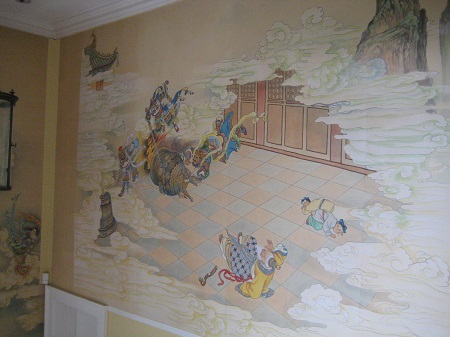
Keeping the location of the wallpaper at Arundells is crucial as it was purposefully created for the location chosen by Sir Heath himself. To remove the wallpaper and hide it away in dark, cold storage would irretrievably reduce its historical value. So the question is how best to preserve the wallpaper on permanent and open display in the museum?

Historic houses often have collection items (otherwise known as fixtures and fittings), such as wallpapers, curtains, carpets and furniture which are required to be maintained in their normal settings. Curtains can best be understood as curtains if they continue to frame a window and wallpaper is best understood if it remains lining a wall. Contrary to our conservation ‘dark box’ a controlled environment is particularly difficult to maintain for fixtures and fittings on permanent display in their original locations. Particular threats to these collections are high light levels from windows and internal lighting, warm conditions from internal heating and pests.

Heritage Open Days – exploring hidden heritage at Chippenham Museum and beyond!
One of the main motivators for me wanting to work in museums was to satisfy my curiosity. What’s beyond that rope or behind that locked door? How are the collections looked after when they aren’t on display? What’s going on going on behind the scenes? Basically I’m just really nosy!

One of the best bits of my job is getting to visit museums across Wiltshire and find out about all the exciting developments that are going on.
Last week I managed to get a peek behind one of those locked doors at Chippenham Museum where they are creating a new exhibition space to hold a programme of changing temporary exhibitions. The project is funded by the Arts Council England through the South West Museum Development Programme and work is being carried out to upgrade the space to meet national security standards. Once this has been completed they will have a fabulous, flexible space that will be able to hold bigger and better exhibitions. Crucially it will enable the Museum to borrow objects from the Nationals, such as the British Museum and the V&A, for the first time, meaning that important collections that tell the story of town can be brought back to Chippenham.


The new gallery’s inaugural exhibition ‘Creative Chippenham’ will open on 20th November 2017 and continue into March 2018. This will be a ‘celebration of local creativity’, showcasing the talents of artists and craftspeople that have lived in and around Chippenham, including Howards Hodgkin and Robin Tanner. Many of items have been acquired for the Museum by the Heritage Lottery Funded ‘Creative Wiltshire’ project.
Plans for 2018 also include an exploration of Chippenham’s Georgian history, with a ‘Little Bath’ exhibition featuring loans from other museums.


Chippenham Museum will be offering the opportunity to see behind the scenes to everyone. On Saturday 9th September, staff there are giving free tours around parts of the building that are not normally open to the public – this includes the collection stores to find out how the collections are cared for and to see items not normally on display. More information and booking can be found here.

Bridport Museum Redevelopment: A Taxidermy Tiger and More
The conservation team have been very busy over the last year as part of the collection consultant team, led by Tim Burge Museum Services (www.timburge.org), helping Bridport Museum with their big redevelopment. We saw the fruits of the Bridport staff, many volunteers, contractors and specialist’s labour at the grand opening on the 26th of May.
The project, mostly funded by the Heritage Lottery Fund, brought the collection consultant team on board at an early stage to help and provide advice at every part of the process. Our work at the museum started just under a year ago, when we were on-site to assist with the safe removal and return to storage of all the objects on-display, before the builders moved in to improve and develop the building.
In the background work continued in many areas, with the collection consultant team advising on environmental controls required within the museum, to the materials which are safe to use in the display cases and mounts, many of which were bespoke made to fit individual objects.
Some of the objects from the collection required conservation treatment to look their best before they were ready to take the lime light on display in the new museum. We provided training so the large and dedicated group of Bridport Museum volunteers could undertake the majority of the cleaning required.

Some objects, though, required a more practised hand or treatments such as stabilisation for which we undertook conservation treatment both at the lab in the Wiltshire and Swindon History Centre and on site at Bridport Museum. This included a wide variety of objects, from a taxidermy tiger, to prehistoric fossils and copper alloy buckles from a set of Lorica (Roman armour).
About Us
Research Tools
What We Do
Contact us
Wiltshire and Swindon History Centre
Cocklebury Road
Chippenham
SN15 3QN
E: cmas@wiltshire.gov.uk
T: 01249 705500
For all conservation enquiries including quotations and object deliveries, please book an appointment in advance.


