

The Fabric of Life
Sometimes here at the Wiltshire and Swindon History Centre, a researcher turns up with an enquiry that really captures your imagination. This happened to me last year when Cathy Fitzgerald arrived to research material for Moving Pictures, a BBC Radio 4 production inviting you to discover new details in old masterpieces:- http://www.bbc.co.uk/programmes/w3cswf9g
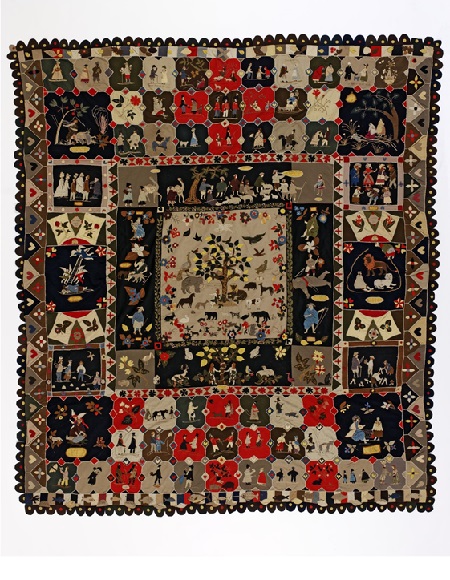
This link will allow you to listen to the programme produced and review the image of this wonderful coverlet that the V & A hold in their textile collections.
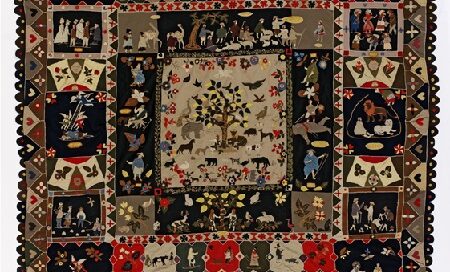
The coverlet was acquired from Kerry Taylor Auctions with the support of the Contributing and Life Members of the Friends of the V & A and was made in Wiltshire in 1820 by a lady called Ann West.
Kerry Taylor of Kerry Taylor Auctions, specialists in textiles, describes the moment of arrival when a gentleman delivered it covered and wrapped in a large flannelette sheet, which when unpacked revealed this large 2.5m square bed cover; a real ‘tour de force’, colourful, vibrant and packed with pictorial images that draw you in and begin to tell a story.
It is wool appliqué and patchwork, with embroidery worked into the surface and is a valuable primary source in a pictorial sense giving a snapshot of life in Wiltshire around 1820, focusing on the everyday and depicting various trades, professions and social events that were part of day to day life.
The images and especially the centre panel depict biblical references, such as the Garden of Eden, David and Goliath and Moses being hidden in the bulrushes. The outer images give a taste of rural Wiltshire life, so have a closer look to see what you can find.
The reason for Cathy’s visit to the history centre was to research Ann West herself. There is a possibility that she may have come from Chippenham as a Milliner’s and Drapers is listed in Pigot’s Directory of 1830 and 1842 in the name of Ann West, but this connection cannot be confirmed. There is also a possibility that she came from the Warminster area, but again, nothing has yet been confirmed. However, the cloth she chose to use is absolutely typical of West of England textiles and lends itself perfectly to this type of appliqué work.
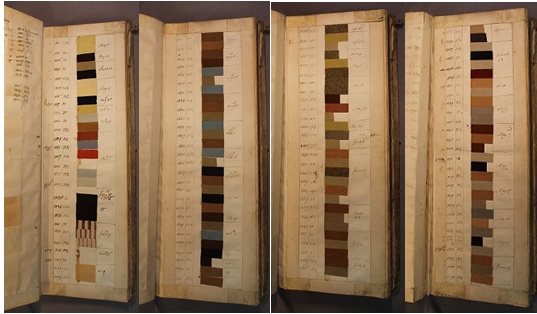
We hold some good examples of cloth pattern books from the Collier family and Crosby and White of Bitham Mill, Westbury, and these show exactly the types of fabric used in the coverlet; strong woollen cloths, typical of the West of England and produced in a wide selection of colours. These would have been dyed with natural materials as chemical dyestuffs were not in use until synthetic dyes were developed in the mid-19th century, specifically William Perkin’s mauveine in 1856. The coverlet is also hand sewn; sewing machines c1820 were still in the early stages of development and not generally in domestic use until mid-19th century. You can begin to imagine the time it would have taken to produce such a piece.
What can the quilt tell us about life at this time in Wiltshire?
Hob-Nob and the Salisbury Giant
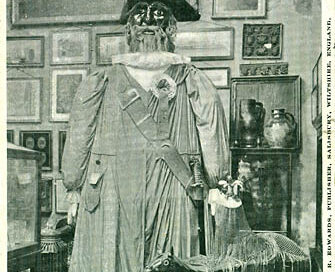
Now in The Salisbury Museum, the Salisbury Giant and Hob-Nob were first mentioned in 1570 and 1572 respectively, in records from the Salisbury Guild of Tailors but it is probable he existed by the 1400s. Originally used by the Salisbury Guild of Tailors on the eve of the feast of St John (Midsummer’s Day), they have been a part of processions and festivals in Salisbury, originally to mark the eve of St John the Baptist’s Day (June 23rd) and the eve of the feast of St Osmund’s translation (July 15th), but later to be paraded for special occasions, such as royal weddings and jubilees.
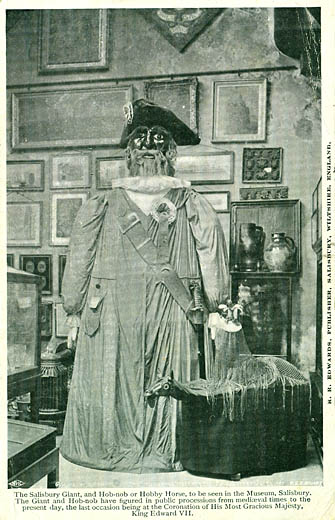
The Salisbury Giant is a tall (now 12ft) figure made from a wooden frame; the oldest part of which is the head. Hob-Nob’s purpose in celebrations and parades was to clear the way for the Giant – he is smaller, and horse-like, with jaws fitted with hob-nails to snap at members of the crowd if they were in the way. In the nineteenth and twentieth centuries there were reports of the hobby horse chasing people and ripping their clothes with his teeth as a result of people throwing things at him. The Giant and Hob-Nob could each be supported by one man holding the frame. This resulted in the Salisbury Giant having a very life-like sway and movement.
The physical appearance of the Giant has changed frequently since the sixteenth century. Most depictions of him in the nineteenth century show a tricorn hat and tobacco pope, but in the twentieth century he was garbed in fifteenth century style robes. One of the biggest changes to his appearance was also in the twentieth century, when his face was painted over with shellac to preserve it, but had the side effect of making him look as if he was from African descent. A restoration later on discovered around 6 layers of pink-ish paint underneath.
Some say that the Salisbury Giant represents St Christopher, the biblical giant, and that he was detached of his religious significance during the Reformation and the Puritan era. However, it has also been pointed out that other than his bearing, the Salisbury giant has no other similarities to the saint.
Sally in the Wood
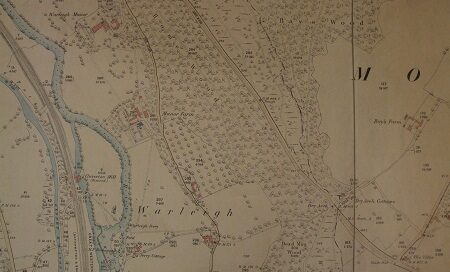
An intriguing enquiry regarding the origins of the road ‘Sally in the Wood’, which can be found just over the border in the parish of [...]
About Us
Research Tools
What We Do
Contact us
Wiltshire and Swindon History Centre
Cocklebury Road
Chippenham
SN15 3QN
E: cmas@wiltshire.gov.uk
T: 01249 705500
For all conservation enquiries including quotations and object deliveries, please book an appointment in advance.


