

I think archivists by their nature get a little bit obsessed with what may seem small, irrelevant or geeky to others, and I am no exception. When I joined the History Centre in 2022, one of my aims was to try and sort out some of the cataloguing that had not stood the test of time or technology, not through lack of suitable cataloguing, but through needing to use our building, our collections and our databases in a different way. There are no possible fun images for what I am going to be talking about in this blog, so here is a photo of me thoroughly enjoying our parish council collection guidance webpage.
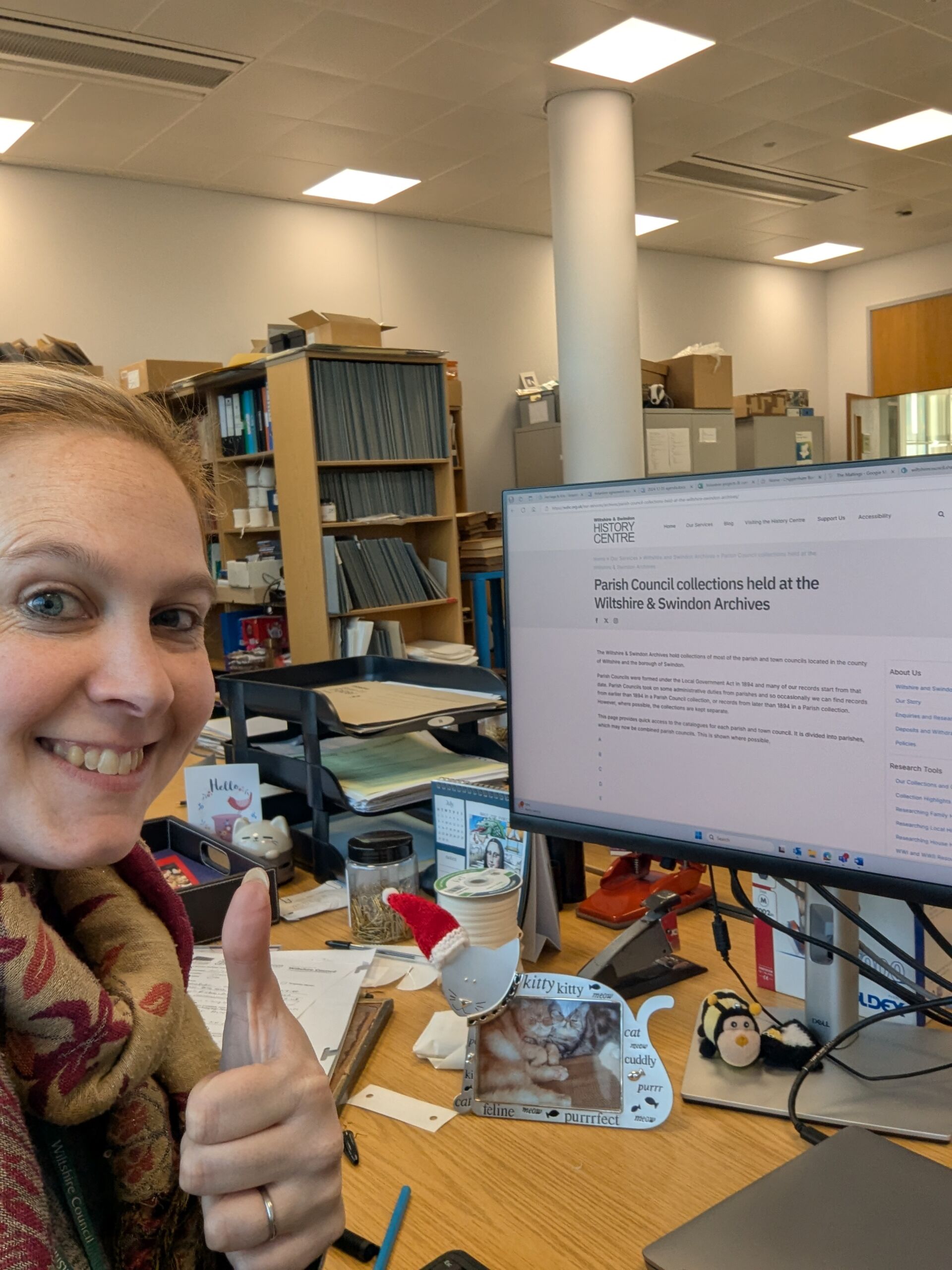
I decided to start, as anyone should, with the parish councils. So, what was wrong (or, less negatively, not quite right) with those?
When we first started taking records in, in 1947, we gave each accession (new deposit) a number, starting with 1, and we filled the records in the strongrooms from 1 to the current number. When our production team went to fetch a record, they would know exactly where it would be by knowing its number (roughly speaking). This worked very well until we reached approximately 4400 and ran out of expansion space in the strongrooms. There was plenty of space, but not where it needed to be. So we had to start being a bit more creative with our numbering system, and this tended to take the form of finding space in the strongrooms that fitted with the amount of material we wanted to add in, and giving it the accruing accession number but with an A following. An example of this is when there was some space, presumably due to re-boxing or appraising, as part of number 1409, and we then added items to that shelf space with the numbers 1409A, 1409B and so on. That worked very well until we were presented with collections that didn’t even fit in those gaps, so we created a location system.
Now I hear you say, what’s that got to do with parish councils?
Well, the problem was, we didn’t tend to attempt to add new deposits from organisations like parish councils into their original number. This meant that often, a parish council’s first deposit would be say in the 1950s with one number, the second in the 1970s with another, and so on. Even worse, we then started using A/B etc references for some. The worst example is Wroughton Parish Council, which has five separate accession numbers (and therefore five separate collection numbers): 716 (the original deposit), 3705, 3895, 3195A, and 3696A. This is the same for numerous other deposits as well – basically any society or organisation that is ongoing and continues to transfer the records to us. Now that we have a location system, we can give the new accessions any number we like, so for a parish council we are now using the original deposit’s reference number and then adding a number to the end to show that it’s an additional deposit to that number. There is no longer confusion about where it should be, because it can be anywhere in the strongrooms as long as we have noted the exact shelf.
I still hear you wonder why that’s a problem?
Firstly, despite the cross referencing and card indexing painstakingly done by archivists before the introduction of electronic databases, there is always an element of human error, either in forgetting to cross reference, or customers or staff forgetting to see if anything else is kept for the organisation. And parish councils were a particular headache, because the catalogues were not printed and filed next to each other; staff and customers had to wade through the indexes to find the relevant catalogues, of which there could be many (see Wroughton above).
Secondly, and more importantly, the electronic database and front-end version for customers to see simply cannot cope with the concept of one collection having multiple different reference numbers. It is not clever enough to know that Wroughton Parish Council 716 is technically the same collection as Wroughton Parish Council 3705. So, when searching the database, often whole collections were missed because someone would find a collection, assume that was it, and not notice the rest.
Another issue was with accruing deposits where the same number HAD been used. The new item would often be added to the end of the collection with the next running number, which meant the database was confusing to look at and work out, because you might end up (for example) with three minute books dating between 1894 and 1956, then an account book 1894-1920, then a few other things, then another minute book. We need a system where all minute books for each parish council had their own series, which would be much easier to add to in future.
So, what did we do about it?
The first thing we did was to allocate a number to each “series” of any potential parish council collection, so that all minutes, accounts, etc, had a place in each collection, whenever they came in and wherever they filled gaps. This means that when customers look at the front-end catalogue, they would see all the minutes, then all the accounts, and so on, and not worry about missing any in a sea of potentially hundreds of separate records.
The second thing to do was to ensure that each separate parish council had its own unique reference number, something that could not be confused with any other reference number in the whole database. We call that the sorting reference number – a unique number that the database can use to work out what belongs to what, which the customer does not need to see. Where possible, we linked that to the relevant parish’s unique reference numbers, which do sometimes appear on the front-end catalogue when they shouldn’t, but are a way of the database sorting the items. Wroughton Parish Council has a reference number PC356, because the parish reference number is PR356. This is the spreadsheet we used:

Having allocated all these reference numbers, we could then go through the different collections and ensure that all items belonging, for example, to any of the five Wroughton collections, all had the same reference number. This means that when staff are searching for the collection on the database, or when customers are searching on the front-end catalogue, everything for each parish council is together in one hierarchy. The ease for both staff and customer use is huge. For example:
A customer wants to know what the covering dates are of the minutes held by X Parish Council. Instead of making sure we remember to check every single collection, staff can simply type in the PC number for that council, and everything is there underneath it. They know for sure that all the minutes are in the same place, and any minutes not noted there will either be in an uncatalogued part (if applicable – there are very few uncatalogued parish council deposits) or still with the depositor.
This can also help a depositor see exactly what we have of theirs.
We were then able to create a page on our website that can enable customers and staff to easily navigate to their council of interest and go straight to the catalogue for that council, done through this page which has links to all the parish councils in Wiltshire: Parish Council collections held at the Wiltshire & Swindon Archives – Wiltshire and Swindon History Centre

By clicking the relevant hyperlink, it will then take you directly to the relevant collection for that council on our front-end catalogue:

And, just like with other collections, you can use the plus symbol next to the series to go into the hierarchy more:

You’ll see the PC number is there next to the collection title (highlighted) – this is what we’re now trying to remove as that number isn’t relevant to our production staff. By clicking in to records of interest, you will then find the reference number to use for ordering (for example):

We have also re-printed all the parish council catalogues into a special parish council folder, so there isn’t as much trawling through all collections to do.
My aim with this blog is not to bore you to tears, but to show you a bit of what goes on behind the scenes to make our collections more accessible and understandable. The way we use archive catalogues is changing, and our old systems have not really been able to cope with that change.
Parish councils, my archivists were pleased to hear, were just the beginning. We have now started working on non-conformist records, parish records, and school records, with much of the council and district council collections also needing sorting for ease of access in our much more digital world.
Ally McConnell, Principal Archivist
Share this post
About Us
Research Tools
What We Do
Contact us
Wiltshire and Swindon History Centre
Cocklebury Road
Chippenham
SN15 3QN
E: heritageadmin@wiltshire.gov.uk
T: 01249 705500


