

The County Car, 1902-1906
December 1903 saw the introduction of the Motor Car Act. A requirement of the new act meant that owners of existing and new vehicles had to register their motor vehicles with the local authority. Under the act, each registered vehicle was assigned a registration number, which had to be displayed at the front and the back of the car. This caused many car owners to complain, who felt they were being treated as if they drove Hackney carriages. The first car to appear in the newly opened vehicle register was a vehicle not owned by a wealthy landowner, as you may expect, but was, in fact, owned by Wiltshire County Council. This vehicle was purchased in 1902 and was used for official county business; in effect was the County Car.

“AM-1 was registered on the 12th of December 1903 to Wiltshire County Council, Charles Septimus Adye, the County Surveyor, County Offices, Trowbridge. 10hp Benz Parsifal; four seated tonneau body, painted blue with yellow lines; 17¾cwt; County purposes”.
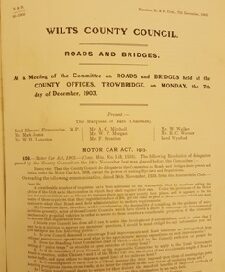
Early Motor Vehicle Registration in Wiltshire 1903 – 1920
In October 1902, Wiltshire County Council received a letter from the clerk of Norfolk County Council asking that a petition be presented to the Local Government Board requesting them to ensure by legislation or likewise that a registration number was affixed on the back of every motor car to ensure the identification in the event of an accident on the public highway, in the interest and for the protection of the public.
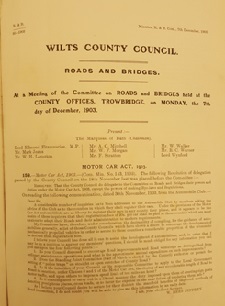

The Motor Car Bill passed through The House of Commons and The House of Lords in the summer of 1903. The circular for the Motor Car Act was issued by the Local Government Board on the 20th November 1903. It set up a system of registration for motor cars and motor cycles, with a view to identifying motor cars/cycles and their owners. It brought in driving licences (legislation for compulsory testing was introduced for all new drivers with the Road Traffic Act 1934 for owners of motor vehicles and anyone wishing to use a motor vehicle). Penalties were introduced for people driving who did not hold a licence, and licences could be suspended for offences against the Act. A new speed limit was introduced of 20mph - raised from 14mph and aimed to prevent reckless driving by adding endorsements to the person’s driving licence.

The registration and licencing system was to be administered by County and Borough Councils throughout England, Wales, Scotland and Ireland. Each County or Borough was issued a letter, or a group of two letters (styled the index mark), issued by the Local Government. Registers were kept for motor cars and motor cycles. These registers could be kept in two parts, one relating to motor cars and one relating to motor cycles. Wiltshire County Council kept separate registers for motor cars and motor cycles.
The Act did not define the term motor cycles, nor could the Local Government Board, but it was generally treated as a motor car with not more than three wheels and weighing not more than three hundredweight (152kg).
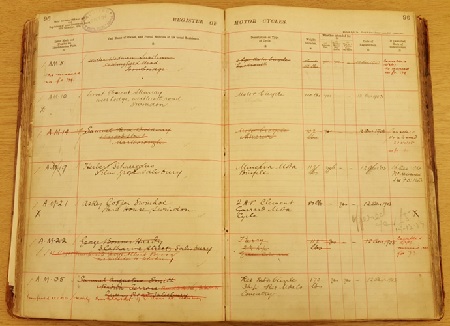
Applications for registrations were made through the council and for a fee of £1 for a motor car and 5 shillings for a motor cycle, an identification mark was issued to the vehicle and it was entered into the register. A copy of the entry was issued to the owner.
Any changes in ownership of the vehicle were given either by the new or the old owner to the council who issued the index mark. The alterations were made to the registers and the new owner was issued a copy of the new entry. If any changes were made relating to the vehicle the owner needed to inform the council, and the register was amended accordingly. If the vehicle was destroyed, scrapped, exported or re-registered with another county or borough, then the index mark assigned to that vehicle was cancelled in the register and that number could then be assigned to another vehicle.
The Roads Act of 1920 came into effect on 1st January 1921. The registers were named vehicle allocation books. With the Wiltshire allocation books, only the vehicle owner’s details and the make of the vehicle were entered, with no indication of colour, style or engine capacity. All subsequent changes made to the vehicle and to ownership were entered into a file which was kept for each index mark and when the number was cancelled due to the vehicle being scrapped or exported this was duly recorded. These files where supplemented with a record card for each index mark. One allocation book was now kept for motor cars, heavy motor cars and motor cycles, so that the same number could not be issued twice, for instance to a motor car and a motor cycle.
About Us
Research Tools
What We Do
Contact us
Wiltshire and Swindon History Centre
Cocklebury Road
Chippenham
SN15 3QN
E: cmas@wiltshire.gov.uk
T: 01249 705500
For all conservation enquiries including quotations and object deliveries, please book an appointment in advance.


