

Local History Month: May 2022
May is Local and Community History Month and in Wiltshire we are celebrating local history with an array of events and exhibitions at libraries across the county!
Events are running from Wednesday 4 May through to Friday 27 May: download a full list of Local History Month events with details and booking information.

Creative Wiltshire Exhibition at Salisbury Museum

Museum and archive collections are, in their very nature, eclectic. They often have roots in one person’s fascination with the past and they develop and grow much like a tree putting out roots. They are often dependent on donations, and collecting policies within museums are developed to provide some structure to this form of collecting, making sure that very valuable storage space is used to advantage and the best are represented. It is not that often that choices can be made by museum and archive staff about what to purchase, what gaps to fill and who to represent.
The Heritage Lottery Funded Creative Wiltshire project has aimed to facilitate just that. With a carefully prepared bid back in 2014 we were successful in achieving funding to add to some of our Wiltshire collections and with careful consideration we have purchased items that aim to fill gaps, often representing a new creator with a strong Wiltshire connection. We are now reaching the end of this project and our final exhibition at Salisbury Museum will show off some of our recent purchases.
This project is not just about the purchases, it is also about offering training and development to volunteers and staff associated with museums within the county, as well as education workshops, a tool kit for teachers and other events in the wider community. The exhibition at Salisbury Museum has provided a perfect opportunity to put an ‘Exhibitions Assistant Trainee’ in place, to plan, oversee and install the final exhibition with the support of the Salisbury Museum Director, Adrian Green and his team. Thank you to Emily Smith, our successful applicant, who has been able to gain great ‘hands on’ experience of all aspects of exhibition work within a museum context. We gave her a tough brief; expecting planning, curation, exhibition design, mounting of work, co-ordinating staff, borrowing and transferring of objects required from around the county and she has had a busy four months putting this in place. We thank you for your enthusiasm and we are thrilled with the results. The exhibition at Salisbury Museum has now been extended to 29th September 2019; why not pop in and see what you think? You will find work by Rex and Laurence Whistler, Howard Phipps, Nancy Nicholson, Nick Andrew, Jonathan Wylder and Wilfred Gabriel de Glehn, amongst others.

During the course of the project other exhibitions have been held at Swindon Museum and Art Gallery and Chippenham Museum and both have focused on recent acquisitions to their collections. Sophie Cummings of Swindon Museum and Art Gallery says the project has exceeded her expectations and allowed them to purchase pieces by Ken White, previously un-represented in their collection, as well as fine art by Joe Tilson, Harold Dearden, David Bent and Janet Boulton and ceramics by Katherine Pleydell-Bouverie, Patricia Volk and Sasha Wardell.
The current exhibitions at Swindon Museum and Art Gallery are well worth a visit.
An Art of the People – Ramsbury & Cricklade Potteries features work by Ivan and Kay Martin of Cricklade, and Peter Holdsworth of Ramsbury.

An Art of the People – Ramsbury & Cricklade Potteries
Out of the Box: An exhibition of paintings by David Bent
An exhibition of work by David Bent which includes geometric landscapes, intricate photographic collages and paintings as well as his aviation art and “Movement 2000” series. Stunning and inspiring work by this Swindon based artist.

On reflection… the legacy of First World War commemorations in Wiltshire
One hundred years ago people and politicians around the globe were contemplating a new world order following more than four years of war. In Britain, January 1919 and the following months were marked by strikes, civil unrest and military mutinies. The flu pandemic continued its deathly march. The month also saw the beginning of the Paris Peace Conference which lasted into the summer concluding with five treaties formally ending the war – including the Versailles Treaty signed 28 June – and the formation of the League of Nations.
As a nation we have spent the last four years commemorating the centenary of the First World War (FWW). A hundred years on from this cataclysmic event and we are living with its legacy – with regional conflicts that have their origins in the war; with advances in medicine (reconstructive surgery, improved anaesthesia); with the music, art, literature and poetry produced during and after the war; with universal suffrage; and with a landscape shaped by war.
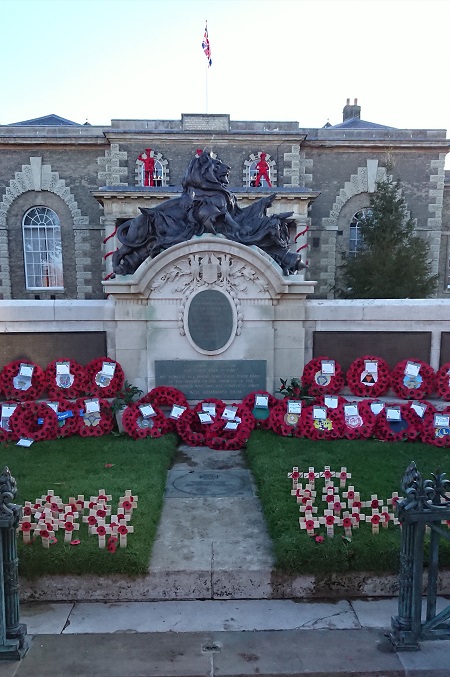
But what of the legacy of these commemorations? What will future generations find when they delve into early 21st century archives and history books, looking for evidence of how we remembered? Without doubt they will find an amazing amount of new, high quality research that has changed our understanding of the Great War. But have the commemorations reflected this changed narrative or have they reinforced the myths and iconography associated with First World War and which are embedded in our collective memory? Some historians are asking whether the last four years have been a lost opportunity.
From a personal point of view it feels as though much of the national commemoration did focus on traditional themes and symbols such as the mud and blood of the western front, the experience of the war poets, the silhouetted soldier. There have been some stunning artistic responses to the centenary, commissioned by 14-18 Now, including Blood Swept Lands and Seas of Red, Jeremy Deller’s We’re Here Because We’re Here, Danny Boyle’s Pages in the Sea and film-maker Peter Jackson’s They Shall Not Grow Old.
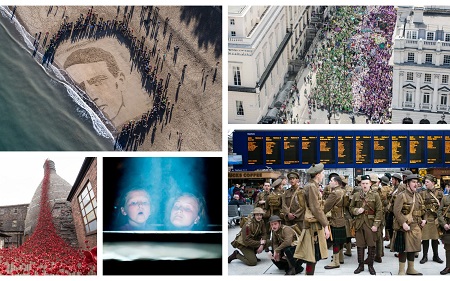
But these have also drawn criticism. 14-18 Now estimates that 35 million people engaged with their commissioned events, but historians Professors Maggie Andrews, of the University of Worcester, and Sarah Lloyd, of the University of Hertfordshire, question whether people critically engaged or merely encountered them. Were these national events, exhibitions and installations sufficiently challenging of historical myths?
There has been much work on myth-busting over the past four years but it can be tough going up against advertising executives and picture editors who are not historians. An enduring myth, reinforced by TV adverts and wrongly credited photographs, is that the Christmas Truce of 1914 happened throughout the western front and that football matches were organised between German and British troops. Neither is an accurate picture of what happened. (Check out Dan Snow’s mythbusting articles for the BBC.)
At a regional and local level, however, I feel very positive about the projects and events that have taken place. Over the last four years much of my work as an education officer has focused on researching Wiltshire’s role in the First World War and passing on that learning to others, especially primary school teachers and pupils keen to make the most of the local history study that is part of their curriculum.

Another aspect of my work has been supporting other organisations in delivering the educational side of their FWW projects. My colleagues in archives and local studies have also been busy acquiring new collections and publications that support the study of the Great War.
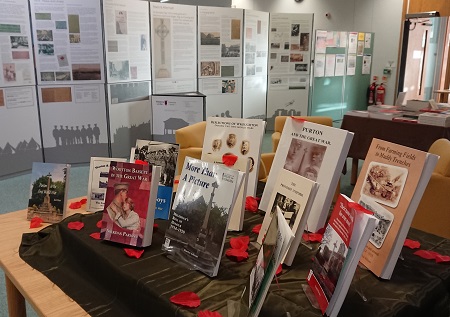
The number and range of FWW projects in Wiltshire has been impressive and sadly I cannot list all of them, but a good place to start is the History Centre’s own Wiltshire at War – Community Stories project.
About Us
Research Tools
What We Do
Contact us
Wiltshire and Swindon History Centre
Cocklebury Road
Chippenham
SN15 3QN
E: cmas@wiltshire.gov.uk
T: 01249 705500
For all conservation enquiries including quotations and object deliveries, please book an appointment in advance.


