

Did you know April 18th is World Heritage Day?
World Heritage is the shared wealth of humankind. Protecting and preserving this valuable asset demands the collective efforts of the international community. This special day offers an opportunity to raise the public's awareness about the diversity of cultural heritage and the efforts that are required to protect and conserve it, as well as draw attention to its vulnerability.

Endorsed by United Nations Educational, Scientific and Cultural Organisation UNESCO the day is an opportunity to raise the profile of World Heritage Sites across the globe and to recognise and explore their unique and special features. Many of you will know the most famous Sites such as the Great Wall of China, the Egyptian Pyramids and the Amazon Rainforest in Brazil but did you know that we have 31 World Heritage Site in the United Kingdom and that the most recent of these is the Lake District which was added to the List last year?
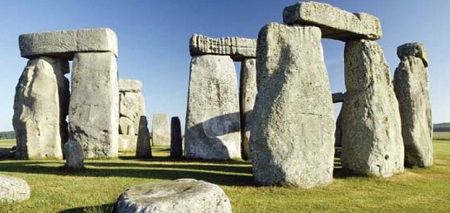
Here in Wiltshire we are incredibly fortunate to have the Stonehenge, Avebury and Associated Sites World Heritage Site – to use its proper title. The globally iconic stone circles are instantly recognisable but do you know about all the other monuments and sites which form part of this 50 square kilometre landscape which makes up our World Heritage Site? The partners that look after all things World Heritage are planning to make sure that this year Wiltshire marks World Heritage Day with an array of fun activities and events all across Wiltshire to help you find out more about our World Heritage and how to get involved.
At Avebury you can join the National Trust for a guided walk and find out why this World Heritage Site is globally important as you explore the landscape visiting the Bronze Age 'hedgehog' barrows and stroll down to Neolithic West Kennet Avenue. You'll discover some of the most exciting parts of the prehistoric landscape at Avebury.
Or join the Human Henge group for a more sensory experience of Avebury's ancient landscape. Human Henge is a ground-breaking project about archaeology, mental health and creativity that is interesting, adventurous, safe and fun. Walk, sing and learn in the company of archaeologists and musicians, connecting with others who have walked here before us.
At Stonehenge, English Heritage invite you to meet their friendly volunteering team. See them make and decorate prehistoric style pottery, fashion rope out of water reed, and make cheese and bread over the open fire in the Neolithic Houses. Learn about the plants foraged from the Stonehenge landscape and chat to the volunteers as they repair the chalk daub walls of the houses. There will be a chance to sign up and join this amazing team and learn some essential Neolithic life skills! There are also free guided walks around the site, a trail for grown-ups, prize giveaways during the day, and a Stonehenge100 talk by Archaeologist Phil Harding in the evening.
Working in Partnership: bringing archives alive
Students like a word search, a little bit of light relief from the rigours of normal lessons, and teachers like them as a sneaky way to revise subject specific vocabulary. We decided on a word search with a difference to introduce secondary school students to archives and working with primary sources. It was part of a new schools’ session developed by Salisbury Cathedral in partnership with the Wiltshire & Swindon History Centre. While the History Centre is open to the public, and has extensive experience using its archives in educational settings, the Salisbury Cathedral archive has not been so accessible. This is changing thanks to the hard work of Cathedral archivist Emily Naish and her band of volunteers, and the willingness of the Dean and Chapter to open up this amazing resource. Members of the public have already enjoyed behind-the-scenes tours of the library, located above the cloisters, and now it is the turn of school children to work with documents from the archive and enjoy the benefits of this cultural education.
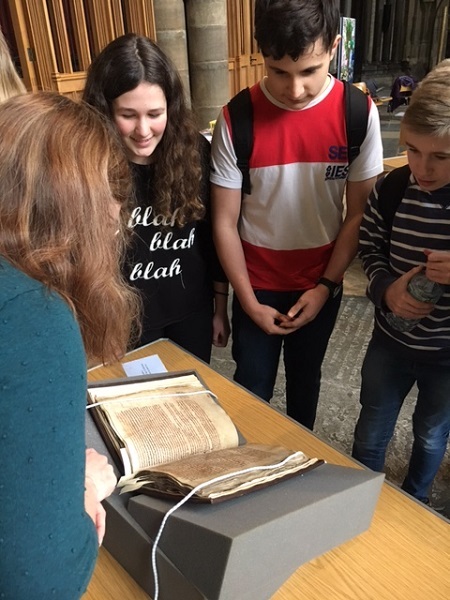
Archivist Emily joined forces with the Cathedral’s teaching & community officer Sally Stewart-Davis and the History Centre to develop the school session which we ran in the cathedral on 27 February.
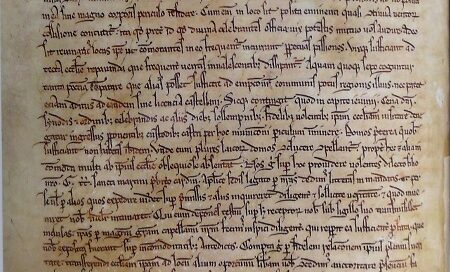
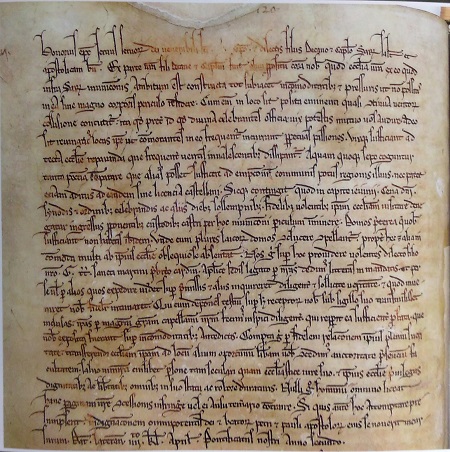
The 13th century Papal Bull that gave permission for the building of a new cathedral on the water meadows by the River Avon, so moving the settlement of Old Sarum to New Sarum. Students from Stanchester Academy near Yeovil are shown the original cartulary, or register, which contains the 1219 Papal Bull from Pope Honorious III.
Emily chose a document in abbreviated Medieval Latin to introduce the difficulties that can arise when working with primary sources. Written in 1219, the document is an official copy of the Papal Bull from Pope Honorious III giving permission for the church authorities to build a new Salisbury Cathedral on the water meadows by the River Avon. As a starter activity we asked the students – aged 11-14 – to identify a list of words that they might find familiar, even though they were in Latin. Among the words they were looking for were Sarum, benedictionem, aquam, castellani and hominum (Salisbury, benediction, water, castle and men/people).
It was a challenge, but a challenge that was well met. The students realised that even when faced with a document in a foreign language, with abbreviations and in a difficult script, there was information they could extract.
While a Papal Bull in Medieval Latin does not immediately spring to mind as the most accessible archive for school children or adults, the youngsters from Bishop Wordsworth School in Salisbury and Stanchester Academy, near Yeovil, really engaged with the document and the activity. This was real and relevant – and they were working in the building that ultimately resulted from this Papal document.
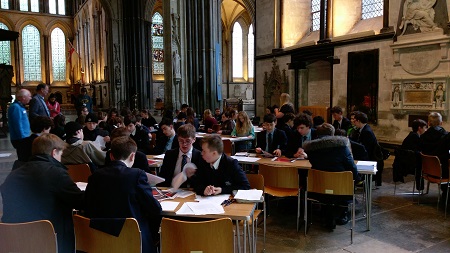
The second document the students worked on was a 1599 letter from Elizabeth I to the dean and chapter at Salisbury Cathedral and relates to Sir Walter Raleigh’s request that he be given the estate of Sherborne Castle which had belonged to the Church. Although in English, the students still faced the challenge of deciphering the handwriting and getting to grips with Elizabethan grammar and spellings. This they did with amazing success.
Dancing Back to 1914 and A Child’s War
This month we celebrated the end of a wonderful project that involved young people from across the county combining heritage and dance to learn about and commemorate the First World War.
The History Centre was proud to have been part of the Dancing Back to 1914 project which was funded by the Heritage Lottery Fund (HLF). The project saw youngsters from Tidworth, Salisbury and Bradford on Avon learn about the 1914-18 war through dance and engage with their local heritage. The groups visited the Wiltshire and Swindon History Centre and also made trips to local museums and to London to see the play Warhorse.
Another group of youngsters from Malmesbury School also took part in the project by visiting the History Centre where they looked at archive material showing what life was like for those who lived through the war, including children. The students also gained an insight into the work of the History Centre with a behind-the-scenes tour. You can read about their visit here: http://www.gazetteandherald.co.uk/news/13882591.Pupils_dance_back_in_time_to_WW1/
Each visit to the History Centre was tailored to the groups’ needs so they saw archives that were relevant to their geographical area.
The Tidworth group were fascinated by the maps which showed how quickly the military town had grown in the run up to 1914 and during the war.
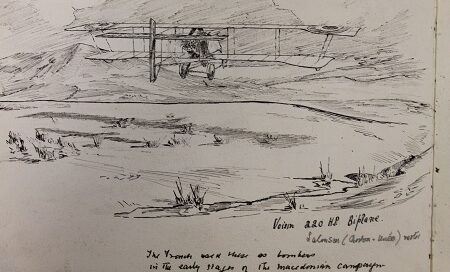
All the students really engaged with the letters, sketch books and diaries that we were able to produce as these were very personal and recognisable – although youngsters today text and email they appreciated reading the letters and diaries that soldiers and nurses had written. Also popular were the photograph albums and sketch books.
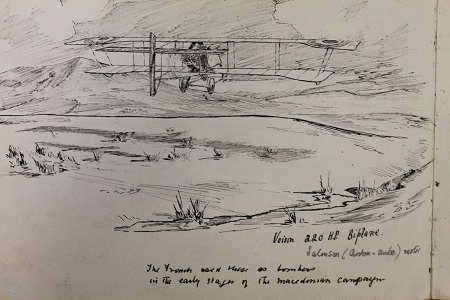
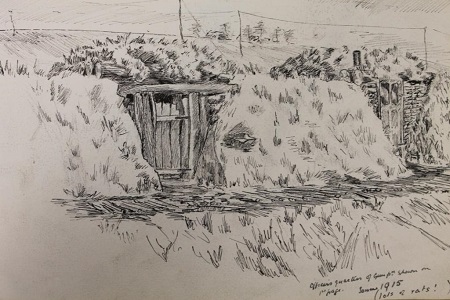
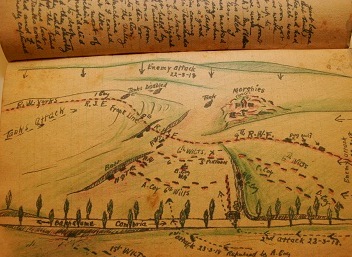
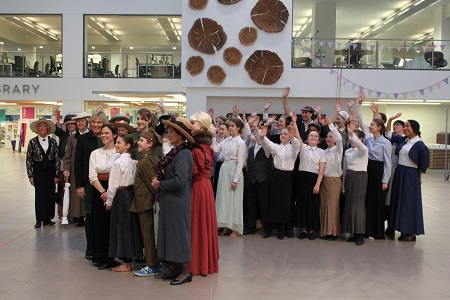
Having learnt about the history of the First World War, including the types of dance and fashions of the day, each group created their own response to what they had discovered. The Salisbury group – which included students from St Joseph’s, St Edmund’s and South Wilts Grammar schools – performed at the city’s Christmas Market in Guildhall Square with a dance that was based on the letters they had read at the History Centre.
All those who took part came together for a grand finale at County Hall, Trowbridge on 3rd March. The event, formally opened by council leader Jane Scott, included tea and cake, with the audience mingling with the dancers.
About Us
Research Tools
What We Do
Contact us
Wiltshire and Swindon History Centre
Cocklebury Road
Chippenham
SN15 3QN
E: cmas@wiltshire.gov.uk
T: 01249 705500
For all conservation enquiries including quotations and object deliveries, please book an appointment in advance.


