

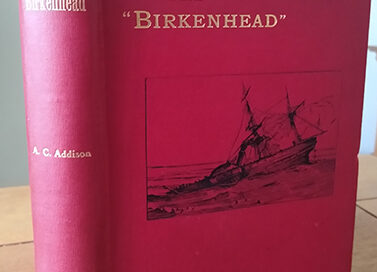
The Story of the Birkenhead
I’d like to share with you a fascinating story that enfolded in the Local Studies Library recently. It begins with an email sent by a [...]

On reflection… the legacy of First World War commemorations in Wiltshire
One hundred years ago people and politicians around the globe were contemplating a new world order following more than four years of war. In Britain, January 1919 and the following months were marked by strikes, civil unrest and military mutinies. The flu pandemic continued its deathly march. The month also saw the beginning of the Paris Peace Conference which lasted into the summer concluding with five treaties formally ending the war – including the Versailles Treaty signed 28 June – and the formation of the League of Nations.
As a nation we have spent the last four years commemorating the centenary of the First World War (FWW). A hundred years on from this cataclysmic event and we are living with its legacy – with regional conflicts that have their origins in the war; with advances in medicine (reconstructive surgery, improved anaesthesia); with the music, art, literature and poetry produced during and after the war; with universal suffrage; and with a landscape shaped by war.
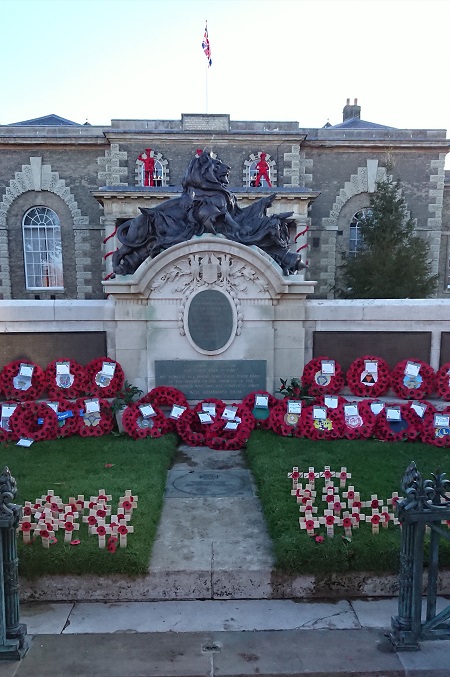
But what of the legacy of these commemorations? What will future generations find when they delve into early 21st century archives and history books, looking for evidence of how we remembered? Without doubt they will find an amazing amount of new, high quality research that has changed our understanding of the Great War. But have the commemorations reflected this changed narrative or have they reinforced the myths and iconography associated with First World War and which are embedded in our collective memory? Some historians are asking whether the last four years have been a lost opportunity.
From a personal point of view it feels as though much of the national commemoration did focus on traditional themes and symbols such as the mud and blood of the western front, the experience of the war poets, the silhouetted soldier. There have been some stunning artistic responses to the centenary, commissioned by 14-18 Now, including Blood Swept Lands and Seas of Red, Jeremy Deller’s We’re Here Because We’re Here, Danny Boyle’s Pages in the Sea and film-maker Peter Jackson’s They Shall Not Grow Old.
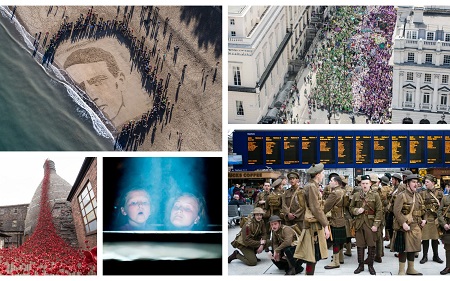
But these have also drawn criticism. 14-18 Now estimates that 35 million people engaged with their commissioned events, but historians Professors Maggie Andrews, of the University of Worcester, and Sarah Lloyd, of the University of Hertfordshire, question whether people critically engaged or merely encountered them. Were these national events, exhibitions and installations sufficiently challenging of historical myths?
There has been much work on myth-busting over the past four years but it can be tough going up against advertising executives and picture editors who are not historians. An enduring myth, reinforced by TV adverts and wrongly credited photographs, is that the Christmas Truce of 1914 happened throughout the western front and that football matches were organised between German and British troops. Neither is an accurate picture of what happened. (Check out Dan Snow’s mythbusting articles for the BBC.)
At a regional and local level, however, I feel very positive about the projects and events that have taken place. Over the last four years much of my work as an education officer has focused on researching Wiltshire’s role in the First World War and passing on that learning to others, especially primary school teachers and pupils keen to make the most of the local history study that is part of their curriculum.

Another aspect of my work has been supporting other organisations in delivering the educational side of their FWW projects. My colleagues in archives and local studies have also been busy acquiring new collections and publications that support the study of the Great War.
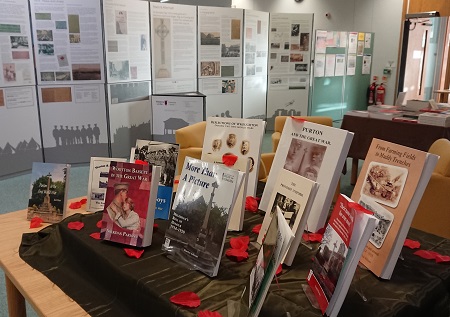
The number and range of FWW projects in Wiltshire has been impressive and sadly I cannot list all of them, but a good place to start is the History Centre’s own Wiltshire at War – Community Stories project.
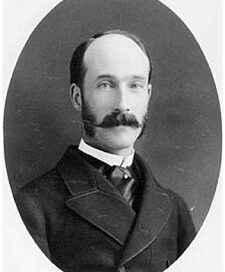
Lord Lansdowne’s Peace Letter of November 1917
Guest blog by John Boaler - originally published in the Wiltshire Local History Forum Newsletter
 2017 marks the centenary of Passchendaele, also known as the Third Battle of Ypres. After catastrophic losses at Verdun and the Somme, it is hard to comprehend how the politicians and generals at the time were again willing to expend the lives hundreds of thousands of soldiers in another such assault on the Western Front.
But the one senior politician did speak up against this military ‘strategy’, calling for a negotiated peace, was Lord Lansdowne (1845–1927), the fifth Marquess and a great-grandson of Lord Shelburne, one of George III's prime ministers.
He had succeeded his father, upon his sudden death in 1866, taking his seat on the Liberal benches in the House of Lords. Lansdowne was appointed a junior whip in Gladstone's first government (1869); was promoted to Under-Secretary for War three years later; and was made Under-Secretary for India at the start of Gladstone's second government (1880). However his opposition to the Irish Land Act soon caused him to resign from the Liberal Party.
In 1883 he was appointed Governor-general of Canada; and from 1888 to 1894 was Viceroy of India. Back in London he was made War Secretary (1895-1900) and then Foreign Secretary (1900 – 1905). He was Leader of the Unionist peers from 1903- 1916.
The First World War
Lord Lansdowne was a member of the Shadow Cabinet in 1914 and strongly supported the decision for war in August. Though Lansdowne's second son was killed in France in October he remained committed to the war. In May 1915 he took office as minister without portfolio in Asquith's coalition, and in Government he supported conscription.
He began to have doubts about the capacity of the allies to score a decisive victory after the disastrous Somme offensive of June 1916. Asquith as Prime Minister invited his cabinet colleagues to submit their views on the course of the war. Lansdowne concluded that while there was no question of defeat, outright victory was unlikely. He argued for a restatement of war aims that might open the way to a negotiated settlement. But Asquith was about to be replaced by Lloyd George, and Lansdowne left office at the same time.

Letter to The Daily Telegraph
In 1917, as deaths quickly mounted in the Battle of Passchendaele, Lansdowne again put the case for a negotiated peace. This time he went public, with a letter printed in the Daily Telegraph on 29 November 1917. His views were well known in senior government circles yet had made no impact. The letter caused a sensation:
"We are not going to lose this war, but its prolongation will spell ruin for the civilised world, and an infinite addition to the load of human suffering which already weighs upon it...We do not desire the annihilation of Germany as a great power ... We do not seek to impose upon her people any form of government other than that of their own choice... We have no desire to deny Germany her place among the great commercial communities of the world.”
He was strongly denounced by the Northcliffe press (then publishers of the Daily Mail & Daily Mirror) and ostracised by the Unionist leadership. But his move attracted a lot of support. He received a large mailbag of which ‘The prevailing note is, “you have had the courage to say what we have been thinking for ever so long”’, he told his daughter.
President Wilson's ‘fourteen points’ were widely seen to be on Lansdowne lines, and he pressed on with further letters in March and July, supplemented by Lord’s speeches, calling for a careful restatement of war aims.
About Us
Research Tools
What We Do
Contact us
Wiltshire and Swindon History Centre
Cocklebury Road
Chippenham
SN15 3QN
E: cmas@wiltshire.gov.uk
T: 01249 705500
For all conservation enquiries including quotations and object deliveries, please book an appointment in advance.


