

Christmas Behind the Wire
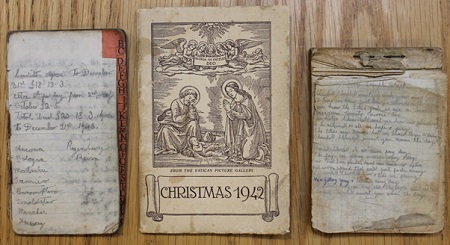
When we think of the Second World War, we often think of the Home Front or the front lines, Dunkirk and D-Day. It’s much less often that we think of those who spent their time behind enemy lines as prisoners of war. As I was looking through the archive catalogue recently I came across an entry for Trooper George Sweetman, of the Royal Wiltshire Yeomanry, whose diary recounts his time as a PoW. As we get close to Christmas and begin to think of spending time with our family and friends, I thought about what life must have been like for men like George at this time of year as prisoners of a hostile nation so far from home. George’s diary gives us a fascinating insight into the lives and emotions of captured British soldiers, how their morale ebbed and flowed with the course of the war, and how important Christmas was to their wellbeing.
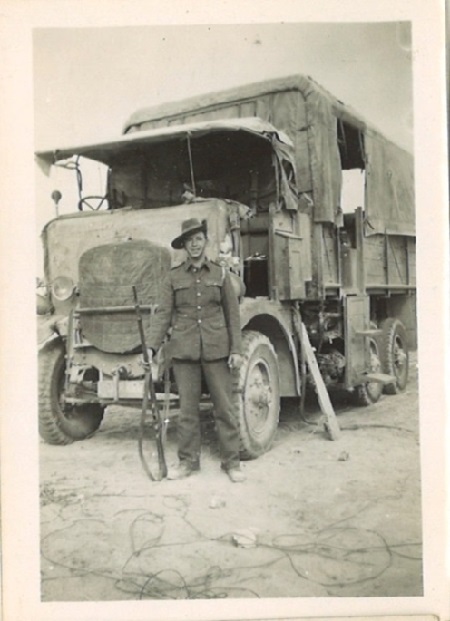
On 2 November 1942 George’s unit went into action in North Africa, as part of Operation Supercharge, part of the Second Battle of El Alamein. The Royal Wiltshire Yeomanry, operating within the 9th Armoured Brigade, lost a large number of tanks during the action, partly as a result of a counterattack led by the 21st Panzer Division. In his diary, George recorded the action: “Went into action at dawn. B Sqd. first in, one shot up A.T.G [anti-tank guns], lorries & tanks, & then Jerries’ main armoured force came & a big fight started”, and his unit took heavy casualties.“We lost B Sqd., lost all our tanks, we got wiped out.” George was taken Prisoner of War (PoW) during this action, and was to spend the rest of the war in a PoW camp.
From El Alamein George was taken through Egypt to Libya and from there he and other PoWs were shipped to Greece and onwards to Italy, arriving in southern Italy on 22 November 1942. The prisoners’ journey was far from easy. The day after his capture George’s convoy was attacked by the RAF: “coming up the Mersa road from Darla we got bombed and machine gunned to hell with our own planes. Several of our mates got wounded & one got blown to bits. A hell of a day that was”. Relative to what was to come in the last years of the war conditions in the Italian camps were fairly good, though life there was apparently rather boring. The prisoners’ main complaint was about the quantity and quality of the food, which came to a head in George’s first Christmas behind the wire.
As you might expect for men held prisoner in a foreign, enemy, country there wasn’t much in the way of a build up to Christmas in the camp. In fact even Christmas cards were a luxury: there weren’t enough available for each man to send one home, and the prisoners had to draw lots to see who would be given a card. Luckily for George he won one, and sent it home on the 8th of December. Post to and from the camps during the war was slow, and George would not receive his first letter from home until March 1943. Apart from this there do not seem to have been any Christmas activities in the camp until Christmas Eve which was, for George and the others, a disappointment: after sports in the morning and afternoon, “we had a meat meal in evening. We had a concert in our hut in the evening it was very good, finished with a blind boxing match so that ended Xmas eve, of course we missed the beer and food. Just went to bed”.
If anything, Christmas Day was an even greater disappointment. Throughout the war the Red Cross distributed parcels to PoWs containing food, tobacco and hygiene items. The parcels were meant to supplement the rations that PoWs received in the camps which were usually insufficient in terms of both calories and nutrients. The parcels often came infrequently due to the circumstances of the war, but when they did arrive they were the highlight of the men’s week. Even more than these deliveries, though, the men hoped for one particular parcel. Every year at Christmas the Red Cross delivered Christmas dinner in a parcel to the PoWs, including everything from Christmas pudding to chocolate and sweets. Unfortunately for George and the other prisoners, in December 1942 their Christmas parcel never arrived.
On Christmas Day the men woke early and made a cup of tea, allowing themselves a ration of 2 or 3 biscuits from their remaining ordinary Red Cross parcel. After finishing this the day continued much as any other, with a parade and count of the prisoners, followed by a church service at 9 o’clock and the standard lunch ration “just the same as any other day”. In his usual understated style George simply recorded in his diary “The Red Cross Xmas parcel which we expected never turned up, a great disappointment”. In the afternoon the men received a small Christmas gift from their Italian captors: one orange for each prisoner. Later, it started to rain. At 4pm the men had their ordinary hot meal, with no Christmas extras. After a “sing song” in the evening their Christmas ended. George’s diary reveals his bitter disappointment: “and so to bed hungry & that was how we spent Christmas Day 1942 in our P.O.W. camp. I thought of home, all the good food. That’s all we think about hear [sic] is food”. Morale in the camps was often low, a consequence of having little to do but sit and think, and the missing Christmas parcel crushed the men’s spirits. This continued into Boxing Day – it rained constantly, and the men were forced to sit in their huts all day, with the same standard food ration that they had on any other day. George simply recorded in his diary “and so to bed, that was Boxing Day and Christmas once again over. Wonder where we shall be next Christmas”.
Over the next week life went on as normal until, in the New Year, a rumour ran round the camp that the Christmas parcels had arrived. On Monday 3 January George recorded in his diary “the tale was true – some Xmas parcels had come in but not enough for one each, so we are keeping them till Wednesday in case some more come in … Roll on Wednesday”. By Wednesday the missing parcels had still not come in, so the men had to share one between two. George copied the contents of his parcel into his diary:

Quite a feast for men used to one hot meal a day, which was often a ‘soup’ of a small amount of vegetables in water; by April 1945, when George was imprisoned in Germany, it was a distant luxury. In 1943, though, the men made sure to savour their good fortune. “We had our Xmas pudding hot”, George wrote in his diary, with “jam & Nestlé’s milk after it”, with an apple given to them by the Italians to mark Epiphany. Compared to his mood on Christmas Day, George was ecstatic: “this is my happiest day since P.O.W. the best food I had … a good day”. The next day the men finished off the remainder of their Christmas parcel, eating their cake, marmalade, butter, and beef & tomato pudding.

In The Line Of Fire – Wiltshire’s Role During German Air Raids
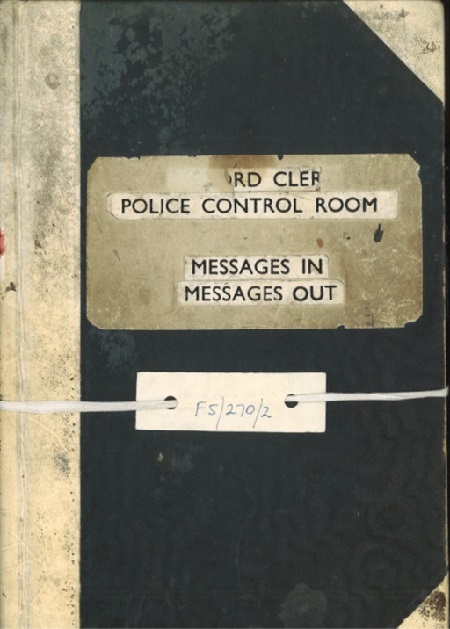
One of the documents in the Wiltshire Constabulary archives held here at the History Centre includes the Wartime Police Control Room Log (F5/270/2) which was used during 1944 and 1945. The Wiltshire Police Control Room was based at Devizes Headquarters and was and still is the central hub of communications for the force. At that time, the Devizes police station was in Bath Road. The new police HQ was built in 1964 and was a considerably larger building.
The log book not only registered downed aircraft, but firing practices, air raid warnings, evacuee arrivals and other war related incidences.
I have looked at two individual incidents which were logged in March and April 1944. Both incidents involved crashed German aircraft, I’ve added extra detail which I have found archived elsewhere. The first incident happened on March 14th 1944.
14/3/1944 2345 hours; initial reports of a plane crash about halfway between Alton Barnes and Devizes reported to Marlborough Police by an Orderly Sergeant at RAF Alton Barnes.
2355 Inspector Shears is dispatched to All Cannings as crash believed to be in vicinity.
15/03/1944 0100 confirmed that a plane, believed to be a German aircraft had crashed in a field adjacent to the canal at All Cannings. The plane had burnt out and bombs were in the field. They were unable to say if occupants were trapped. The RAF was guarding the scene and an Ambulance was en route from Devizes.
0120 Confirmation received that the aircraft was a German one with twin engines, model unknown at this stage. There was no trace of any crew ‘but feared from odour and fierceness of conflagration they have been trapped inside.’
0420 aircraft was identified by flight Lieutenant Rickitto as a J.U.88. (This aircraft a Junkers 88 no. 141152 was part of the Luftwaffe which had blitzed London that night. The crew had had specific orders to bomb Buckingham Palace and Whitehall. The plane had been pursued westerly out of London and experienced engine failure as it reached Wiltshire.)

0710 Major Hailey US forces at Tidworth reported that he had a German airman in custody. The prisoner had supplied descriptions of three other crewmen who had bailed out at the same time. RAF Lieutenant Ricketts (Interrogation Officer) requested that the prisoner be brought to Devizes Police Station for interrogation.
Two other German crew members were detained; one in Patney and the other in Bulford. Both were taken into custody in Devizes.
16/3/1944 1745 the body of the missing airman, the last of the crew, was found in a field in Patney, about 1 and a half miles from the crash scene. A parachute was attached to the body. (German Officer Unteroffizier Hans Schonleitner was buried at Haycombe Cemetery in Bath- local schoolchildren had found his body with a partially opened parachute).
There is a full narrative of that fateful flight on http://indianamilitary.org/ by the surviving tailgunner on board, Gerhard Grunewald (he was subsequently interred as a POW in America).

Poems and stories inspired by the Arctic Convoys

The final piece of the Arctic Convoy project has just been completed – and what a resounding success.
The History Centre joined forces with writer and arts facilitator Dawn Gorman to work with a group of young people on a creative writing project using the Second World War Arctic Convoy oral histories as source material. We approached St Laurence School in Bradford on Avon and the Chippenham Air Scouts to recruit youngsters to the project.
We were knocking on an open door at St Laurence as we had worked with the school in 2016 on the Iron Duke project and we knew there would be students eager to hone their creative writing skills. Four students signed up to the poetry workshops being run by Dawn.
To be fair the Scouts were a slightly trickier audience, even with the promise of earning another badge if they took part. Dawn and I attended one of their meetings and spoke with around 20 youngsters, mostly aged 11-13 and mostly boys, about the stories of the Arctic Convoy veterans and the idea that anyone and everyone can enjoy creative writing!
I had brought with me Second World War magazines, a selection of photographs of veterans interviewed by the History Centre in the first part of the project, and a medal presented by Russia to British sailors who had served on the convoy ships.
This brief session prompted two of the Scouts to share with the group that their great grandfathers had been sailors on Royal Navy ships escorting the merchant ships carrying supplies to Russia. In the end we had four Scouts signed up to the workshops and they were joined by a member of Corsham Sea Scouts.

The starting point for the creative writing was to listen to the stories told by some of the Wiltshire veterans of the convoys. These oral histories and their transcripts can be accessed at the History Centre. On our website we have uploaded a series of short films with abridged versions of the oral histories and it was these recordings that were used in this project.
Dawn worked in school with the Year 10 and 11 students on poems inspired by these men’s stories while the Scouts took part in a more structured series of workshops held at the History Centre.

The boys created both poetry and storyboards based on the Arctic Convoys. Dawn worked with them on “found poetry” – creating poems from pre-existing text – the five senses and creating a hero profile and story.
About Us
Research Tools
What We Do
Contact us
Wiltshire and Swindon History Centre
Cocklebury Road
Chippenham
SN15 3QN
E: cmas@wiltshire.gov.uk
T: 01249 705500
For all conservation enquiries including quotations and object deliveries, please book an appointment in advance.


