


Trowbridge shows its sympathy

I was recently cataloguing an early 20th century postcard for our Historic Photograph & Print Collection which was quite unusual; it was commemorating the death of two gunners called Harrild and Murray. Included on the front of the postcard were photographs of each of them. I really wanted to find out more. What happened to these men and what were their full names? Even a location for the event wasn’t clear, so I needed help!
After a timely tweet, Trowbridge Museum came up trumps and confirmed that the men had been stationed at Trowbridge Barracks and had been involved in an accident with the funeral being held on 30th July 1909.
My next port of call was to a local newspaper, the Wiltshire Times, where on Saturday 24th July 1909 the inquest was reported. The two gunners were Sidney Harrild (age 19) and Richard Murray (age 26), and another, Gunner Wells, who was seriously injured. It appears that the gunners were removing primers from shells although there was a debate around whether the powder was also being removed. The powder in seven of the cartridges exploded, with “terrible results”. The funeral was also reported, occurring slightly earlier than we thought, on 27th July.

“With full military honours, the remains of Gunners Murray and Harrild were laid to rest on Tuesday afternoon, the awfulness of the tragedy and the solemn progress through the streets of the soldiers with their dead comrades combining to make this occasion one that will not soon be forgotten.”

Parish War Books
I’ve been producing documents for the public from the archives for 21 years, during which time I’ve come to know the collections quite well. There are several extremely interesting collections that are very under used. One particular collection is the Parish War Books (WSRO F2/851/3/1 – F2/851/4/52) which are a very interesting piece of local history.

WSA 2601/5
The Wiltshire Parish War Books have their origins with the Napoleonic Wars when there was a real threat of invasion from the French. In 1798 a plan was drawn up to make provisions in the event of this happening. Titled “Rendering The Body Of The People Instrumental In The General Defence” it laid out three plans. The first was to cut off the food supply to the French by moving all the live stock away from the enemy advancing. Another measure was “Breaking the upper millstone and the crown of the oven are deemed the most effectual and least expensive modes of derangement”. Second, was to supply the number of wagons, carts and horses with drivers and conductors that could be made available to help supply the British Army with provisions. Lastly, a plan for insuring the regular supply of bread to the army with instructions for bakers to bake loaves of three pounds or four and a half. A hard crust all the way around was needed otherwise they would not keep in hot weather.
Copyright Imperial War Museum
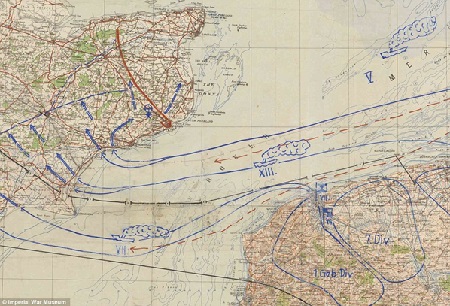
Fast forward 143 years and the risk of invasion was once again upon us. By mid 1940 German forces had invaded France, Belgium, Luxembourg and the Netherlands. “Operation Sea Lion” was the code name for Nazi Germany’s invasion plan of the U.K. during the Battle of Britain. In preparation, invasion committees were set up around the country.

First World War Tunnels at Larkhill
I have written before about some of the amazing finds at the site that will become the Larkhill Service Family accommodation. Archaeologists from Wessex Archaeology and White Young Green have been ensuring that the archaeology has been excavated, with archaeologists from the Wiltshire Council Archaeological Service (mostly me!) helping to ensure that anything affected by the development is properly excavated and recorded. We’ve had Neolithic, Bronze Age and Iron Age finds, including a Neolithic causewayed enclosure, a new (probable) henge and an enclosed settlement (with associated roundhouses). I’ve also mentioned before that we have the remains of a First World War training battlefield, with what has turned out to be over 8km of trenches that have been excavated by the archaeologists and unexploded ordnance specialists that have been working on the site (an example of some of these trenches are shown in this picture – the trenches are white from the excavated chalk being backfilled into them. The second photo shows part of the trench system).


In addition to the trenches, we can now reveal that the practice battlefield also included tunnels and dugouts. On battlefields, dugouts were used for lots of reasons, including troop shelters, medical posts, headquarters and stores. Their position underground meant that they were less likely to be affected by bombs, shells or bullets. We have a number of these at Larkhill, along with a number of tunnels. Both sides dug tunnels into no-man’s-land in order to lay mines that could blow up the other side’s trenches. Counter trenches were also dug to try to stop this. Tunnels were also used as listening posts (listening for the sound of the other side’s digging).
(These pictures show the entrance to one of the dugouts, with steps leading down, and another with a cob wall and doorway forming a room inside.)


The presence of these tunnels and dugouts (along with the trenches, ammunition, grenade fragments and food containers – amongst other things!) show that the troops training here were learning to undertake all aspects of trench warfare. They may well have come from all over the Commonwealth, but we know for a fact that we have people from the Wiltshire Regiment, drafted West Yorkshire coal miners, Manchester Scouts and troops from Australia. We know this thanks to the over 100 pieces of graffiti that have been found written on and carved into the chalk of the defences. Sometimes the graffiti was written in soot from candles, but more often if was written in pencil on the chalk.
About Us
Research Tools
What We Do
Contact us
Wiltshire and Swindon History Centre
Cocklebury Road
Chippenham
SN15 3QN
E: cmas@wiltshire.gov.uk
T: 01249 705500
For all conservation enquiries including quotations and object deliveries, please book an appointment in advance.


