

The Memory Box Reading Group
Do you love reading and history? Our latest venture might just suit you down to the ground! Our reading group is based at the History [...]
The Truth about Stonehenge*
(*or what was held to be The Truth in the Middle Ages)
At the summer solstice, Stonehenge falls under the spotlight: in the solar sense and in the cultural sense. People all over the world find it fascinating and are reminded to ponder it when the sun is at its highest. Much of the appeal of Stonehenge may be attributed to its encompassing aura of mystery, its air of mind-bending antiquity. There is much about it we don’t understand, despite the advances made by ingenious researchers, but we are not the first generations to try to account for Stonehenge. So what did our forebears believe?
According to a twelfth-century author called Geoffrey of Monmouth, the ancient stone circle now known as Stonehenge was originally brought to mount Killarus in Ireland from Africa by a group of giants. It was known then as the Giants’ Dance and had healing properties. The stones came to Wiltshire with the help of a very young Merlin, at the behest of King Arthur’s uncle, Aurelius Ambrosius, to be reconstructed as a memorial to a group of Britons massacred during the reign of the malicious usurper, Vortigern. Some decades later the structure renamed Stonehenge becomes the final resting place of Uther Pendragon.
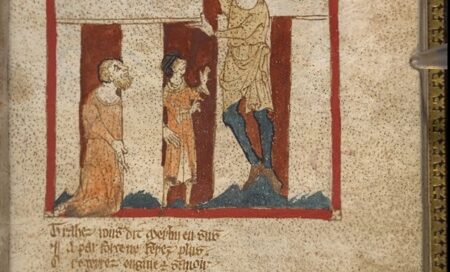
I studied this story while writing my PhD about an illustrated medieval manuscript containing an abridged version of Wace’s Anglo-Norman French translation of Geoffrey’s history: La Roman de Brut. Even in its shortened form, the episode in which the child Merlin guides the reconstruction of Stonehenge celebrates brains over brawn, great power despite littleness of stature:

“They grasped the stones behind, in front and sideways: they pushed and thrust them hard and shook them hard, but however much force they used, they could not find a solution.
‘Rise’ said Merlin, ‘you will so no more by force. Now you shall see how knowledge and skill are better than bodily strength.’ Then he stepped forward and stopped. He looked around, his lips moving like a man saying his prayers. I do not know if he said a prayer or not. Then he called the Britons back.
‘Come here,’ he said, ‘come! Now you can handle the stones and carry them into your ships.’ As Merlin instructed, as he devised and told them, the Britons took the stones, carried them to the ships and placed them inside. They brought them to England and carried them to Amesbury, into the fields nearby.”
– Based on Judith Weiss’ 2002 translation of Wace’s Roman de Brut
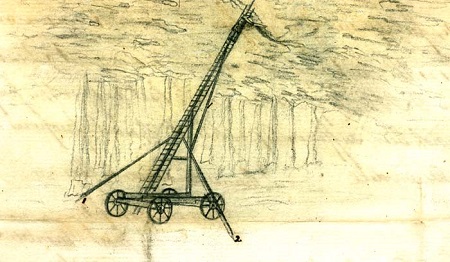
To the medieval mind, the stone circle was a monument to human mastery of nature, as well as to the fallen Britons. Still today we measure ourselves by the power of our prehistoric ancestors to have created it. I recently created a linocut of the child Merlin guiding the reconstruction of Stonehenge. Both Geoffrey of Monmouth and Wace focus on the dismantling of the stones in Ireland, which is also the moment illustrated in the manuscript I worked on for my PhD. Instead, I depicted the moment when that iconic plain was undergoing its momentous transformation.
“Very disorderly, danced the Morris Dance”: Morris, Garlands, Sedition and Riot
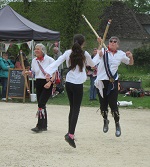
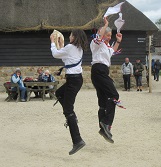
Devizes Jubilee Morris
Here at the History Centre, we’re no stranger to Morris Dancers. We’ve had dancers on the staff, while each May Bank Holiday Chippenham hosts its popular Folk Festival. It’s great fun watching the street theatrics, but there was once a darker side to Morris Dancing that led to the following stories being recorded by the Wiltshire Magistrates (and now appear in Records of Wiltshire).
What happened at Woodborough in May 1652 caused official concern, but how was it that Morris Dancing threatened the pillars of the state?
Capers against the Commonwealth
On the evening of Sunday, May 16th 1652, Edward Smyth and Edward Hawking left their homes in Woodborough and went to All Cannings, where they met and conspired with about a dozen people. That same Sunday, Robert Golfe went from Woodborough into Marlborough “to get a drummer”, while Thomas Beasant went to Ram Alley in Easton and “there invited and procured a fiddler”.
The following day, their plans were revealed when a crowd gathered from the surrounding countryside; according to the records, “three hundred persons, or thereabouts … gathered together in a Riotous, Routous, Warlike and very disorderly manner’.” If anyone thought about stopping them, they were armed “with muskets, pistols, bills, swords drawn and other unlawful weapons”.
The musicians led the crowd from Woodborough to Pewsey where they “very disorderly, danced the Morris Dance”, and committed other misdemeanours, including “drinking and tippling in the inn and Alehouse”. While the prevalence of weapons may, happily, be less, it’s reassuring to see that the drinking still continues in and around Morris circles to this day (and sometimes, people still disapprove).
Public nuisance, party, or Sedition?
In 1652, England was a republic, following the execution of Charles I. The Commonwealth kept a close eye on signs of dissent, looking for evidence of Royalist insurgency: traditional sports and pastimes were suspect. Ales, Morris and other customs had been the target of religious reformers since before the Civil War. The opposition from these authorities meant that Morris and other customs now symbolised the old order prior to the Civil War, when license and liberty were, supposedly, more freely allowed; as such, Morris dancing and the open drinking of ale was as much an open challenge to the authorities as the bearing of arms. Although the weapons offered a challenge to the authorities, the Morris spoke of tradition, culture, custom and a perceived stability before the upheavals of the 1640s. The new rulers of England were right to view the emotional power of such demonstrations with suspicion.

While the Morris at Pewsey may not be as famous as folksinger Pete Seeger, who was blacklisted by McCarthy in Cold War America, or Victor Jara, the Chilean musician executed during the 1973 coup, the Wiltshire boys used their folk art and their rootedness in the traditions of their place to show dissent toward the Authorities. Were the ringleaders seeking to incite rebellion, or just standing up for traditional fun? No doubt motives were mixed and shifting, including a mass of local and national grievances, as well as people being there for the fun, the beer and the free entertainment. What also seems remarkably modern was the casting of The Commonwealth as an alien, faceless Authority that stopped fun and meddled in the lives of “ordinary folk” (“Bonkers Conkers” anyone?).
However, as our next story shows, the dancers in Pewsey were evoking an idealised past in an “imagined village” …1
About Us
Research Tools
What We Do
Contact us
Wiltshire and Swindon History Centre
Cocklebury Road
Chippenham
SN15 3QN
E: cmas@wiltshire.gov.uk
T: 01249 705500
For all conservation enquiries including quotations and object deliveries, please book an appointment in advance.


