


Villages of the White Horse, 1913
“But here, on the downs, you are not compassed about with trees and boughs, and locked fast in rich meadows… Instead there are bareness, simplicity, and spaciousness, coupled with a feeling of great strength and uncontrolled freedom, an infinity of range, and an immortality of purpose.”
Alfred Williams is better known for his poetry, having gained the title ‘Hammerman Poet’ whilst working for the Great Western Railway in Swindon.

Williams wanted to sketch a view of the people and landscape covering a whole locality rather than just one village or parish. The site was well known to him; along the ridgeway overlooking the Vale of the White Horse which extends into Oxfordshire, now part of the North Wessex Downs AONB.

Alfred’s attempt was successful and what remains are a collection of stories and imagery that takes you from community to community over a 20 mile area. Alfred notes that the characters he writes about are exactly as he found them, and he paints a good picture, describing their clothes, their speech, their backgrounds and trades, but the picture appears to have always been so rosy… perhaps possible artistic licence makes for a more nostalgic read?
The downs are described in detail including how they were cultivated and the flora and fauna that could be found. There were also the buildings; where they were located, what they looked like and their uses. The journey is fondly itinerated, from village to village, up slopes, through thickets and coombs, beside springs. Information on the history of the locations as Alfred knew it is recorded, along with tales of poaching, thieves, smugglers and ghosts. Time was spent talking about local sports such as cockfighting and backswarding and their importance in the community, the relationship between locals and their bees, and the customs that bound these traditions together. Williams presents a unified picture of old village life with ballad sheets in every house and many songs sung in pubs; fairs and revels; village ales. He also vividly notes the changes in the area from the first threshing machine, the first train, the arrival of telegraph poles, the decline of village trades.
Alfred encapsulated the lives of a number of local craftspeople such as the carter, the sawyer, the weaver, the tailor and the basket maker to name a few, describing who they were and how they worked. He also went into great depth regarding how to make certain products, from soap and candlemaking to watercress and elderflower products. Elderflower wine stood high in the estimation of the villagers. The famous north Wiltshire bacon could not be excluded.

Wiltshire’s Strong Room Cat and the Magical Protection of Buildings
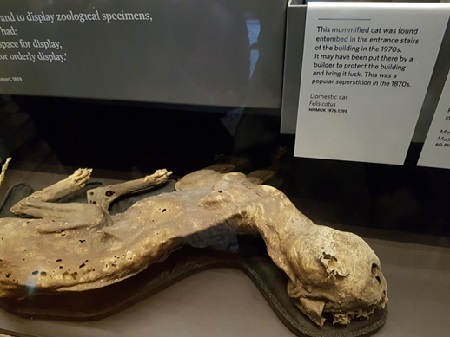
Last summer I visited the Natural History Museum in London. While looking at the displays one item on display caught my eye, a mummified cat! This was of interest to me because kept in a strong room at the History Centre is a mummified cat, who, we’ve affectionately named Bing Clawsby!

In 1989, the then County Archivist Ken Rogers and Archivist Margaret Moles collected the archives of solicitors Mann, Rodway and Green from their offices at 57 Union Street, Trowbridge. While clearing their strong room a dead cat was found amongst the documents. A feeling of sadness was felt for the cat and they decided to bring it back to the Record Office in Trowbridge. “Bing Clawsby” now resides in Strong Room 2 here at the History Centre in Chippenham. Bing’s hearing and eye sight is not what it used to be and now spends most of the day asleep in its box.
During the 16th and 17th centuries, predominately during the witch-trials (first half of the 17th century), people believed that Satan was very active and that witches made pacts with him, they would hand over their soul in exchange for supernatural powers. Witches had the ability to take the form of animals to help them perform their evil deeds. Witches also had the help of familiars. These were believed to be supernatural entities that would assist the witch. Familiars would often appear as animals and could even take the form of humans. It was vitally important to take steps to protect oneself and the family and to destroy witches and their familiars. The house had to be protected by day and night from these evil forms that would enter the home and cause harm to the family.

One important way to protect the home would be to conceal items within the wall, roof space, under the floor but quite often near points of entry, the door, window and chimney area. Concealed items included shoes, horse skulls, witch-bottles, dried animals such as birds, rats, mice and cats. These objects would have been hidden in secrecy because this itself was considered an act of magic and such beliefs were regarded as unlawful.
Mummified cats or “Dried Cats” as they are officially known were used across Europe. It is not known if these cats had died before or after concealment, but some had been placed in a position that looks like they are about to pounce, which must have occurred after death. Cats were regarded as possessing a sixth sense and would carry on hunting in the afterlife. Some cats have been found with a dried rat or mouse next to them, one cat even had a rat in its jaws. Cats have been found from the period when London was rebuilt after the Great Fire. Some of these cats were in building designed by Sir Christopher Wren and could have been put there by Wren’s masons.
As with cats, horses are believed to be able to see things on a spiritual plane and would be able to watch over the family and guide them from witches and spirits.

It’s all Chalk and Cheese
North Wiltshire’s edible tradition
Wiltshire is well known for its southern chalk and northern rich pasture dairy land, and cheese production was once a well established part of Wiltshire life, from cottage industry to factory production. Chippenham’s cheese market opened in 1850, reported in the London Illustrated News and the market soon became famous. Wiltshire Cheese was renowned from the 18th century and became highly sought after. The Wiltshire Loaf is a semi-hard cheese, smooth and creamy on the outside and crumbly in the centre. The North Wiltshire (or Wiltshire) Loaf reached the peak of its popularity in the 18th & early 19th centuries.

William Nichols was a Chippenham Chemist who developed the use of the substance annatto as a food additive. Annatto comes from the achiote shrub seed and is produced in South America. You can still see it as the orange skin on some cheeses today, and it is used to give colour to dairy products.

About Us
Research Tools
What We Do
Contact us
Wiltshire and Swindon History Centre
Cocklebury Road
Chippenham
SN15 3QN
E: cmas@wiltshire.gov.uk
T: 01249 705500
For all conservation enquiries including quotations and object deliveries, please book an appointment in advance.


