

Malmesbury and the Evacuees of World War II
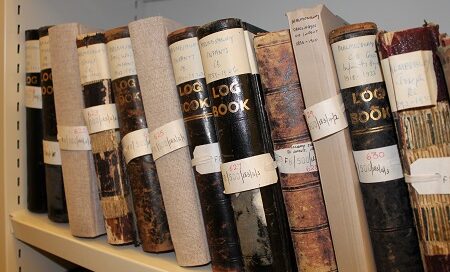
Two visitors to the History Centre, a grandfather and his grandson were very interested by what they discovered in the school log books of two Malmesbury schools during WWII. We were so impressed by Ben’s research on the topic, we thought you would be too, and he kindly agreed to let us publish it as a WSHC blog. Many thanks to Ben Tate, age 11.

Malmesbury and the Evacuees of World War Two
Westport Church of England Boys’ School
Westport CofE Boys’ School was a primary school for boys which was running during the second world war. This historical article on it includes many real accounts from the school’s log book in the time of world war 2, which can be located at Wiltshire & Swindon History Centre.
1939 In 1939 alone, 32 evacuees (and also their teachers) attended Westport, 14 of which were from London.
Due to the breakout of war, the term began a week late on September 11th 1939, rather than September 4th 1939. Within 2 weeks of the start of term, 2 evacuees had already gone back home and 2 more had just arrived. This shows the real instability for schools managing evacuees.
At Westport they had separate registers and separate classes for evacuees and local children (as order of the attendance officer).
Something I found fascinating was that at the start of the term (September 1939) they had 32 evacuee pupils but by October 1939 they only had 16 left as the rest had gone home. This again shows the instability of schools trying to manage evacuees.
1940 The headteacher of Westport wrote in the school’s log book on 18th January 1940 that 9 local boys and 5 evacuee boys from Westport had sat a public examination.
A few weeks later in February, the headmaster wrote that Mr. Ellis (one of the teachers who had come with the boys) had had to go back to his house in London as it had been burgled.
In May that year, the headteacher wrote of how 2 evacuee boys were up against the court for crimes like robbery and vandalism.
I worked out that by May 1940 the evacuees had been integrated into one class with the local children at Westport. (That was only the first record I could find in the log book. It may have been earlier, but I haven’t found evidence).
Later that year, in June, the headteacher wrote that there was a possibility of more evacuees going to Westport but the headmaster had said that unless the top floor was brought into use, the school was going to have a real problem finding accommodation for the extra pupils. I failed to find out whether they ever opened the top floor, but I did find out that later in June, 71 evacuees and 3 teachers arrived at Westport, all from east London.
A couple of weeks later, the headteacher wrote about two evacuees who had tried to escape their foster parents and run back to London by road. He went on to say about how they had robbed their foster parents and had only got as far as Swindon when they got caught.
A couple of days after that, the headteacher recounted that Mr Murray (a teacher) had been called up for war service.
On 8th November 1940 the headteacher of Westport wrote about how he had had to keep getting new teachers as they were being called up for service and teachers who had come with the evacuees kept going back home. I found an account of this in June 1940 when the headteacher of Westport wrote, 4 new teachers arrived at the start of June: “The month isn’t even out and 1 of them has already gone back to his home in Essex”.
Something I found interesting in the Westport School’s Log book was on November 15th 1940 the headteacher wrote that bombs had been dropped on Hullavington (obviously due to the air base). He went on to say that a couple of children had been frightened but it was ‘quickly forgotten’. I was personally surprised at that.
1941 In January 1941 the headteacher of Westport wrote in the log book that all evacuees at his school currently had spent Christmas with their foster parents.
The headteacher wrote in the log book on 4th April 1941, that before the holidays the school had 130 evacuees, yet after 2 weeks holiday, they only had 117. On the 25th April 1941 he wrote about how 2 boys had gone back to their homes in Tilbury. He went on to say exactly: “It’s turning into a slow and steady flow”.
1942 I could find no references to evacuees, though I am not saying there weren’t any. I believe there were references to evacuees that I read, it was just that the headmaster had not specifically said the boy is an evacuee. I think this because by now evacuees were not a new thing and they were more integrated and accepted in the local communities.
1943 The same thing happened for 1943 as it had done in 1942.
1944 In 1944 again I had trouble finding accounts saying the child was evacuee although I found a reference talking about how the older boys at the school – some of whom must have been evacuees – were being allowed afternoons of school to help with the potato harvest.
1945 On 8th May 1945 the headteacher of Westport wrote in large writing – very unlike his usual, neat style – ‘VICTORY DAY! WAR IN EUROPE ENDED TODAY.’
Shortly after that (25th June 1945), he wrote that since the war in Europe was over, many evacuees had gone home. Therefore he had had to shuffle around the classes, as many of the students had been evacuees.
The last account that I found in Westport Church of England Boys School Log Book I’m going to tell you about was written on 10th September 1945 which simply said – in large handwriting – ‘THE WAR IS OVER. THE JAPANESE WAR IS OVER!’
A Stitch in Time
Did you watch this year’s series of the Great British Sewing Bee? Sewing has become a popular hobby again, thanks to a renaissance in crafts and resurgence in interest in the handmade.
The famous proverb ‘a stitch in time...’ was first recorded in Thomas Fuller's Gnomologia, Adagies and Proverbs, Wise Sentences and Witty Sayings, Ancient and Modern, Foreign and British, 1732 but is likely to be much older. The virtues of hard work, prudence and associated with this adage have long been affiliated with sewing and been seen as desirable attributes, particularly for women.
A traditionally female pursuit, sewing has been a source of enjoyment, income and protest for women over the centuries. As one of the few respectable trades women, particularly poor women, could engage in, it could provide an albeit low level of income. Most of this work was piece work completed at home by women and children. The below show receipted bills for sewing services:
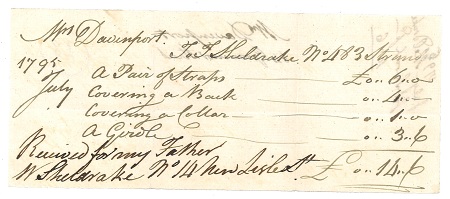
The pay was not only low, but a deposit had to the paid to the overseer for the materials, which was repayable on completion of the work. The ‘Song of the Shirt’, published in Punch in 1843, took this as its subject and helped draw attention to the working conditions of the poor.
'Stitch! Stitch! Stitch! In poverty, hunger, and dirt, And still with a voice of dolorous pitch She sang ‘The Song of the Shirt!’
Aside from the principal cloth and woollen industries, both gloving and lace making have been important industries for Wiltshire. A prohibition on imported lace created a strong lace industry in Salisbury in the 18th century which continued after the prohibition was withdrawn. Nearby Downton was a lace-making centre with many of its cottagers engaged in it with some manufacturing continuing into the early 20th century. It also established in Malmesbury and was one of the principal occupations there in the late 18th century.
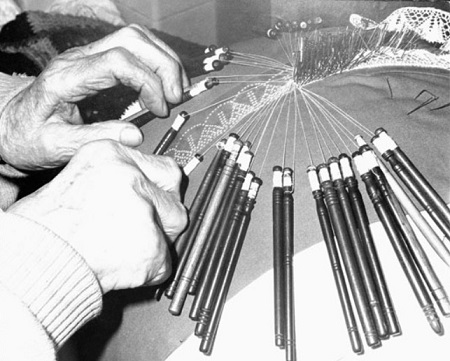
Inevitably the industry was by the competition of machine-made lace and the census records show the decline in lace-making occupations with 391 in 1850, 35 in 1871 and only 6 in 1900.
Gloving employed a large proportion of female outworkers and based on the number of references to it, it seemingly expanded in the 16th and 17th centuries. It has continued into the 20th century with both continuing and new firms. The oldest firm with surviving records is J. & T. Beavan Ltd. at Holt. Many of the cutters worked in the Great House (formerly the Spa Hotel) but outworkers living at Holt, Atworth, Melksham, Somerset and the Cotswolds completed the sewing work.
Wiltshire at War: Community Stories – an Update and a Call to Arms!
Since I started at the Wiltshire and Swindon History Centre in November 2015, the main project I have been working on has been Wiltshire at War: Community Stories. I would like to let you know what the project has achieved so far, what we would still like to do, and how you can get involved.

What is Wiltshire at War: Community Stories?
Wiltshire at War: Community Stories aims to bring people together from across Wiltshire to discover, explore and share stories about Wiltshire’s response to the First World War. It is supported by the Heritage Lottery Fund.
What has been achieved so far?
During 2014, enthusiastic people from museums and heritage organisations were trained to carry out oral history interviews and community engagement sessions relating to gathering stories about the First World War. Throughout 2014 and 2015 (and now into 2016) research has been carried out by museums, history societies, and individuals from all over Wiltshire who have donated the stories to the Wiltshire at War project. In January 2015 the Wiltshire at War website went live. Do visit the website and explore this growing archive of stories.
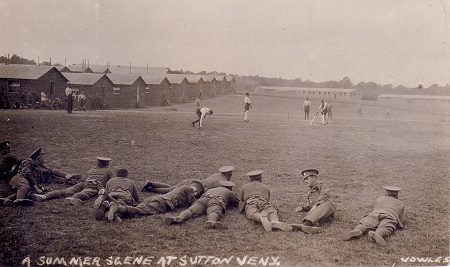
The Call to Arms, the first of the five exhibitions, launched in February 2015 and is currently on display in the Springfield Campus Library, Corsham, until 3 March 2016. The theme focuses on the soldiers called up to fight, and the preparations for war in Wiltshire. The second exhibition, Wiltshire Does Its Bit, launched in September 2015, and is currently on display at Chippenham Museum, until 27 February 2016. The theme focuses on the contributions of ordinary people to the war effort at home in Wiltshire. Both these exhibitions are currently touring Wiltshire, and are available to hire, free of charge.
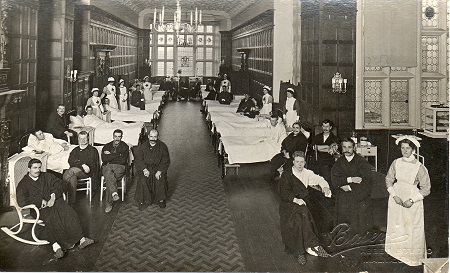
There are four identical schools’ exhibitions that have launched, are touring, and can be booked free of charge. They come with a handling kit to bring the exhibition to life, and complimentary teaching resources for key stages 1-3 are available on the website. There were library talks in 2015 from the likes of Stewart Binns and Elizabeth Speller, in Corsham, Salisbury, Warminster, and Mere, and they have been accompanied by a comprehensive book display.
About Us
Research Tools
What We Do
Contact us
Wiltshire and Swindon History Centre
Cocklebury Road
Chippenham
SN15 3QN
E: cmas@wiltshire.gov.uk
T: 01249 705500
For all conservation enquiries including quotations and object deliveries, please book an appointment in advance.


