


Herbal Lore
In times gone by, the Rev. W. Zapprell Allan of Broad Chalke claimed that there was no wise woman better than Old Dame Zargett with her knowledge of herbs and simples.
The most highly regarded of all the herbs were hellebore, rosemary, lavender, sage, comfrey, rue, wormwood, marjoram and vervain, with verbena, mint and chamomile following close on their heels. Kathleen Wiltshire, long-term resident of All Cannings, lists almost 60 in her book ‘Wiltshire Folklore’, available at WSHC, and I have listed just a few for you here.
Betony was the one herb not to be without. It is a woodland plant with purple-red flowers that bloom from June to September and, excepting the roots, the whole plant is of good use. ‘Sell your coat and buy betony’ is an old Wiltshire saying. It was said to have still surpassed modern drugs during WWII being especially helpful for the burns of RAF pilots.

I don’t know about you, but I usually try to avoid brambles, especially when picking blackberries, but they were very good at easing scalds. Just dip nine leaves in water and apply to the wound whilst repeating a chant three times to each leaf:
‘Three ladies came from the east,
One brought fire, and two brought frost,
Out with the fire, and in with the frost,
In the name of the Father, and of the Son, and of the Holy ghost,
Amen-Amen-Amen’
The bramble was considered to be a sacred plant, in the same vein as the rowan and oak. Brambles could also be used as a cure for whooping-cough if they were forming an arch with the tip of the arch sending down a new root. Initially the treatment was just to crawl under the arch, but it was later modified, usually by repeating the process nine times on nine consecutive days.

Fleabane does what it says on the tin! It was burnt to drive out fleas and other insects from the straw used on floors in rooms.

Malmesbury Fire Pump
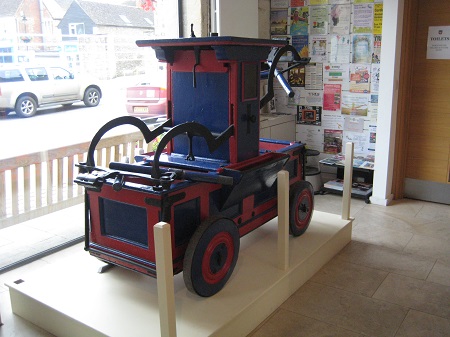
Last year we posted a blog about work we did to conserve Malmesbury’s historic fire pump for display. The pump is one of the largest items the museum owns and arranging a space suitable for it to be displayed in was not straight forward for the museum. For this reason the fire pump had to go back into storage whilst a display area was arranged for it. But recently I have been able to go back and help with putting the item on display.
The pump belongs to the Athelstan museum in Malmesbury but is too large to fit in their own store so it has been kept in a commercial storage facility in an old aircraft hangar. I met the curator at the storage site along with two members of the modern fire brigade who had volunteered to help move the object. It was interesting to hear their opinion on this piece of historic fire fighting equipment. In particular I learnt that that although I had been calling it a fire engine it should in fact be called a fire appliance or pump. Apparently the modern fire service does not use the term fire engine at all. In the case of the appliance I had worked on it should not be called an engine as it does not have any sort of engine or motor. Its pump was powered by people pushing its handles up and down.

WSHC are encouraging young people to step back in time
Young people are being encouraged to step back in time and learn dances from the First World War as part of an arts initiative to [...]
About Us
Research Tools
What We Do
Contact us
Wiltshire and Swindon History Centre
Cocklebury Road
Chippenham
SN15 3QN
E: cmas@wiltshire.gov.uk
T: 01249 705500
For all conservation enquiries including quotations and object deliveries, please book an appointment in advance.


