

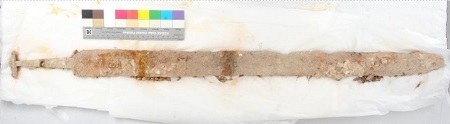
Secrets of an Anglo-Saxon Sword
The Conservation and Museums Advisory Team (CMAS) work very closely with several Archaeology Services carrying out excavations across the UK.
Having been buried in the ground for hundreds or thousands of years, freshly excavated finds can be very delicate! We can carry out x-raying and analysis, treatment and specialised packaging to stabilise them and ensure that they survive for the future.
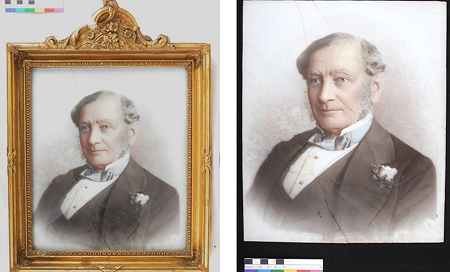
Conservation of an opaltype belonging to STEAM, Museum of the Great Western Railway, Swindon
A rather interesting object arrived in the lab a few months ago, which at first glance appeared to be an intricately detailed portrait painting on a milky-white opaque glass (known as opaline glass), displayed in a gilded frame. The portrait was of Daniel Gooch (1816-1889), an English railway locomotive engineer, responsible for identifying the site of Swindon Works and designing the first complete locomotive to be constructed there in 1846.
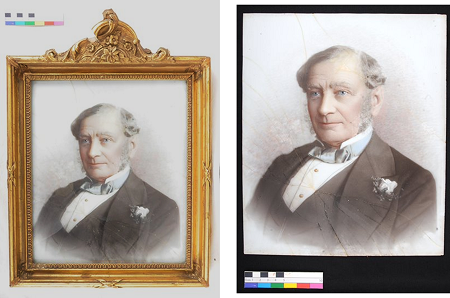
Assessing the object more closely, out of its frame, I was immediately concerned by its poor condition. It had previously shattered into multiple small pieces and been adhered back together with a glue that was now yellowing and failing. The glass was ‘stepped’ in multiple locations where the joins were not well-aligned. My eye was also drawn to the disruption of the original paint around the fractures, which had been dissolved in the process. There was a ‘smudged’ appearance to the image, particularly visible around the edges where the black background thins and blends into the glass. It was clear that any further handling and conservation treatment going forward would run the risk of damaging the piece further, and that great care would be needed. Understanding the materials used for creating the piece, and for restoring it, was also vital to determine if, and what, could be done to stabilise it.

How to conserve a camel

Image 1: Toy Camel Before Treatment
If you follow our twitter feed, you will have seen back in March we featured a leather toy camel who had come into the Conservation and Museums Advisory Service (CMAS) for some treatment (Image 1). A beloved family toy, it is always an honour to be entrusted with an object that is owned by a private client rather than a museum. This camel had previously entered the lab back in 2016 where it had extensive repairs on the leather and re-stitching. However, some further stitching had failed so needed further repairs.

Image 2: Consolidating leather under magnification
There were a few small areas of leather that were flaking and needed consolidating (Image 2), an adhesive needed to be chosen that would not discolour the leather. The treatment was carried out using a conservation grade adhesive that was viscous enough to flow easily under the flake layers but strong enough to support the leather structure, applied under the flakes using a fine brush.

Image 3: Previous repairs and new areas of damage
It is very important within conservation to document every treatment – as we had previously carried out treatment on the camel we knew what was original stitching, what was a 2016 repair, and could identify new areas of damage (Image 3).

Image 4: ICON Principles of Conservation ©ICON
As conservators we follow the guidance from our governing body the Institute of Conservation (ICON). Although it would normally be dictated that ethically a repair should not visually detract from an object but still be identifiable, for this treatment a thread was selected that blended in with the colour of the original thread, making the repairs less visible. To over come this concern, we produced documentation recording where these repairs took place making them identifiable in the future. What may seem like a simple repair can contain a lot of ethical dilemmas and you can find out more about Conservation Ethics by visiting the ICON website (Image 4).
About Us
Research Tools
What We Do
Contact us
Wiltshire and Swindon History Centre
Cocklebury Road
Chippenham
SN15 3QN
E: cmas@wiltshire.gov.uk
T: 01249 705500
For all conservation enquiries including quotations and object deliveries, please book an appointment in advance.


