

Conservation Training with the Royal Artillery Museum
The Conservation and Museums Advisory Service (CMAS) team can normally be found working in our two conservation laboratories at the History Centre. However, another way we can support museums is by providing training for staff and volunteers within their own organisation. We recently spent some time with the team at the Royal Artillery Museum providing a series of Collections Care workshops.

The Royal Artillery Museum holds an internationally important historic collection which brings to life the story of The Royal Regiment of Artillery, generally known as the Royal Artillery or the Gunners, who provide firepower, surveillance, and target acquisition for the British Army. Having recently moved to a new object store in original 1910 Royal Flying Corps hangars, the museum is planning on creating a new museum on Salisbury Plain where Gunners have trained for over a century. The team wanted to use this opportunity to carry out a full audit of their collection as they undertake a major unpacking and sorting exercise.
The collection ranges from an extensive uniform collection and heavy field guns down to individual medals, and CMAS’ role was to provide advice and training on how to handle, identify hazards, condition check, pack and store the objects in the best possible way to prevent future deterioration.

The Bersted Sword
A truly fascinating and very significant object has returned to our studio for conservation work, and I have been the lucky conservator to work on it, on behalf of the Novium Museum.
The Bersted sword is over 2000 years old, discovered during excavations for a new housing estate in Bersted, West Sussex. It was found with the remains of a man, since dubbed the ‘mystery warrior’, alongside his helmet and a very elaborate and unusual headdress. Archaeologists believe he was a refugee French Gallic fighter who fled Julius Caesar's Roman Army in Europe around 50BC.
The sword itself is bent into a v-shape, understood to be a ritual ‘killing’ of the weapon at the time of burial with its deceased owner.
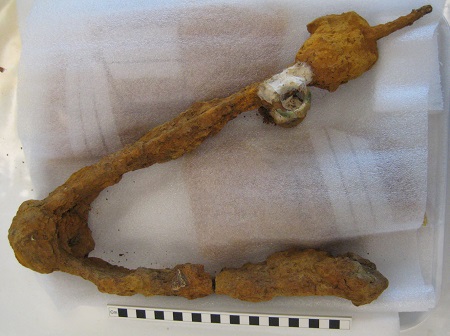
X-rays and investigative cleaning were undertaken by CMAS in 2010, which were able to expose parts of the sword beneath the thick corrosion products, revealing that it is fused to a ribbed iron scabbard, complete with intact suspension loop and two copper alloy rings for attaching the scabbard to a belt. Remarkably, remains of horn, which is a material frequently lost due to decomposition on burial, are still present on the hilt. The tip of the sword was missing, but discovered separately during the excavation.

Conservation of a Plaster Model Horse
Hello! I have just joined the team at CMAS as an object conservator, having spent the last four years working on the Burrell Collection in Glasgow.
In my first three weeks I have had some lovely objects to get stuck into; one of which is a cream painted plaster model horse with a leather and textile collar from the Mere Museum.

We think this was a display model for a saddlery, although the records are a bit thin on the ground. It was brought in for conservation with fractures across all four lower legs and pieces of plaster had come away from the hind right leg exposing the iron armature inside. On top of this, the paint surface was flaking in places and is rather uneven, having been touched up and repainted several times.
Both the body of the horse and the base show signs of previous damage and repair, and indeed there are records of the horse having already been conserved twice by CMAS in the last 20 years.
About Us
Research Tools
What We Do
Contact us
Wiltshire and Swindon History Centre
Cocklebury Road
Chippenham
SN15 3QN
E: cmas@wiltshire.gov.uk
T: 01249 705500
For all conservation enquiries including quotations and object deliveries, please book an appointment in advance.


